
On this page
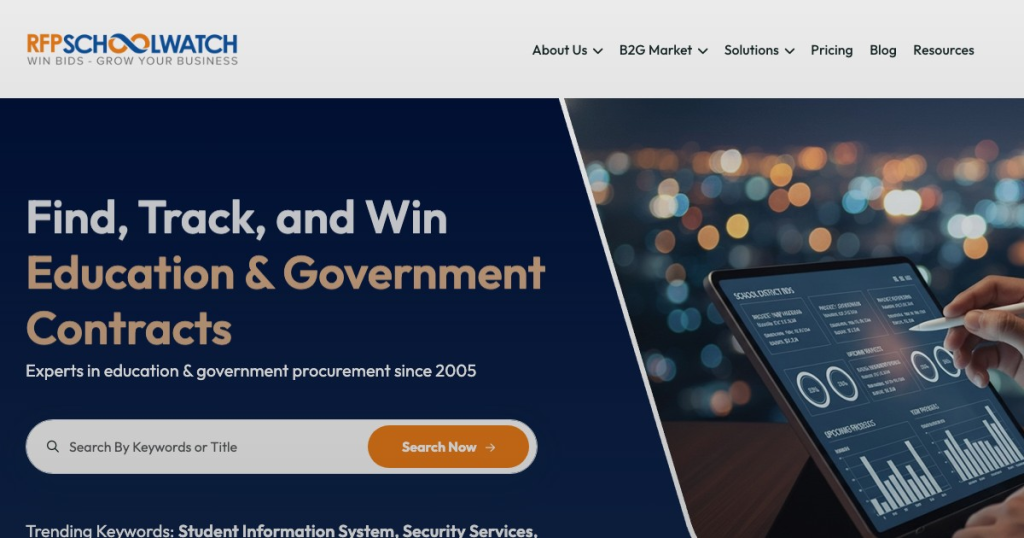
School district bid portals, university procurement pages, and local government websites remain messy places for pipeline research. RFPSchoolWatch is designed for that environment: it sends daily targeted alerts for education and government RFPs, allows users to access available bid documents, and focuses on K-12, higher education, and state and local purchasing.
This is not a general-purpose public-sector sales platform. It is more like a procurement discovery service for contractors and suppliers who need relevant bids by keyword, geography, and category, without manually checking thousands of official sources each day.
The strongest case for it is straightforward: if your revenue team sells to schools, colleges, or local government, RFPSchoolWatch offers a focused category and public pricing starting at $795 per year for coverage in one state. The main uncertainty is not what it claims to do, but how well its coverage matches your specific territories, keywords, and agency types.
Quick Verdict
RFPSchoolWatch is best suited when education procurement visibility is more important than broad federal intelligence or extensive workflow automation. It appears useful for sales teams needing daily school and SLED bid alerts, but the demo must demonstrate coverage depth in your specified districts, colleges, and local agencies.
- Best for: Vendors selling to K-12, higher ed, and state/local agencies
- Not ideal for: Teams that need federal-heavy coverage or documented CRM integrations
- Biggest strength: Education-focused bid monitoring with daily alerts and document access
- Biggest risk to verify: Actual match quality and source coverage for your target agencies
What Is RFPSchoolWatch?
RFPSchoolWatch is a GovTech procurement intelligence platform focused on bid discovery for education and government vendors. The core workflow is simple: define keywords, regions, and industries; receive daily matching opportunities; access open source bid documents; and use those opportunities to pursue contracts with schools, colleges, and government agencies.
That places it in the bid-alert and opportunity-monitoring category, not in CRM, proposal management, or full market intelligence software. If your team needs a system of record for pursuits, account planning, or federal capture management, this does not appear to replace those tools.
The company states it was founded in 2005 and is headquartered in Nashville, Tennessee. LinkedIn lists the company as having 11–50 employees. Named customer references on its site include Intel, Oracle, and Instructure. These references indicate recognizable vendor usage, though they are testimonials rather than detailed case studies.
Its market focus is specific: public education procurement, higher education procurement, and state and local government procurement in the United States and Canada. This is narrower than some broader bid databases, but it is also why education sellers may find it more relevant than a general government bid feed.
Key Features
Targeted bid notifications
Users can set alerts by industry, keyword, and location. This is the main workflow driver: instead of browsing agency sites individually, teams receive daily bid notifications tailored to the segments they actually sell into.
Daily alerts with bid document access
RFPSchoolWatch sends daily email alerts for new opportunities and provides access to available RFP documents at no extra cost. While this is standard for a bid service, it remains important because it eliminates some of the manual document searching that can slow down qualification.
Education and SLED source monitoring
The platform states it scans thousands of official procurement sources, including school districts, colleges, education agencies, and government procurement websites. For buyers focused on K-12 and higher education, that source mix is more relevant than a federal-first database.
Award and contract expiration alerts
Beyond active bids, RFPSchoolWatch also notifies users about award announcements and expiring term contracts when available. This broadens the workflow from bid discovery to renewal and replacement tracking, helping account-based public-sector sellers identify timing windows earlier.
Hands-on account support
The vendor emphasizes personalized service and keyword support. While this is not strictly a software feature, for a search-driven product it affects output quality: poor keyword setup leads to noisy alerts, while well-tuned profiles reduce irrelevant opportunities.
Privacy policy compliance disclosures
Public compliance information is limited, but the privacy policy states GDPR and UK GDPR compliance for applicable users and includes COPPA-related child data language. This is useful context, though it is not the same as a broader published enterprise security package.
Pros
- Education-focused bid alerts
- Daily source scanning
- Bid document access
- Award expiration tracking
- US and Canada coverage
- Public starting pricing
Cons
- Federal fit is weak
- CRM details not documented
- Limited compliance docs
- Coverage claims need testing
Buying Checks
RFPSchoolWatch publishes its pricing: plans start at $795 per year for one state, $1,295 per year for two to nine states, and $1,595 per year for nationwide coverage. More importantly, you should confirm whether the feed is actually strong in your territories and categories, not just affordable on paper.
- Run a live search against your named districts, colleges, cooperatives, and local agencies to confirm they appear in the monitored source set.
- Spot-check recent alerts for source links, publication dates, and document availability so your team can confirm the records trace back to official procurement pages.
- Test keyword precision with your actual product categories to see how many irrelevant opportunities show up in daily alerts.
- Ask for examples of pre-solicitation signals, active solicitations, award notices, and expiring term contracts so you know what each alert type actually includes.
- Verify whether the claimed U.S. and Canada coverage holds in the states and provinces your reps own, rather than assuming nationwide breadth equals local depth.
- Clarify export behavior, API access, and CRM handoff options, because no integrations are publicly documented.
- Request current security and admin documentation if your procurement or IT review expects more than privacy-policy disclosures.
Who Is RFPSchoolWatch Best For?
Best fit: Vendors with dedicated education or SLED sales teams, especially those selling to K-12 districts, higher education, education cooperatives, and local agencies. If your team follows school and local government bid calendars, the product’s category focus is a real advantage.
Possible fit: Broader public-sector suppliers seeking a lower-cost way to monitor education and local government opportunities alongside a separate CRM or proposal workflow. Named references such as Instructure, Oracle, and Intel suggest it can support established vendors, not just small contractors.
Not ideal for teams that need federal opportunity depth, capture management, or a documented integration layer with the rest of the revenue stack. Buyers expecting a modern sales orchestration product will likely find this more limited than they want.
Best Alternatives to RFPSchoolWatch
GovWin IQ is a better fit if your team needs broader federal and SLED intelligence, historical opportunity data, and a more comprehensive government contracting research workflow. It is a broader platform than RFPSchoolWatch’s education-focused bid monitoring.
GovSpend is worth considering when spend analysis is as important as active bids. It is more adjacent than direct for buyers seeking procurement intelligence connected to spending data, supplier visibility, and broader market research.
BidNet Direct is a closer option for teams focused on aggregated state and local bid opportunities. If your process is primarily about finding local and regional solicitations, this is one of the more comparable alternatives.
FindRFP is another bid-alert option that provides daily notifications based on keywords from federal, state, and local sources. It may be a better fit if you prefer a simpler cross-market bid feed rather than RFPSchoolWatch’s education-focused approach.
Final Verdict
RFPSchoolWatch is easiest to justify for revenue teams that actively sell to school districts, colleges, and local governments and need a practical way to catch bids without constant manual searching. Its public pricing is unusually accessible for the category, and the combination of daily alerts, source document access, and award or expiration tracking gives it a concrete operational role.
Keep it on the list if education procurement is a core segment and your team values tailored alerts over broader platform sprawl. Keep looking if federal coverage, CRM integration, or formal security documentation are key buying requirements.
The deciding test is not a generic feature tour. Ask RFPSchoolWatch to show recent matches from your specific agencies, including dates, source links, and document access, then compare the alert quality to your current manual process. If the output is clear, the product has a definite place. If it is not, the low entry price will not justify the evaluation.