School board minutes, county purchase orders, cooperative contracts, and various bid sites make research difficult for public-sector sales teams. SmartProcure, now branded as GovSpend, consolidates these records into a single procurement intelligence system, allowing teams to find agencies, suppliers, contracts, and purchasing activity more quickly.
The product is most relevant for vendors and contractors selling to state and local governments, as well as agencies and consulting firms that need market and pricing data. Its strongest evidence is its SLED coverage, which includes nearly 1 billion procurement records from about 30,000 agencies, according to company-backed acquisition materials.
The catch is appropriate. If your pipeline is primarily federal, available evidence indicates that SmartProcure is less effective in this area, with weaker support for federal-specific workflows such as set-asides, NAICS-focused analysis, and advanced bid scoring.
Quick Verdict
SmartProcure is most persuasive when your team needs historical spending, line-item purchase orders, contracts, bids, and meeting signals within the same SLED sales workflow. It is less convincing as a primary system for federal-only contractors.
- Best for: SLED vendors that need both historical spend data and current opportunity tracking
- Not ideal for: Federal-focused teams that rely on set-aside and NAICS-specific qualification workflows
- Biggest strength: Combines bids, purchase orders, contracts, contacts, and meeting records in one platform
- Biggest risk to verify: Whether coverage and ranking quality hold up for your exact agencies and product categories
What Is SmartProcure?
SmartProcure is a government procurement intelligence platform. Its main function is to help revenue teams, agencies, and consultants search public-sector purchasing activity, identify likely opportunities, monitor bids and projects, and move relevant records into the sales process.
That means it falls between bid tracking, spending intelligence, contract visibility, and account research. It should not be mistaken for a simple bid-notification tool. The platform also includes purchase orders, contracts, cooperative purchasing agreements, agency contacts, and public meeting records, which changes how teams approach territory planning and account prioritization before a formal solicitation appears.
GovSpend states that the platform serves federal, state, local, and education buyers and sellers, though available evidence indicates stronger state and local presence than federal. Founded in 2011 and headquartered in Boca Raton, Florida, the company has been in this market long enough to be beyond the early-stage risk category.
Named users and customer examples span both sides of the market. City of North Miami Beach and Rockland County are cited in agency-facing examples, while Blue Star and Circle K appear in vendor-oriented case material. This is relevant because the product is not only for sellers pursuing bids; agencies also use it for pricing and market checks.
Key Features
Line-Item Spending and Purchase Order Search
SmartProcure’s main asset is access to historical and current government spending data at the line-item purchase order level. For sellers, this enables account planning, pricing research, incumbent analysis, and product-level demand discovery. For agencies, it enables price benchmarking and vendor comparisons.
Bids, RFPs, and Opportunity Ranking
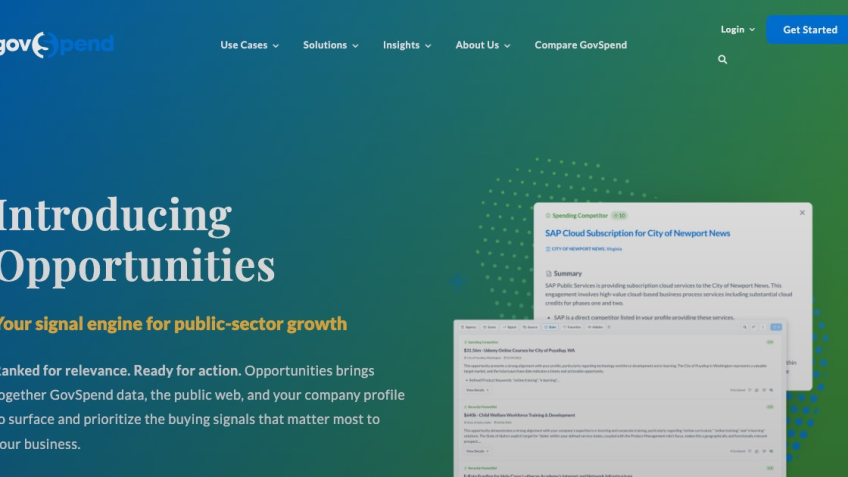
The platform tracks active solicitations and integrates them into an Opportunities module that evaluates bids, contracts, meetings, and spending signals against a company’s profile. This offers more than just a bid inbox if the ranking quality is high, but the demo should show how much noise it generates in your categories.
Meeting Intelligence
Meeting transcripts and searchable public meeting records help identify early discussions of spending initiatives and agency priorities. This is important for teams seeking context before a bid becomes formal, especially in local government, where board and council discussions often reveal timing and intent earlier than procurement portals.
Contracts, Co-ops, and Agency Contacts
SmartProcure also provides access to existing contracts, cooperative purchasing agreements, and government contact data. This supports two specific workflows: finding piggyback opportunities through co-ops and identifying the appropriate contact when an account is already purchasing a category from another vendor.
CRM and Workspace Integrations
Salesforce and HubSpot integrations are documented, as are Slack, Microsoft Teams, Zapier, and an API. CRM sync is important because the platform should feed account and opportunity records into pipeline management rather than exist as a disconnected research tab.
Pros
- Large procurement dataset
- SLED-focused coverage
- Line-item PO data
- Meeting intelligence module
- Salesforce and HubSpot sync
- Contracts and co-op visibility
Cons
- Federal depth is weaker
- Contract terms need scrutiny
- Compliance docs absent
- Coverage claims need testing
- AI search needs validation
Buying Checks
The demo must establish data trust before anything else. SmartProcure makes broad claims about coverage, refresh rates, and AI-assisted search, but these claims are only valuable if they hold true for your specified agencies, categories, and CRM workflow.
- Load 10-15 target agencies and confirm recent purchase orders, bids, contracts, and meeting records appear with visible dates.
- Spot-check source traceability on several records, including whether line items and meeting entries link back to the underlying public source.
- Test the Opportunities module using your actual product categories and ask what qualifies as an opportunity: bid, contract renewal, meeting mention, spending pattern, or inferred signal.
- Validate Salesforce or HubSpot sync by mapping one account, one contact, and one opportunity into your existing fields and stages.
- For federal use cases, inspect set-aside handling, NAICS-related filtering, and bid qualification detail instead of assuming the federal module matches SLED depth.
- Ask for a direct walkthrough of the Slack or Teams query workflow and compare the answers against manual searches for accuracy.
- Clarify renewal terms, seat counts, export limits, and onboarding scope before legal review, especially since outside reporting has raised concerns about contract rigidity.
Who Is SmartProcure Best For?
Best fit: Vendors selling products or services to state, local, and education agencies who need more than bid alerts. Teams focused on territory planning, incumbent analysis, pricing research, and co-op strategy will benefit most from SmartProcure’s combination of purchase orders, contracts, and agency data.
Possible fit: Public-sector consulting firms and procurement teams that need to benchmark pricing or analyze category spend across agencies. The North Miami Beach and Rockland County examples highlight agency-side value, not just vendor prospecting.
Not ideal for: Federal-first contractors who rely on in-depth federal opportunity qualification. If your capture process depends on set-asides, NAICS details, and federal-specific scoring, SmartProcure appears more adjacent than central.
Best Alternatives to SmartProcure
GovWin IQ (Deltek): A better fit when federal opportunity intelligence is the priority or when your team needs a broader contracting workflow across federal, state, local, and Canadian markets. This is the clearest alternative for buyers who find SmartProcure too focused on SLED.
BidPrime is a better fit for teams focused on bid tracking and notifications across federal, state, and local sources. It is more specialized than SmartProcure’s spend and contract intelligence approach, but this narrower workflow may be sufficient for bid-centric teams.
Govly: Consider Govly if contractor networking and RFx sharing are as important as raw procurement data. This platform is more focused on contractor collaboration than on SmartProcure’s purchase order and pricing intelligence.
Procurement Sciences AI is more relevant for contractors seeking opportunity identification closely linked to proposal assistance. This is also adjacent rather than direct, as SmartProcure’s primary documented focus is procurement data aggregation and market visibility, not proposal production.
Final Verdict
SmartProcure attracts attention when the buying problem involves fragmented SLED procurement research, not when the task is strictly federal capture management. The product’s main value is that a single system can link line-item spend history, current bids, existing contracts, cooperative purchasing options, contacts, and meeting records well enough to make account planning less reliant on guesswork.
Shortlist it if your reps cover state and local territories and your current process still relies on bid emails, spreadsheet account notes, and manual price checks. Keep looking if federal qualification details are non-negotiable.
One SmartProcure-specific test matters more than a polished demo: can it display the last few months of relevant activity for your exact agencies and then push the correct records into Salesforce or HubSpot without creating errors? If that workflow functions smoothly, the platform has substance. If it doesn’t, broad dataset claims won’t save it.