On this page
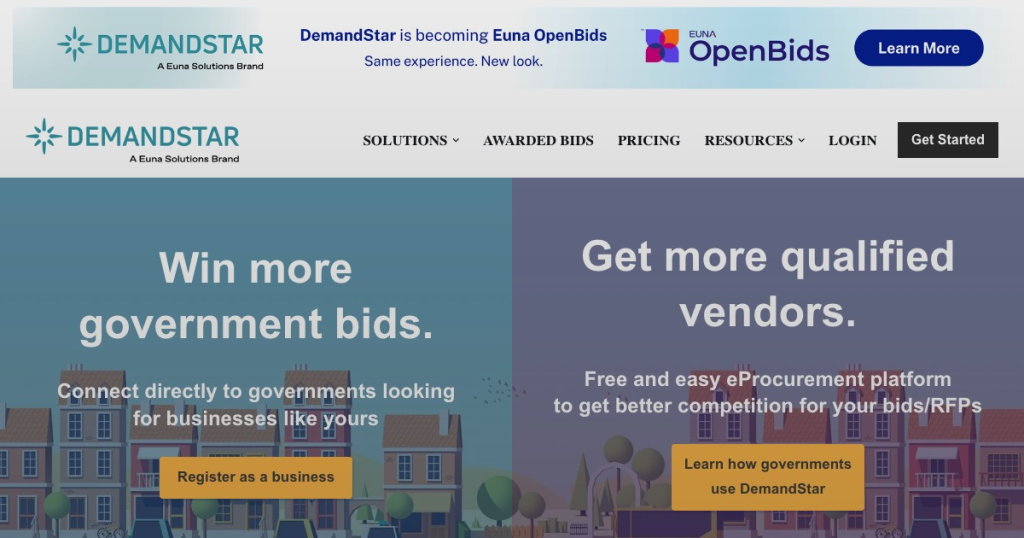
Local government procurement quickly becomes complicated when bids are spread across city, county, school district, and utility portals. DemandStar aims to centralize this process by providing agencies with a platform to post solicitations and suppliers with a single marketplace to search, track, and submit bids.
The product is best suited for state and local procurement activities, not for broad federal market intelligence. DemandStar states that its network includes over 1,400 government agencies and more than 150,000 supplier companies. Its supplier plans range from free alerts for a single agency to $2,599 per year for nationwide access.
That two-sided model is the key factor to evaluate. If your target agencies already post through DemandStar, the product can reduce manual bid searching and paperwork. If they don’t, the coverage advantage declines quickly.
Quick Verdict
DemandStar is most effective when local government bid discovery and e-bidding are more important than broader procurement intelligence. It is practical for suppliers selling to cities, counties, school districts, and similar public entities, as well as for agencies seeking free e-procurement tools with a built-in vendor audience.
- Best for: Local agencies posting solicitations and suppliers pursuing state/local bids
- Not ideal for: Teams that need documented federal depth, CRM plumbing, or enterprise compliance detail
- Biggest strength: Shared marketplace for agency posting, supplier alerts, and online bid submission
- Biggest risk to verify: Whether your target agencies and categories are actually active in the network
What Is DemandStar?
DemandStar is a government procurement marketplace focused on U.S. state and local purchasing. Agencies use it to post and manage solicitations online, while suppliers use it to search for opportunities, subscribe to matching notices, download bid documents, and submit bids through eBidding tools.
This places it between an agency procurement portal and a supplier-side opportunity feed. It should not be used as a general CRM, contract lifecycle suite, or broad public-sector research database. Its core function is more focused: to present local government bids to suppliers and enable both parties to conduct more of the solicitation workflow online.
Company details are clearer than those of some newer vendors, though not perfectly clean. Public company data lists DemandStar as founded in 1998 and headquartered in Seattle, Washington. DemandStar was acquired by GTY Technology’s Bonfire business unit in December 2022. Team size is listed as 11 to 50.
Named public customers include the Town of Briny Breezes, Florida; the City of Greenacres, Florida; Fox Valley Technical College, Wisconsin; and Missouri State University. These examples reinforce the product’s focus on local and educational procurement.
Key Features
Bid Search and Territory Subscriptions
Suppliers can search a large database of active bid opportunities and subscribe by county, state, or nationwide coverage. This matches the top-of-funnel workflow for contractors who would otherwise monitor many local procurement sites manually. Public pricing is unusually specific: plans start with a free basic option and go up to $2,599 per year for nationwide access, with $5 document downloads outside subscribed areas.
Automated Bid Notifications
DemandStar claims to use over 9,000 commodity code keywords to match supplier profiles with relevant solicitations and send notifications as soon as bids are posted. While this is standard for bid platforms, the key question for buyers is match quality: do the alerts reduce manual searching without generating too many irrelevant notifications?
eBidding Submission Workflow
The built-in eBidding module allows suppliers to submit, review, and manage proposals digitally. For agencies, this reduces paper-based steps. For vendors, it can eliminate separate submission processes across participating local entities.
Agency-Posted Solicitation Source Data
DemandStar states that solicitations come directly from participating government agencies. This is important because the value of any bid feed depends heavily on source traceability. In this case, the marketplace is not simply scraping public notices; the agencies themselves are involved in the posting workflow.
Historical Award and Bid Data
Suppliers can access past contract awards and bid histories for similar projects. This helps when pricing a response or deciding whether an opportunity is worth pursuing, especially for contractors seeking to understand prior vendor patterns in local government purchasing.
Buying Checks
The product is easy to understand at a high level. The demo must demonstrate local coverage, matching accuracy, and whether the workflow is robust enough for your actual bid process.
- Search for your named target agencies and confirm they actively post through DemandStar, not just that similar agencies exist on the network.
- Run your actual NAICS or commodity terms through the 9,000+ keyword matching setup and inspect false positives and missed notices.
- Open recent solicitations and verify posting dates, document availability, and source traceability back to the participating agency.
- Test a real submission workflow in eBidding, including attachments, revisions, deadlines, and what the supplier sees after submission.
- Clarify package scope: county vs. state vs. nationwide access, included document downloads, and where the $5 per-document fee still applies.
- Ask for current proof behind the 3x bid response and ~15% contract savings claim, preferably from agencies similar to yours.
- Request security and compliance documentation early, especially if your procurement team needs formal vendor review.
Who Is DemandStar Best For?
Best fit: Local government procurement teams seeking a no-cost posting and e-bidding system, and suppliers selling to cities, counties, school districts, housing authorities, airports, and similar entities. The value is greatest when these buyers and sellers already operate in the same regional procurement markets.
Possible fit: Contractors building a state and local pipeline who need broader bid visibility than individual municipal portals offer. Historical award data and territory subscriptions can also help newer government contractors decide where to bid more selectively.
Not ideal for teams that require documented federal opportunity details, comprehensive integration options, or enterprise-grade compliance information upfront. It is also less suitable if your target accounts prefer other procurement portals and rarely post through DemandStar.
Best Alternatives to DemandStar
Vendor Registry is the closest alternative among the available options because it also focuses on procurement portals and vendor registration for cities, counties, utilities, and educational institutions. It may be a better fit if your agency’s workflow relies more on registration and portal administration than on marketplace reach.
OpenGov Procurement & Contract Management is another agency-oriented alternative. It is a better fit when the procurement office wants a broader sourcing and contract workflow, not just bid posting and supplier access through a marketplace.
GovWin IQ is more adjacent than direct because it covers federal, state, and local opportunity intelligence rather than focusing primarily on a local government procurement marketplace. Teams that prioritize broad market intelligence over e-bidding workflow may prefer this option.
GovSpend is also relevant. It may be a better fit if the buying priority is spending visibility and contract intelligence rather than the posting and submission experience that DemandStar emphasizes.
Final Verdict
DemandStar is easiest to justify when you know your market is focused on local government and you want a single platform to find bids, receive matched alerts, and submit electronically. The product has a clear operational structure: agencies post for free, suppliers subscribe by territory, and both sides use the same procurement workflow.
Shortlist it if your sales or procurement team works with cities, counties, schools, or similar entities, and verify the network using your own named agencies before purchasing. Keep searching if you need federal coverage, documented integrations, or stronger compliance evidence. The deciding factor isn’t generic bid volume; it’s whether DemandStar has enough activity in your specific public-sector area to replace the manual portal-checking your team currently does.