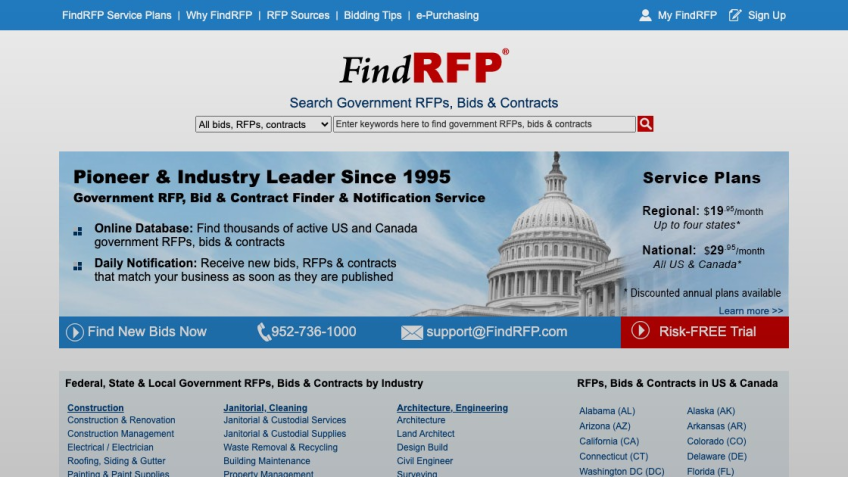
Government bid searches quickly become complicated when a team must monitor city portals, state systems, school districts, federal notices, and Canadian public-sector sources simultaneously. FindRFP’s pitch is simple: consolidate those notices into one searchable database and send daily alerts when matching opportunities arise.
This is primarily suited for contractors and vendors seeking a lower-cost way to monitor public-sector opportunities across the U.S. and Canada. Public pricing starts at $19.95 per month for a regional plan covering up to four states, which is unusually easy to evaluate in a category that often hides pricing.
The tradeoff is product depth. Available evidence supports searchable bid discovery, filters, and notifications, but does not document integrations, security credentials, or a more advanced pursuit workflow. There are also reported complaints about billing and support responsiveness that deserve careful consideration before purchase.
Quick Verdict
FindRFP is easiest to justify when the job is straightforward bid discovery across public-sector sources, not account planning or complex pipeline workflow. It gives smaller contractors and lean teams an affordable way to scan U.S. and Canadian government opportunities, but the demo must prove coverage quality and account support.
- Best for: Contractors needing low-cost public-sector bid search and daily notifications
- Not ideal for: Teams that need documented integrations, compliance credentials, or a modern revenue workflow
- Biggest strength: Public pricing with regional and national coverage options
- Biggest risk to verify: Source coverage quality and account support experience
What Is FindRFP?
FindRFP is a government contracting intelligence and RFP search platform focused on public-sector procurement notices. It operates in the bid discovery stage of the workflow, allowing users to search for open opportunities, filter by geography or category, and receive alerts when new notices match their criteria.
The company states it has operated since 1995 and lists its headquarters in Las Vegas, Nevada. This long operating history is more important here than brand polish because the product seems built around a durable utility workflow rather than a broader sales platform.
Coverage spans the United States and Canada, including federal, state, and local agencies, as well as public-sector institutions such as education and healthcare. The vendor states that its database sources information from official procurement portals and notices from approximately 100,000 government buyers and subcontractors, with daily updates.
This should replace manual portal monitoring and scattered email subscriptions. It should not be assumed to replace CRM-driven opportunity management, partner collaboration, compliance review, or in-depth federal account intelligence. These capabilities are not documented in the available material.
Key Features
Searchable RFP and bid database
FindRFP offers an online database of government RFPs, bids, and contracts throughout the U.S. and Canada. The core workflow is that sales or capture staff search for active opportunities, eliminating the need to check individual procurement sites one by one.
Daily matching alerts
The platform sends daily email notifications for matching government contract opportunities, reducing the need for manual repeat searches and providing small teams with a basic monitoring loop for new notices.
Regional and national subscriptions
FindRFP offers individual plans with a regional option at $19.95 per month for up to four U.S. states and a national option at $29.95 per month for coverage across the U.S. and Canada. For buyers with limited territory needs, the regional package is more than just a pricing detail; it determines whether the product is economically viable.
Keyword and geography filtering
Users can filter by industry category and geography to narrow the opportunity set. This is standard for this category, but it matters here because the platform’s value depends on whether those filters reduce irrelevant notices instead of flooding inboxes.
North American public-sector source aggregation
The vendor states it aggregates data from official government procurement portals and notices linked to about 100,000 government buyers, with daily updates. If accurate, this provides buyers a single place to monitor federal, state, local, education, and healthcare public procurement sources.
Pros
- Low published pricing
- Regional or national plans
- Daily email alerts
- 100,000 government buyers claimed
- US and Canada coverage
- Long operating history
Cons
- Support responsiveness concerns
- Billing complaints reported
- Integrations not documented
- Compliance details absent
- Source-count claims need testing
Buying Checks
FindRFP does publish pricing, which is helpful. The regional plan costs $19.95 per month for up to four states, and the national U.S. + Canada plan is $29.95 per month. The more important evaluation is not price; it is determining whether the listings, alerts, and account experience meet your specific territory needs.
- Run live searches for your named agencies, states, and keywords, then confirm the results include opportunities you already know should appear.
- Inspect several listings and verify that each one links back to the original government source with a clear posting date.
- Test the daily alert flow with narrow keywords and categories to see whether notifications are relevant or too broad to act on.
- Check how the regional package works in practice: confirm state-selection rules, whether changes are allowed, and how Canadian coverage is handled.
- Ask the vendor to show the current source list behind its claims of about 100,000 government buyers and more than 10,000 sources.
- Confirm export options for spreadsheets or internal workflows, since CRM and other integrations are not publicly documented.
- Review trial terms, renewal terms, and cancellation steps in writing before purchase, especially given reported billing and support complaints.
Who Is FindRFP Best For?
Best fit: Small and midsize contractors who primarily need a searchable feed of public-sector bids and contracts, especially if they sell in a specific set of U.S. states or want a single tool that covers both U.S. and Canadian notices.
Possible fit: Larger teams that need a low-cost supplemental source alongside other procurement monitoring tools. This can make sense if the goal is broader notice collection rather than serving as a primary system for capture management.
Not ideal for: Revenue teams that require documented integrations, formal compliance materials, or more advanced workflows beyond search, filters, and email notifications. If your process depends on CRM handoff, audit requirements, or tightly managed account administration, you will need evidence of these features before FindRFP can be trusted as a core tool.
Best Alternatives to FindRFP
BidPrime is the closest alternative in this set for buyers seeking a state and local contract aggregator with email alerts. If your work focuses more on SLED than on broad cross-border U.S. and Canada discovery, this may be a better fit.
BidNet Direct is another notification-driven option organized by location and category. It is a sensible alternative when the primary need is bid alerts rather than a broader contracting intelligence workflow.
SAM.gov is adjacent rather than direct because it is the official U.S. government opportunities database and is more federally focused. It suits buyers who can tolerate the government interface and do not require a paid aggregation layer.
GovTribe is also adjacent rather than direct. It is positioned as federal contracting intelligence for midsize contractors, so it makes more sense when the buying motion involves federal account and opportunity analysis rather than a broad public-sector bid search.
Final Verdict
FindRFP stands out because it offers a straightforward bid-search workflow with public pricing that is much lower and simpler than many government contracting tools. If your team only needs to find relevant public-sector opportunities and receive daily notices without spending much, that is a valid reason to consider it.
Do not expect more than the documented scope. The evidence supports searchable procurement listings, filters, and daily alerts across U.S. and Canadian public-sector sources. It does not support assumptions about integrations, compliance posture, or a modern capture stack.
Shortlist it if your evaluation begins with territory coverage and alert relevance, especially under the four-state regional plan. Keep searching if your process relies on documented system integrations or strict vendor support. Before signing, use the trial or demo to verify recent notices from your specific agencies and obtain cancellation terms in writing. This is the practical test for whether FindRFP is a cost-effective research tool or an avoidable administrative burden.