On this page
Government bid databases often end with the notice itself. The harder work begins after that: sorting irrelevant postings, tracking addenda, and determining who won, at what price, and whether the same buyer will purchase again.
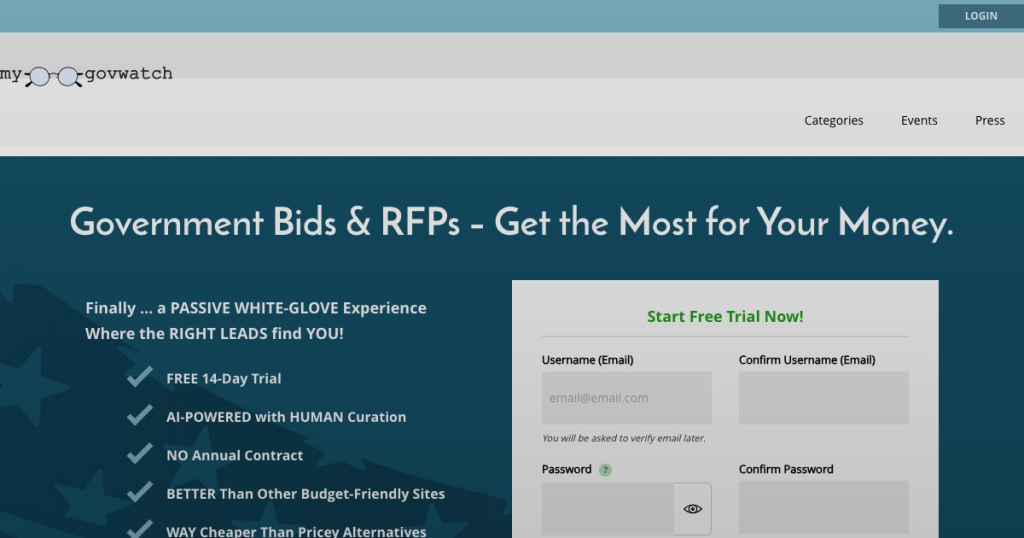
MyGovWatch is designed for that workflow. It covers federal, state, and local opportunities in the U.S. and states that it routes leads across more than 200 industry subcategories, with options to access contract documents and winning bid details through open records requests.
This makes it more interesting than a basic bid alert feed for contractors who need targeted public-sector leads and competitive context. However, several important claims still require direct validation during evaluation, especially category depth, AI match quality, FOIA delivery speed, and how its CRM API performs in a real sales process.
Quick Verdict
MyGovWatch is ideal for teams seeking targeted government bid alerts along with downstream intelligence on awards, pricing, and procurement documents. It is especially useful for contractors operating in both federal and SLED markets who need more than just another inbox full of RFP notices.
- Best for: Contractors that want bid alerts, award visibility, and competitor pricing research in one workflow
- Not ideal for: Teams that need proven enterprise-grade workflow documentation or strong public compliance evidence
- Biggest strength: Open-records document access tied to bid discovery
- Biggest risk to verify: Whether its claimed coverage and lead matching hold up in your exact agencies and categories
What Is MyGovWatch?
MyGovWatch is a government bid notification and intelligence platform. Its main purpose is to help contractors find relevant public-sector opportunities, track procurement changes, research contract awards, and move selected leads into a CRM via an API.
The product falls between a basic alert service and a comprehensive procurement research tool. It is designed to assist with lead discovery, competitive research, and some post-award analysis. It is not intended to be a full proposal management suite, nor is there evidence that it replaces dedicated federal opportunity management systems for large capture teams.
Target users include government contractors of various sizes, from sole proprietors to larger enterprises. Public examples emphasize industries such as debt collection and call centers, though the vendor states the platform now supports more than 200 industry subcategories.
Public information lists MyGovWatch as founded in 2007 and headquartered in Collingswood, New Jersey. Team size is unclear; one source reports 1-10 employees, but the available data includes a conflict warning, so this figure should not be considered definitive.
Key Features
Targeted Bid Alerts by Industry
Users can set detailed industry and subcategory preferences so the system routes more relevant government contract leads to them. This is important for firms that do not want a broad public procurement stream and instead need opportunities filtered for specific service lines.
Federal, State, and Local Opportunity Monitoring
MyGovWatch states it covers U.S. government opportunities at the federal, state, and local levels. For mixed-market contractors, this can reduce the need to monitor separate sources for federal and SLED work, though agency-level depth still needs to be verified in the demo.
Procurement Change and Award Notifications
The platform tracks procurement updates, including addenda, modifications, and award notifications, on watched opportunities. This is essential for serious bid monitoring and remains useful because it prevents active pursuits from drifting when the buyer changes dates, scope, or award status.
Open Records Document Retrieval
One of the more distinctive features is access to contracts, evaluations, winning proposals, and pricing through FOIA and other open records processes. This moves the workflow beyond lead alerts into post-award intelligence, allowing sales teams to examine what actually won and how buyers structured previous purchases.
Competitor Pricing and Bid Research
Search tools are described as a way to analyze competitor bids, pricing, and winning proposals by agency, region, and related attributes. If this works as advertised, it gives users a practical reason to stay on the platform after lead discovery: pricing research and incumbent analysis before the next bid arrives.
CRM Lead Export via API
MyGovWatch offers APIs to feed leads into CRM systems like Salesforce. This is especially important for teams that do not want another standalone government sales inbox and instead need procurement leads integrated into their existing pipeline and ownership model.
Pros
- 200+ industry subcategories
- Federal-state-local coverage
- Award document access
- Competitor pricing research
- CRM API export
- No-contract monthly plans
Cons
- Coverage depth needs testing
- FOIA turnaround unclear
- User-submitted lead reliance
- AI routing needs proof
- Limited compliance docs
Buying Checks
The live evaluation should focus on evidence, not broad marketing claims. Ask MyGovWatch to use your actual territory, agencies, and categories instead of a canned search.
- Run searches for your named agencies and NAICS-adjacent categories to confirm the claimed 200+ subcategory coverage includes your real market.
- Inspect a sample of recent opportunities across federal and SLED sources and verify source links, posting dates, addenda history, and award status.
- Test the lead-routing logic with a narrow profile and review false positives, not just matched opportunities, to see whether the AI personalization is actually useful.
- Request a documented example of an OpenRex or FOIA-based retrieval, including what documents were obtained, how long it took, and what happens when an agency denies or delays release.
- Review competitor research outputs against one known incumbent account and confirm whether pricing, winning proposal details, and award data trace back to official documents.
- Push sample leads into your CRM through the API and check field mapping, deduplication, update behavior, and whether addenda or award changes sync cleanly.
- Clarify package scope around monthly plans, pay-as-you-go credits, export limits, and any separate charges for open-records document requests.
Who Is MyGovWatch Best For?
Best fit: U.S. government contractors who need targeted bid alerts across federal and SLED markets and want to research contract awards, pricing, and past winning proposals without using separate tools.
Possible fit: Small and mid-sized firms exploring public-sector sales, especially those that value no-contract monthly plans or pay-as-you-go access and want a lighter entry point than a large enterprise contracting platform.
Not ideal for procurement teams that require comprehensive documentation of enterprise security posture, robust CRM and administrative controls, or a vendor with clear public evidence of implementation and support depth.
Best Alternatives to MyGovWatch
Deltek GovWin IQ is the leading alternative for enterprise federal contracting intelligence. It may be a better fit for large capture teams that prioritize formal federal opportunity workflows and in-depth analyst support over flexible monthly access.
GovTribe is a better fit if your main focus is federal pipeline analysis and collaboration. However, for buyers who also need MyGovWatch’s open-records approach to contract documents and pricing, GovTribe is more adjacent than directly aligned.
BidPrime is the most relevant alternative for teams focused on state and local opportunities. If your book of business is primarily SLED, BidPrime may be easier to justify than a platform that spans both federal and local markets.
GovSpend (Fedmine) is a better fit when spending analytics are as important as bid discovery. Buyers conducting incumbent analysis or market sizing may prefer this approach over MyGovWatch’s lead-routing and document-retrieval workflow.
Final Verdict
MyGovWatch stands out when bid alerts alone are not enough. The key differentiator is the combination of targeted procurement leads, award notifications, and access to contracts, evaluations, and winning proposals through open-records workflows. This can change how a contractor qualifies markets and studies incumbents before the next bid cycle.
Shortlist it if your team sells to U.S. government agencies and wants a single system for opportunity discovery and post-award research. Keep looking if you need extensive enterprise controls, clearer proof of integration depth, or a platform with stronger public evidence of coverage consistency.
One buying insight is specific to this product: don’t treat the FOIA and open-records capability as a minor feature. For some teams, that’s the main reason to buy. The demo should show recent, traceable examples from your target agencies, with turnaround expectations and CRM handoff tested before you commit.