
On this page
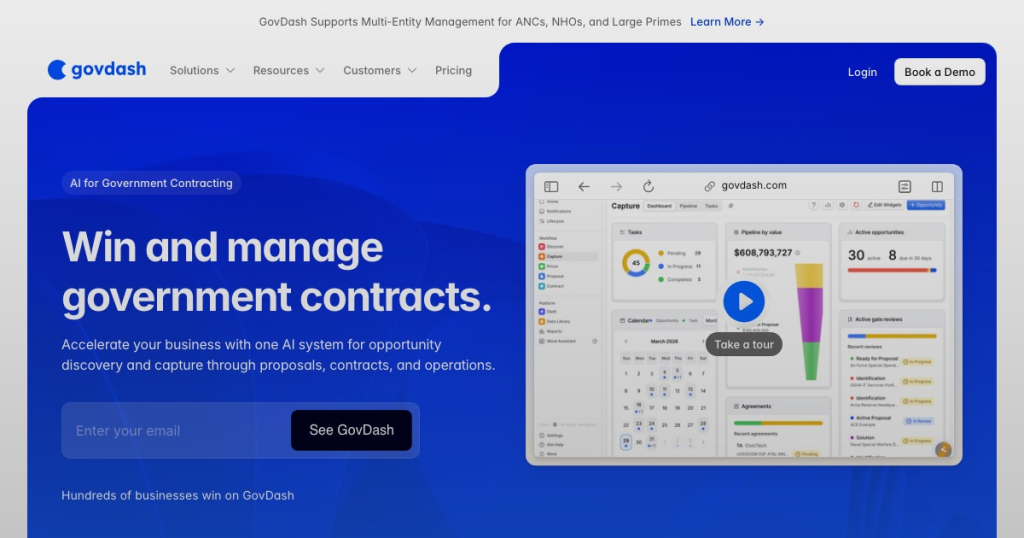
Government contractors often piece together SAM.gov searches, spreadsheets, CRM records, proposal folders, and post-award trackers. GovDash aims to consolidate that sprawl into a single platform, covering discovery, capture, proposals, contracts, and pricing workflows.
The product targets U.S. government contractors, especially primes operating in defense, civilian, health, and SLED markets. It also addresses multi-entity organizations such as ANCs and NHOs, where duplicate pursuits across subsidiaries cause significant internal friction.
What stands out is the breadth. GovDash goes beyond bid discovery; it also includes a pipeline CRM, proposal work within Microsoft Word and SharePoint, pricing tools, and contract tracking. The risk is equally clear: when one system claims to cover the entire GovCon lifecycle, the demo must prove that each handoff actually works.
Quick Verdict
GovDash is ideal for contractors seeking a single system for federal and SLED opportunity intake, capture tracking, proposal collaboration, and post-award visibility. It is less suitable if your team only needs a specialized research database or if AI-generated recommendations and drafting outputs do not meet internal review standards.
- Best for: Prime contractors that want a single GovCon workflow spanning discovery, capture, proposals, pricing, and contract management
- Not ideal for: Teams that only need narrow federal market research or those without disciplined profile and data governance
- Biggest strength: Broad GovCon workflow coverage in one platform, with federal, defense, and SLED data sources plus proposal and contract modules
- Biggest risk to verify: Match quality, AI output quality, and whether the integrations and data refresh claims hold up in your actual pursuit process
What Is GovDash?
GovDash is a government contracting platform designed specifically for U.S. contractors, not just a generic CRM or document tool. Its category is best described as GovCon workflow software, combining opportunity discovery, capture management, proposal development, pricing support, and post-award contract tracking.
That means it can replace parts of a bid database, a capture spreadsheet, a proposal coordination layer, and some contract administration tools. It is not just a lead source, nor is it a pure contract lifecycle management system.
The company was founded in 2021 and is headquartered in New York, NY. Publicly cited customers include Scale AI, SPATHE Systems, and Rose Consulting. GovDash also targets large primes and multi-entity structures such as ANCs and NHOs, where a parent organization may need separate pipeline visibility across subsidiaries while preventing duplicate pursuit work.
Coverage is U.S.-focused. Documented data sources include SAM.gov, PIEE, GSA eBuy, state and local procurement portals, and GovWin IQ via API. This provides a broad federal and SLED footprint, but also means the platform relies heavily on public procurement data and related sources rather than private buying signals.
Key Features
Opportunity Discovery and Matching
GovDash searches and tracks opportunities across SAM.gov, PIEE, GSA eBuy, and state and local procurement portals. It also matches opportunities to saved company profiles and past performance, reducing manual triage and highlighting bids that fit the contractor’s capabilities.
Capture Pipeline CRM
The platform features a unified pipeline CRM for business development and proposal teams. It serves as the system of record for capture status, pursuit data, and team coordination, eliminating the need to split this work across spreadsheets and a separate sales CRM.
Proposal Work in Microsoft Tools
Proposal development relies on Microsoft Word and SharePoint. GovDash states that teams can edit proposals directly in Word, sync documents from SharePoint, generate outlines, and run compliance checks. For contractors focused on proposals, this is more important than generic document storage because it keeps writing and review within the familiar formats teams already use.
Pricing and Cost Modeling
GovDash features a pricing workflow called Pricer for labor rates and cost scenarios. This is useful for capture and proposal teams that need pricing work to be integrated with the pursuit record rather than stored in separate spreadsheets.
Post-Award Contract Tracking
The platform goes beyond pre-award work to include contract management, such as tracking deliverables, modifications, obligations, and CPARS. This is a significant distinction from products that end when the proposal is submitted.
Salesforce and Multi-Entity Coordination
Salesforce integration is documented, with bid and pipeline data syncing between systems. GovDash also flags duplicate pursuits across entities, which is especially relevant for ANCs, NHOs, and large primes managing multiple subsidiaries that might otherwise pursue the same work without realizing it.
Pros
- Full-lifecycle GovCon workflow
- Federal and SLED sources
- Salesforce sync
- Word and SharePoint editing
- Multi-entity pursuit controls
- FedRAMP Moderate-equivalent
Cons
- Public-source limits
- Profile upkeep required
- AI outputs need review
- Some feed delays
- Package scope unclear
Buying Checks
GovDash covers enough of the GovCon workflow that a surface-level demo is insufficient. Test the data integration, proposal workflow, and the quality of its recommendations using your own agencies, contracts, and entity structure.
- Run a live search for your target agencies and NAICS codes across SAM.gov, PIEE, GSA eBuy, and the specific state or local portals your team actually monitors.
- Inspect matched opportunities against your saved capability profile and past performance to see whether relevance improves or whether the platform produces obvious false positives.
- Ask the team to show refresh timestamps for federal and defense feeds, including whether any sources still lag by 12-24 hours.
- Test the Salesforce sync on opportunity stages, contacts, and field mapping so capture data doesn’t fork into two competing systems.
- Open a real proposal workflow in Microsoft Word and SharePoint, then verify document sync, collaboration behavior, outline generation, and compliance checking on your own file set.
- Have GovDash demonstrate duplicate pursuit detection across multiple subsidiaries or business units if you operate an ANC, NHO, or multi-entity structure.
- Validate security claims with procurement documentation, especially the scope of FedRAMP Moderate-equivalent controls and how CUI is protected in storage, processing, and transmission.
Who Is GovDash Best For?
Best fit: U.S. prime contractors with active business development, capture, proposal, and post-award teams who want a single operating system instead of separate point tools. This is especially relevant in defense, civilian federal, health, and SLED contracting, where opportunities, proposal work, and contract obligations must remain connected.
Possible fit: Multi-entity organizations such as ANCs, NHOs, and large primes with subsidiaries. GovDash’s duplicate pursuit controls and entity-level coordination are more specific than the typical GovCon platform pitch. Contractors like Scale AI, SPATHE Systems, and Rose Consulting are publicly cited customers, which suggests the product is used by actual GovCon operators.
Not ideal for teams that only need a narrow federal research database or lean organizations that will not maintain accurate capability profiles, certifications, and entity data. If that foundation is outdated, the recommendation engine becomes less useful and the workflow starts with poor inputs.
Best Alternatives to GovDash
Deltek GovWin IQ is a better fit if you want a more established GovCon intelligence platform focused on market research, analyst support, and enterprise capture tracking. It is more like a mature intelligence database than an all-in-one proposal and contract workflow.
GovTribe: Better for teams focused on federal market research and pipeline tracking without needing the broader post-award and proposal stack that GovDash is integrating into a single platform.
Civic IQ: This is more adjacent than direct. Civic IQ focuses on pre-RFP intelligence and agency signal detection, so it may be a better fit if your gap is in earlier-stage demand sensing rather than proposal writing or contract administration.
R3 Contract Management is better suited for buyers who primarily need contract lifecycle management and FAR/DFAR-oriented document control. Its scope is narrower than GovDash, but that focus may be exactly what some post-award teams want.
Final Verdict
GovDash is most valuable when your team is tired of moving the same pursuit through five disconnected systems. Its real advantage isn’t just opportunity discovery; it keeps discovery, capture, proposal work in Microsoft tools, pricing, and post-award tracking all connected to the same contract record.
Shortlist it if you are a U.S. government contractor with enough process complexity to justify a single GovCon operating layer, especially if you manage multiple entities or want Salesforce connected to capture activity. Keep looking if your primary need is federal market intelligence, or if your team will not trust AI-assisted matching and proposal drafting without extensive manual review.
The deciding test is simple: have GovDash handle a live pursuit from source ingestion to proposal document, to CRM sync, to contract record using your own targets. If that chain holds up, the product has substance. If the handoffs break, the breadth becomes overhead instead of leverage.