On this page
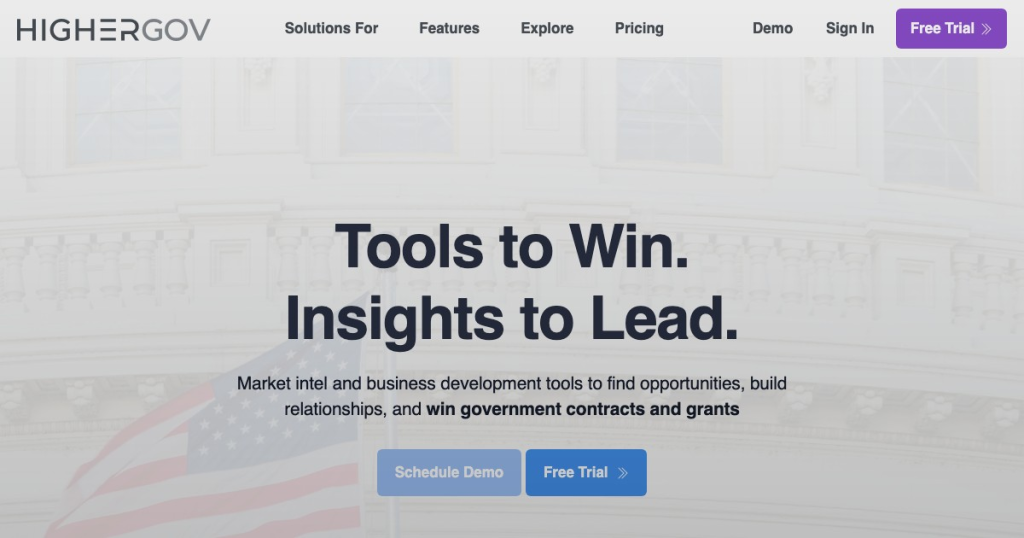
Government sales teams often piece together SAM results, state procurement sites, grant notices, and old award records in spreadsheets. HigherGov aims to streamline this process into a single market intelligence product that covers federal, state, and local contracts and grants.
The main appeal is its breadth. The company says users can search millions of opportunities, analyze over 65 million contract and grant awards, and review more than 3,000 federal agencies and 4,000 contracting vehicles. It also publishes annual pricing starting at $500 for a single user, which is unusual in this category.
This is intended for government contractors, agencies, consultants, and grant-focused organizations that need discovery, research, and pursuit tracking rather than a full capture CRM. This distinction is important because external analysis indicates that HigherGov’s built-in pipeline features are limited, so the demo must show where research ends and actual pursuit management begins.
Quick Verdict
HigherGov is ideal for teams seeking a single searchable layer across federal, state, and local government intelligence without paying enterprise-platform prices from the start. Its value is greatest when award history, agency research, and grant and contract discovery are more important than a fully developed capture system.
- Best for: GovCon and grant teams that need broad U.S. public-sector search, award analysis, and light pursuit tracking
- Not ideal for: teams that need a mature built-in capture CRM or automated proposal-writing workflow
- Biggest strength: federal, state, and local coverage combined with awards, agencies, vehicles, exports, and API access
- Biggest risk to verify: whether the claimed data freshness, FOIA-derived data, and workflow depth hold up for your exact agencies and sales process
What Is HigherGov?
HigherGov is a government market intelligence platform positioned between a raw bid database and a full capture platform. It allows you to search for opportunities, study awards, analyze agencies and contracting vehicles, track pursuits, and export data to other systems.
The target market is broad within public-sector sales. The company positions the product for government contractors, government agencies, consultants, advisors, and grant recipient organizations. The workflow is also broad, including opportunity discovery, competitor and partner analysis, agency research, reporting, and business development pipeline support.
Company details are limited but clear on the basics. HigherGov was founded in 2022 and is headquartered in New York, NY. LinkedIn lists the team size as 2-10. No named customers are publicly mentioned in the available material, so there is little external evidence yet of adoption by large contractors or agencies.
That makes category fit important. HigherGov should be evaluated as a research and intelligence layer with some pursuit management, not as a replacement for a full CRM, proposal platform, or capture management stack unless the demo shows otherwise.
Key Features
Opportunity Search Across Contracts and Grants
HigherGov says users can search millions of opportunities across federal, state, and local contracts, grants, forecasts, and SBIRs. For teams selling to multiple levels of government, this reduces the need to switch between separate procurement portals and grant sources.
Awards and Competitive History
The platform provides analysis of more than 65 million contract and grant awards, including subawards, SBIRs, and OTAs. This is especially important in recompete and adjacency work, where buyers need to see who won, with which vehicle, and where a competitor already has traction.
Agency and Contract Vehicle Intelligence
HigherGov provides data on more than 3,000 federal agencies and over 4,000 contracting vehicles, including schedules, IDIQs, BPAs, and GWACs. This supports territory planning and qualification, especially when a team needs to understand which offices use which vehicles before pursuing an opportunity.
Pursuit Tracking and Alerts
Saved searches, custom alerts, and pipeline management are included. These help keep analysts, capture leads, and sellers aligned on new pursuits, but they function more as a lightweight business development workflow than a full capture system.
Exports, API, and Zapier Workflows
All subscriptions include API access, with documentation specifying 10,000 records per month. CSV export limits range from 1,000 records per search on Starter to 20,000 on Standard. Zapier connects HigherGov to tools such as Salesforce, HubSpot, Pipedrive, Slack, monday.com, and Microsoft Teams. For buyers with an existing CRM, this is a key aspect of the product because it determines whether HigherGov becomes part of the daily workflow or just another research tab.
Vendor and Partner Research
HigherGov also offers a people database for vendors, as well as labor pricing, M&A, and investor data. This is more specific than a standard bid feed. It could be important for teaming strategy and market mapping, but buyers need to review actual record depth and coverage during evaluation.
Pros
- Federal-state-local coverage
- 65M+ awards analysis
- Public yearly pricing
- Zapier and API access
- Agency and vehicle data
- Team-friendly seat tiers
Cons
- Built-in CRM is limited
- Learning curve looks real
- Compliance docs absent
- FOIA coverage needs testing
- Data freshness needs testing
Buying Checks
HigherGov offers annual plans at $500 per year for Starter, $2,500 per year for Standard, and $5,000 per year for Leader. While that’s helpful, the real evaluation focuses on coverage quality and workflow fit.
- Run searches for your named agencies, NAICS codes, contract vehicles, and target states, then inspect whether results are actually relevant to your pipeline.
- Spot-check recent opportunities and awards for source links and dates so you can see whether updates are current enough for your sales cycle.
- Ask the team to show what “opportunity” includes in the product: formal solicitations, forecasts, grants, contract renewals, or other signals.
- Test the FOIA and proprietary data claims on a market where open-source coverage is usually thin, not just on easy federal records.
- Walk through a full export into your CRM or data warehouse, including field mapping, deduping, and the 10,000-record monthly API limit.
- Have them show the pursuit workflow end to end so you can judge whether saved searches and pipeline views are enough or whether you’ll still need a separate capture system.
- Request security and compliance documentation early if procurement requires it, because no public compliance credentials are listed in the available material.
Who Is HigherGov Best For?
Best fit: contractors and consultants who sell across multiple government layers and need a single place to research opportunities, awards, agencies, and vehicles. It also suits smaller teams that prefer published annual pricing instead of requiring a custom enterprise quote to get started.
Possible fit: agencies or grant-focused organizations seeking market and program analysis, as well as teams already using Salesforce, HubSpot, or another CRM that primarily need an upstream intelligence source to feed those systems.
Not ideal for organizations that expect the product to handle mature opportunity management, proposal generation, or complex bid workflows. Available evidence indicates support for research and pursuit, not a complete capture stack.
Best Alternatives to HigherGov
GovWin IQ (Deltek) is the more established option for enterprises seeking comprehensive federal forecasting and longstanding GovCon workflow coverage. It is a better fit when the primary focus is large-scale federal opportunity intelligence.
GovTribe is another federal-focused alternative, especially for teams that prioritize contact data and CRM connectivity. This is related but not identical, as HigherGov has a broader focus across federal, state, and local data, as well as grants.
GovDash (Scout) is worth considering if your team wants search along with a more explicit pipeline and AI-oriented workflow in one platform. It is a better comparison for buyers who feel HigherGov’s pursuit tools may be too limited.
Govly is the alternative to consider when capture workflow and AI-driven procurement assistance are more important than HigherGov’s broader market intelligence approach. Govly appears more focused on workflow, while HigherGov emphasizes data and research breadth.
Final Verdict
HigherGov is most compelling when your team needs a comprehensive government intelligence layer, not just another federal bid list. The combination of contracts, grants, awards, agencies, vehicles, exports, and API access is substantial, and the published pricing lowers the barrier to trying it.
Still, this isn’t a blind buy. Founded in 2022, with no publicly named customers and no public compliance credentials in the available material, the product needs a stronger demo than an incumbent would. The proof points for demand are there on paper; proof of operational fit must come from your own test.
Shortlist it if your current process is fragmented across procurement portals, spreadsheets, and CRM handoffs, and if award history and agency research are central to qualification. Keep looking if you need the platform to run capture management. One specific lens: don’t stop at search results. Make HigherGov show your actual target agencies, the source records behind them, and exactly how a pursuit moves from discovery into your CRM without manual cleanup.