
On this page
School board minutes, county budgets, purchase orders, and old contract records are where much public-sector pipeline work becomes complicated. NationGraph is designed for that challenge: it aggregates data from over 110,000 government agencies and transforms records such as meetings, budgets, contracts, grants, and procurement notices into sales signals.
This targets revenue teams selling to U.S. cities, counties, states, schools, universities, and special districts. The value goes beyond bid discovery, offering earlier account research, territory planning, and timing outreach before a formal RFP is issued.
The challenge is maturity and verification. NationGraph was founded in 2024, and several headline claims – including 100% territory visibility, AI document parsing quality, and a 60x reduction in research time – need to be tested directly in a demo.
Quick Verdict
NationGraph is most useful for B2G teams that want meeting, budget, contract, and contact data integrated into their sales workflow instead of relying on manual public-record research. It is particularly strong in U.S. state and local sales, especially when account prioritization and pre-procurement signals are more important than having another federal bid database.
- Best for: GovTech revenue teams selling to state, local, education, and special-district accounts
- Not ideal for: Teams centered on federal contracting or buyers that need a long enterprise track record
- Biggest strength: Combines meetings, budgets, contracts, purchase orders, and FOIA automation into one workflow
- Biggest risk to verify: Whether signal accuracy and agency coverage hold up in your exact territory and vertical
What Is NationGraph?
NationGraph is a GovTech sales intelligence product. Its main function is to scan public-sector records, identify likely buying activity, and route those signals into outreach and account planning. This places it between a government market intelligence database, a public-record automation tool, and a CRM-connected signal feed.
The product is designed for sales and marketing teams that sell to U.S. public agencies, including cities, counties, state agencies, K-12 districts, public universities, and special-purpose districts. It supports workflows such as identifying budget-cycle timing, viewing incumbent vendors through purchase orders and contracts, finding likely decision-makers, and monitoring events like RFP postings or contract renewals.
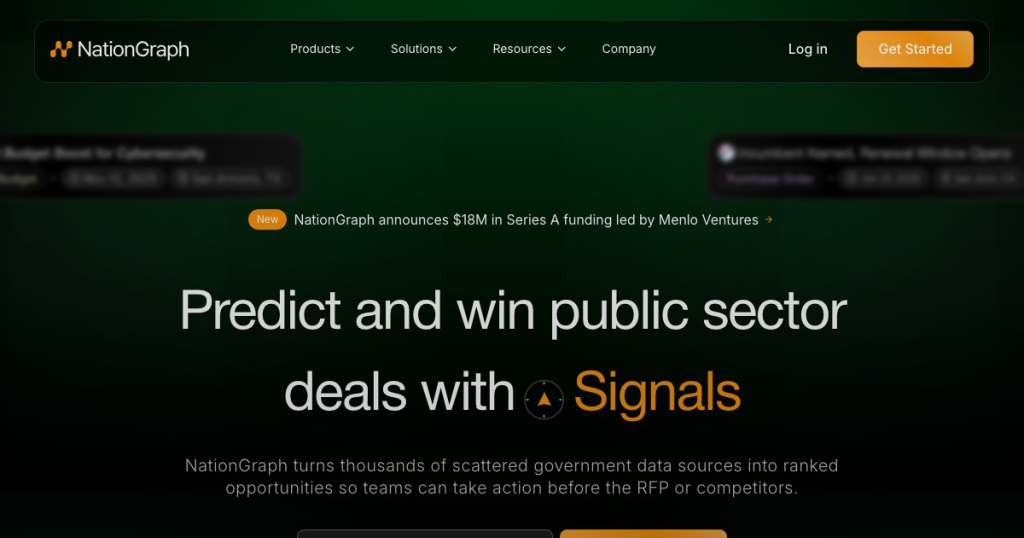
NationGraph was founded in 2024 and is headquartered in San Francisco, California. The company reports a team size of 11–50 and has raised $22.5 million in total funding, including an $18 million Series A. Named customers in public materials include FlexPoint, RocketLit, and CareSolace.
What it should replace depends on your stack. It can reduce manual record searching and spreadsheet-based territory research. It is not clearly positioned as a full federal opportunity platform, and the available evidence points more strongly to state and local government sales work.
Key Features
Meeting and budget signals
NationGraph parses board meeting minutes, transcripts, budgets, financial documents, grant announcements, and policy records to identify buying triggers. This supports the top-of-funnel research stage, where representatives aim to spot projects, leadership changes, funding shifts, or planned initiatives before procurement becomes formal.
Purchase orders, contracts, and renewal visibility
The platform pulls contract and purchase order data to show which vendors an agency has bought from, how much it spent, and when contracts may renew. This provides a concrete workflow advantage for competitive displacement, renewal planning, and territory reviews, where incumbent visibility matters more than generic lead lists.
Procurement rule context
NationGraph also highlights procurement rules and thresholds, such as sole-source caps and bidding requirements. This helps sellers determine whether an opportunity will likely require a formal process or allow for earlier direct engagement. It is not flashy, but it can prevent reps from misjudging how a deal will progress.
Alerts and CRM delivery
Signals can be routed through Salesforce, HubSpot, Zapier, Slack, email digests, CSV, and API export. Salesforce and HubSpot have the most clearly documented integrations. For teams already managing opportunities in a CRM, this is more important than having another standalone dashboard that reps may forget to check.
Contact enrichment and FOIA automation
NationGraph claims it can identify decision-maker titles, validate emails, and map contacts to signals. It also offers automated public-record requests to pull structured contract and spend data into existing sales workflows. These are meaningful capabilities if they work reliably, as they reduce two of the slowest parts of public-sector prospecting: finding the right person and obtaining hard purchasing data that is not readily published.
Pros
- 110,000+ agencies tracked
- Meeting-to-contract signals
- FOIA automation workflow
- Salesforce and HubSpot sync
- Verified contact enrichment
Cons
- Short operating history
- Limited compliance docs
- AI extraction needs proof
- Agency coverage needs testing
- FOIA turnaround unclear
Buying Checks
The demo must show that NationGraph works with your specific agencies, not just in a polished territory overview. Emphasize source traceability, coverage in your exact market, and how seamlessly the data integrates into your CRM.
- Run a territory test with specific agencies you already track and confirm whether meetings, budgets, contracts, and contacts appear with recent dates and source links.
- Spot-check a few signals against original board minutes, budget PDFs, and procurement notices to see whether the extracted trigger is accurate or overstated.
- Ask what an “opportunity” or “signal” actually means in the product: meeting mention, budget line item, contract renewal, formal RFP, grant, or model-generated prediction.
- Test purchase-order and contract records on a known incumbent account to verify vendor names, spend amounts, and renewal timing.
- Inspect Salesforce or HubSpot sync behavior field by field, including duplicates, contact mapping, account matching, and whether reps can act without cleanup work.
- Request a live example of FOIA automation, including turnaround expectations, success rate, and how returned data is structured for sales use.
- Clarify package scope, export limits, onboarding work, and whether niche verticals in your market are actually covered.
Who Is NationGraph Best For?
Best fit: B2G sales teams with named-account territories in state, local, education, and district markets. If your reps spend time reading meeting packets, chasing contract records, and trying to determine which agency is actually moving, NationGraph addresses that exact problem.
Possible fit: Marketing and sales operations teams that need to rank public-sector accounts, enrich contacts, and push signals into Salesforce or HubSpot. Consultants supporting government-facing go-to-market efforts may also find the record automation and contract visibility useful.
Not ideal for: Federal-first contractors seeking a mature federal opportunity platform. The documented strengths focus more on U.S. SLED research and pre-procurement intelligence than on federal contracting depth. Teams with strict security review requirements will also need additional documentation before moving quickly.
Best Alternatives to NationGraph
GovSpend is the closest fit among the listed alternatives for teams focused on state and local procurement and spending intelligence. If your workflow focuses less on meeting intelligence and more on procurement and spend analysis, it may be a more appropriate comparison.
Deltek GovWin IQ is a stronger option when federal contracting is central. While this is adjacent rather than directly aligned with NationGraph’s state and local focus, buyers with both federal and SLED coverage needs will likely compare the two.
Federal Compass is another alternative focused on federal opportunities. It is better suited for contractors analyzing federal opportunities and agency spending than for teams focused on local meetings, school districts, or special districts.
GovTribe is a simpler federal contract search option. It is not a close workflow match for NationGraph’s meeting-budget-contract signal model, but it should be included for smaller teams that primarily need federal search coverage rather than public-record automation.
Final Verdict
NationGraph stands out by treating messy public records as sales inputs rather than just background research. Its combination of meeting intelligence, purchase order history, procurement rule context, contact enrichment, and FOIA automation is more specific than the typical government opportunity database pitch.
Shortlist it if your team sells to U.S. state and local agencies and spends too much time gathering account intelligence from PDFs, board packets, and scattered procurement sites. Keep looking if your focus is mainly federal or if your buying process requires comprehensive compliance documentation from the start.
The smartest way to evaluate NationGraph is to include a few known agencies, an incumbent competitor, and a recent public project in the demo. If it can surface the right signals, show the source documents, map the correct contacts, and sync usable records into the CRM, then the product is providing real value. If not, the impressive coverage numbers won’t matter.