
On this page
Federal capture work becomes complicated when opportunity searches, CRM updates, task orders, and proposal drafting are managed in separate systems. NextStage.ai aims to consolidate that sprawl into a single GovCon workspace.
The product is designed for government contractors, particularly business development, capture, and proposal teams working on federal opportunities. It gathers data from sources such as SAM.gov, FPDS, GSA eBuy, GovWin, CIO-SP3, OASIS, and Seaport, then integrates that data into pipeline workflows.
That combination is the reason to consider it. The caution is simpler: the all-in-one pitch only works if the sync behavior, workflow customization, and proposal outputs are good enough for your team’s actual process.
Quick Verdict
NextStage.ai is ideal for GovCon teams seeking federal opportunity intelligence integrated directly with CRM and proposal workflows, rather than purchasing separate point solutions.
- Best for: Small to mid-size government contractors running BD, capture, and proposal work in one operating rhythm
- Not ideal for: Teams focused outside U.S. federal contracting or those wanting a pure market-intel database without CRM/process change
- Biggest strength: Opportunity search, pipeline management, task orders, and proposal tooling in one platform
- Biggest risk to verify: Whether the auto-sync, no-code workflow setup, and proposal generation actually match your current capture and proposal process
What Is NextStage.ai?
NextStage.ai is a government contracting CRM and business development platform. It sits between a market intelligence database and a proposal management system, providing workflow support for finding federal opportunities, moving them into the pipeline, managing task orders, and drafting proposal materials.
This is designed for GovCon teams, not general B2B sales. The documented workflow is federal: opportunity search and tracking, pipeline management, task order management, and proposal writing. It should replace a patchwork of spreadsheets, source portals, and disconnected capture or proposal tools, rather than a broad enterprise CRM strategy.
The company states it was founded in 2020 and is headquartered in San Francisco, California. Research reports a team size of 11–50. Named customer references on the site include Metronome, RSC2, Inc., Boston Government Services, iTech AG, and SRC Technologies.
Category fit is clear. If your team sells to federal agencies and needs a single platform to manage opportunities from discovery through proposal preparation, the product aligns well. If you require state and local coverage, commercial sales workflows, or evidence of a large integration ecosystem, this profile is less compelling.
Key Features
Federal Opportunity Search Across Multiple Sources
NextStage.ai aggregates federal opportunity data from sources such as SAM.gov, FPDS, GSA eBuy, and GovWin. For BD and capture teams, this means less portal-hopping when building target lists and checking opportunity history.
CRM and Pipeline Sync
The platform automatically syncs RFP data from source systems into CRM records and supports one-click pipeline additions. While this isn’t a flashy feature, it matters when reps are still retyping solicitation details and capture managers are manually cleaning up outdated records.
Task Order Management
Task orders from GSA eBuy and CIO-SP3, as well as email-driven sources like Seaport and OASIS, can be managed within the platform. This benefits contractors handling IDIQ-heavy pipelines, where task order volume can overwhelm a generic CRM setup.
Proposal Authoring and Compliance Setup
NextStage.ai provides AI-assisted proposal tools, including compliance matrix support, automated outlines, and SharePoint integration. The value for buyers is not simply “AI” itself, but whether the system can reduce setup time for proposal teams and keep drafts linked to the underlying opportunity record.
Configurable Workflows and Document Integrations
No-code fields, workflows, and reports are included in the product, along with integrations for SharePoint, Google Drive, and Outlook. These features are essential for document-heavy proposal work, and they are important here because proposal files and capture artifacts often end up scattered across drives and inboxes.
FedRAMP Moderate Equivalency Claim
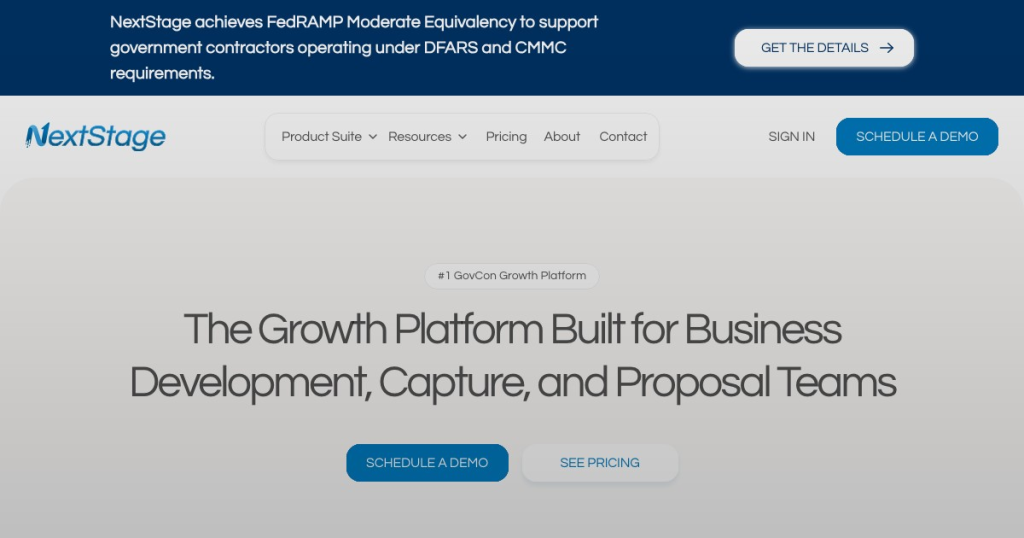
NextStage announced a FedRAMP Moderate equivalency assessment by A-LIGN in March 2026. For buyers handling regulated federal work, this is more relevant than generic security language, though the exact scope still needs to be reviewed during procurement.
Pros
- Federal source aggregation
- Auto-synced CRM records
- Task order workflow
- Proposal document integrations
- FedRAMP equivalency audit
Cons
- Federal-only fit
- AI proposal output unproven
- HubSpot via Zapier
- Package limits unclear
Buying Checks
The demo must demonstrate that NextStage.ai delivers more than just a bundled promise. Emphasize the connections between federal source data, your internal capture process, and the subsequent proposal work.
- Run searches against your actual target agencies and contract vehicles across SAM.gov, FPDS, GSA eBuy, and any other source you rely on most.
- Inspect a recent opportunity record and confirm the source link, update timestamp, and what fields are auto-synced into the CRM entry.
- Test one-click pipeline creation and verify whether your Shipley-style stages, fields, dashboards, and reports can be configured without vendor intervention.
- Walk through a real task order workflow for GSA eBuy, CIO-SP3, Seaport, or OASIS and check how email-originated items are captured and deduplicated.
- Generate a compliance matrix and proposal outline from one of your live or historical opportunities and judge the output for structure, relevance, and edit burden.
- Check SharePoint, Google Drive, and Outlook behavior with your document naming, versioning, and access controls rather than a canned demo setup.
- Clarify seat limits, onboarding scope, export rules, and the difference between native integrations and Zapier-based connections such as HubSpot, Slack, and Microsoft Teams.
Who Is NextStage.ai Best For?
Best fit: Federal government contractors seeking a single system for opportunity search, pipeline tracking, task orders, and proposal preparation. This is especially relevant for small to mid-size firms where business development, capture, and proposal teams overlap and manual data re-entry between tools wastes time.
Possible fit: Contractors who already use external market intelligence sources but want more efficient execution once an opportunity is identified. The product may also suit teams managing recurring task order activity under vehicles such as CIO-SP3, OASIS, or GSA eBuy.
Not ideal for: non-government sales teams, state and local-focused teams, or enterprises that require extensive proof of native CRM ecosystem depth before replacing established systems. If your process relies on a complex existing CRM and a separate proposal stack, carefully assess potential migration challenges.
The publicly cited customer references, including Metronome, RSC2, and Boston Government Services, align with the GovCon operating model rather than a broad public-sector sales approach.
Best Alternatives to NextStage.ai
Deltek GovWin IQ is the best alternative if market intelligence is the priority. It is more established as an opportunity research product, while NextStage.ai focuses more on CRM and proposal workflow.
GovSpend is a better fit when agency sales leads and competitor contract intelligence are more important than managing capture and proposal work within the same platform.
Govly focuses more on collaboration around RFx sharing across the government contracting supply chain. That is adjacent, rather than identical, if your main goal is an internal GovCon operating system.
EZGovOpps Market Intelligence is a more focused option for procurement research. Teams that do not want to change their CRM or proposal process may prefer this narrower scope.
Final Verdict
NextStage.ai is most compelling when your federal team is tired of copying opportunity data into CRM and then rebuilding the same context for task orders and proposals. The product’s distinct advantage is not just federal search; it aims to carry a single opportunity record across BD, capture, and proposal work.
Shortlist it if the handoff problem is costing you time and accuracy today. Keep looking if you mainly want a research database, need broader non-federal coverage, or require a proven set of native CRM integrations beyond the documented stack.
One specific evaluation lens matters here: observe how a real federal opportunity moves from source ingestion to pipeline record to proposal draft. If that process is smooth, NextStage.ai could replace several disconnected tools. If the sync is unreliable or the generated proposal setup requires more cleanup than it saves time, the all-in-one solution quickly loses its appeal.