On this page
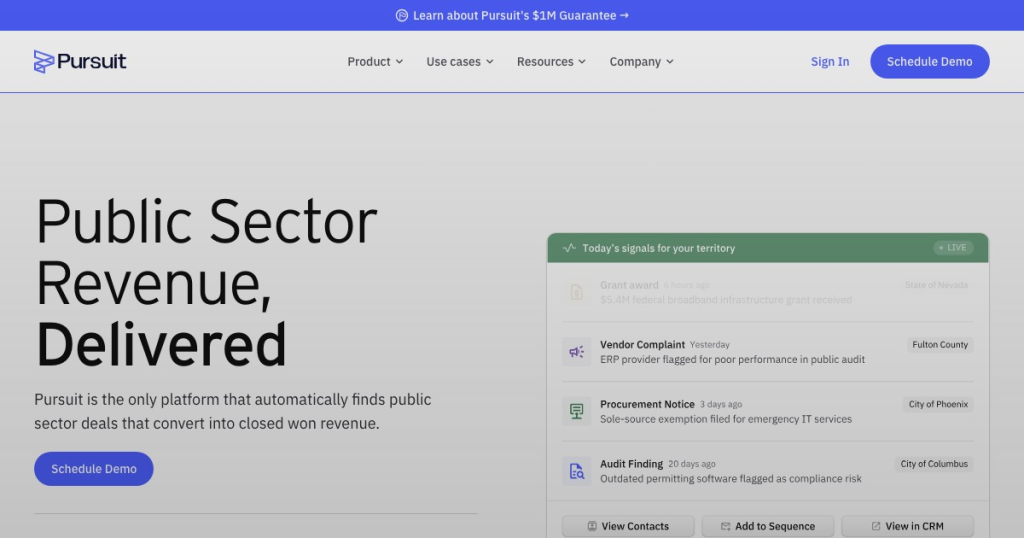
School board minutes, budget documents, contract registers, and agency planning PDFs are where much public-sector pipeline work starts to get complicated. Pursuit is designed for that complexity. It scans government sources to identify early buying signals, contacts, and account updates for teams selling to state, local, and education agencies.
The product targets GovTech vendors, government contractors, and revenue teams who need more than a bid feed. Pursuit claims it can identify procurement signals 6 to 18 months before an RFP by analyzing budgets, plans, meeting transcripts, and related public records.
The interesting part is the workflow integration. Pursuit doesn’t just pitch research; it also pushes account and contact data into Salesforce, HubSpot, and Microsoft Dynamics, with one-click sequencing into Outreach and Salesloft.
The uncertainty is valid and supported. Its documented strength is SLED, not federal, and the main claims about timing and pipeline lift should be tested against your own territories and named agencies.
Quick Verdict
Pursuit is most effective when CRM-ready SLED signals are more important than another bid database. It is especially relevant for GovTech sales and RevOps teams seeking account intelligence from public records, but teams with significant federal pipeline needs should assess fit early.
- Best for: SLED-focused GovTech revenue teams using CRM-led outbound and territory planning
- Not ideal for: Federal-first contractors that need deeper federal procurement coverage
- Biggest strength: Early public-sector signals tied to contacts and CRM sync
- Biggest risk to verify: Whether the 6-18 month pre-RFP signal claims hold up in your exact agencies and states
What Is Pursuit?
Pursuit is a GovTech sales intelligence platform. Its main purpose is to help commercial teams identify public-sector demand before it becomes a formal procurement event, then connect that signal to the appropriate agency contacts and CRM records.
This places it between a public-sector data source, an account intelligence product, and a revenue workflow tool. It is not just an RFP feed, nor is it a generic contact database. The workflow covers early opportunity discovery, contact verification, account enrichment, and territory planning for public-sector sellers.
The company was founded in 2023 and is headquartered in Ann Arbor, Michigan. Research also indicates a $22 million Series A announced in April 2026, suggesting the product is still in a relatively early stage, even though the feature set already appears broad.
Named customers and examples include Flock Safety, OpenGov, and Polco. AWS Marketplace materials also cite Skydio, Tyler Technologies, and Datadog as trusted users. These examples align with the product’s positioning for public-sector revenue teams rather than procurement back-office users.
Key Features
Pre-RFP signal discovery
Pursuit’s Radar and predictive signal capabilities scan public-sector sources such as budgets, strategic plans, meeting minutes or transcripts, RFP notices, contract registers, and FOIA records. The practical use is straightforward: reps and market teams can monitor budget language, project mentions, leadership changes, and other buying signals before a formal bid appears.
Public-sector contact intelligence
The Intel module provides verified government buyer details, including email, phone, and title information. For teams selling to fragmented agencies and districts, this is designed to reduce the typical manual search for current decision-makers and prevent named-account outreach from relying on outdated records.
CRM synchronization and data hygiene
Pursuit supports bi-directional sync with Salesforce, HubSpot, and Microsoft Dynamics. This is important because the product aims to integrate directly into the sales workflow, not operate alongside it. It also offers automatic contact verification and rescraping to keep account and contact data up to date.
Outreach and activation workflow
Beyond CRM sync, Pursuit connects to Outreach and Salesloft for one-click sequencing, Slack for alerts, and marketing systems such as Marketo, Pardot, HubSpot Marketing, and LinkedIn Ads for audience sync. This is standard for modern revenue tools, but it matters here because a public-sector signal only has value if it can quickly move into an actual campaign or sales rep action.
Security posture
Pursuit publicly states that it is SOC 2 Type II certified and designed with NIST in mind. For buyers feeding account and contact data into CRM and engagement systems, this is a useful baseline credential, though enterprise teams should still request current documentation and scope.
Pros
- 6-18 month signal window
- Official-source public records
- Bi-directional CRM sync
- 8M contact database
- 110K public entities
- Sales engagement integrations
Cons
- Weak federal fit
- Short operating history
- 3x pipeline claim unproven
- Agency coverage needs testing
Buying Checks
A Pursuit demo should not remain at the category level. Require the team to demonstrate signal quality, source traceability, and workflow fit using your own agencies, territories, and CRM fields.
- Run a live test on 10-20 target agencies and confirm whether signals appear from the exact states, municipalities, schools, or universities your team covers.
- Inspect the source behind several opportunities and verify that each alert links back to the original budget, meeting record, plan, contract register, or other official document.
- Check signal timing by comparing a few surfaced opportunities against known procurement dates to see whether the claimed 6-18 month lead time shows up in your market.
- Spot-check contact records for current title, email, phone, and agency assignment, especially in agencies with frequent leadership turnover.
- Watch the Salesforce, HubSpot, or Dynamics sync in action and confirm field mapping, duplicate handling, update logic, and whether reps can trust the write-back behavior.
- Test one-click sequencing and alert delivery in Outreach, Salesloft, or Slack so the team can see whether signals actually trigger usable follow-up work.
- Request current SOC 2 Type II documentation and clarify package scope, including the AWS Marketplace 12-month, 10-user listing at $25,500 versus any direct-sales packaging differences.
Who Is Pursuit Best For?
Best fit: GovTech vendors and revenue teams focused on U.S. state, local, and education accounts that need earlier visibility than standard RFP monitoring. If your sellers work named territories and care about budgets, board discussions, leadership changes, and account-level CRM hygiene, this product is a strong match.
Possible fit: RevOps and public-sector marketing teams that want to sync high-intent segments into CRM, sequencing tools, and ad platforms. Customer examples like Flock Safety, OpenGov, and Polco suggest Pursuit can support broader go-to-market coordination, not just individual rep research.
Not ideal for teams whose pipeline depends mainly on federal contracts. The available evidence points much more clearly to SLED and education coverage than to federal procurement depth.
Best Alternatives to Pursuit
Civic IQ: A closer alternative if you want AI-driven SLED procurement intelligence. This option is more directly comparable in its state and local focus than federal-heavy databases.
Deltek GovWin IQ is best known for federal procurement workflows and analyst-driven opportunity coverage. It is a better fit when federal opportunity tracking is more important than CRM-connected SLED signals.
GovSpend: More adjacent than direct. It is better described as government spending and budget analysis, so it may suit teams that care more about spend visibility than pre-RFP meeting and planning signals.
GovTribe: Another adjacent option with a stronger federal emphasis. Consider it when contract history and federal opportunity data are more important than Pursuit’s state and local signal workflow.
Final Verdict
Pursuit is best suited for public-sector sellers who need account intelligence before procurement becomes formal and want that information to flow quickly into CRM and outbound systems. The combination of public-record scanning, contact verification, and bi-directional sync is more targeted than a generic lead database offering.
Shortlist it if your team sells to SLED agencies and your current challenges are weak territory visibility, outdated government contacts, or excessive manual research across meeting records and planning documents. Keep looking if federal is the focus of your pipeline.
The key evaluation criterion is simple: don’t let the demo remain at the level of impressive signal stories. Make Pursuit pull recent, source-linked signals from your specified agencies and show exactly how those records are synced, deduplicated, and used to trigger outreach. If it meets that standard, it deserves serious attention.