
OpenGov logo

OpenGov

OpenGov offers a strong public-sector procurement workflow with supplier tools, APIs, and finance/ERP handoffs, while implementation remains the biggest tradeoff.

Reviews.vc score

4.0 /5
How we scored it

Is OpenGov worth it?

Nick Oscar
Editor, Reviews.vc · Updated July 21, 2026
Good For

Documented procurement coverage spans the full lifecycle from requisitions through contract administration.

Caution

Implementation can require substantial configuration, training, and ongoing assistance.

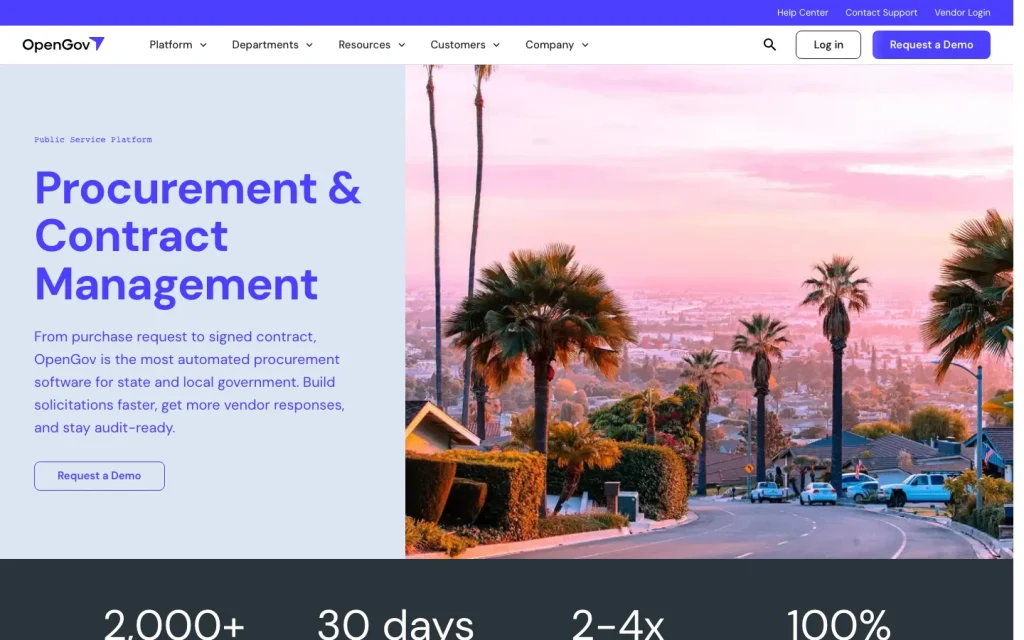
OpenGov product image
opengov.com

OpenGov is a strong fit for U.S. local and state governments that need a documented, end-to-end procurement workflow spanning request intake, solicitation development, supplier engagement, evaluation, award, and contract management. Its public API surface and developer portal add useful handoff options, while user reviews are broadly positive on ease of use, reporting, and support, with implementation and training remaining the most mixed area.

What is it?

OpenGov Procurement is a cloud procurement platform for U.S. public-sector organizations, especially local and state governments. The product is positioned around procurement and contract management within the broader OpenGov Public Service Platform, with workflows that connect purchasing activity to budgeting, finance, and ERP environments.

Procurement workflow

The documented workflow covers request intake, requisitions, solicitation creation, supplier response collection, evaluation, award, contract drafting, execution, administration, reporting, and audit controls. OpenGov also describes tools for templates, policy checks, approval routing, notifications, and budget checks, which makes the platform more than a simple bid portal.

Supplier experience and integrations

Suppliers can access opportunities through a portal with one login, electronic forms, Q&A, addenda alerts, and live chat support. On the systems side, OpenGov provides an official developer portal and public APIs, including a Purchase Order API. Its procurement materials also describe integrations with financial management and ERP systems for procurement, budgeting, and finance handoffs.

Who it's for

OpenGov is best aligned with procurement, finance, contract management, and vendor management teams in local and state government that need compliance-heavy workflows and a unified procurement record. The strongest fit is for agencies that want structured buying controls, supplier communication tools, and integration touchpoints with finance or ERP systems, while accepting that implementation may take planning and training.

Buyer scenarios

Where the product fits — and where to be careful

A state procurement team wants a single workflow from requisition to contract

Need
The team needs structured procurement intake, solicitation creation, supplier response handling, evaluation, award, and contract administration in a single system.
Why it fits
OpenGov documents that end-to-end workflow clearly and also ties it to budgeting and finance handoffs.
Watch out
Implementation may require configuration, training, and internal process alignment.

It’s a strong fit if the agency wants a comprehensive public procurement platform and can support a guided rollout.

A procurement office needs supplier self-service and bid communication

Need
The office wants a supplier portal with opportunity access, Q&A, addenda alerts, and electronic forms to simplify responses.
Why it fits
OpenGov publicly documents all of those supplier-facing capabilities.
Watch out
Validate supplier feature availability for the intended package and deployment.

It is a good fit for teams that prioritize supplier communication and response workflows rather than using a minimal bid intake tool.

Pros & Cons

Pros

  • Documented procurement coverage spans the full lifecycle from requisitions through contract administration.
  • Supplier-facing workflows include bid access, Q&A, addenda alerts, and electronic response forms.
  • Verified public API surface includes OpenGov Open API and OpenGov Purchase Order API.
  • Official materials connect procurement with budgeting, finance, and ERP systems.
  • Reviewers frequently praise reporting, support responsiveness, and centralized workflow efficiency.

Cons

  • Implementation can require substantial configuration, training, and ongoing assistance.
  • Some users report confusing workflows or setup tasks that benefit from more training.
  • Reporting flexibility can feel limited for certain users who want more customization.
  • Package-specific feature availability requires validation during evaluation.
Rating Breakdown

Reviews.vc scores

Reviews.vc
4.0
Procurement workflow
4.0

OpenGov documents a broad public procurement workflow spanning request management, solicitation development, supplier engagement, evaluation and award, and contract management. Buyers should validate package-specific feature availability for their deployment.

Supplier workflow
4.0

The supplier experience is well documented with bid access, Q&A, addenda, guided electronic response forms, alerts, and live communication support. That is a strong supplier workflow, though not enough evidence to call it exceptional end-to-end across every stage.

Integrations
4.0

OpenGov provides an official developer portal and Purchase Order API, and its materials document procurement handoffs with financial management systems and ERPs. Buyers needing pre-built third-party connectors should validate the required systems during evaluation.

Implementation & support
4.0

Customer reviews are generally favorable on support quality, and many users describe helpful guidance and responsiveness. Implementation is more mixed, with configuration and training needs creating friction for some buyers, so this lands below exceptional.

From our complete category comparison

OpenGov alternatives

See the full comparison
Reviewed here
Best for
Budget and procurement context
Key tradeoff
Implementation can require substantial configuration, training, and ongoing assistance.
Best for
Municipal capital-project indicators
Key tradeoff
Some reviews mention occasional nonrelevant results, suggesting noise in the data.
Best for
State and local account research
Key tradeoff
Reviewed public documentation gives limited detail on plan-level integration and workflow entitlements.
Best for
Spend, contract, and incumbent research
Key tradeoff
User reviews are mixed on data quality, with complaints about stale, late, duplicate, or missing records.
ProductReviews.vc scoreBest forKey tradeoff
OpenGovReviewed here
4.0/5Budget and procurement contextImplementation can require substantial configuration, training, and ongoing assistance.
Citylitics
4.0/5Municipal capital-project indicatorsSome reviews mention occasional nonrelevant results, suggesting noise in the data.
Civic IQ
4.0/5State and local account researchReviewed public documentation gives limited detail on plan-level integration and workflow entitlements.
GovSpend
3.8/5Spend, contract, and incumbent researchUser reviews are mixed on data quality, with complaints about stale, late, duplicate, or missing records.

OpenGov customer reviews and sentiment

Based on 37 public customer reviews. Source mix: 21 from capterra.com, 11 from softwareadvice.com, 3 from g2.com, and 2 from trustradius.com.

37 public reviews analyzed
Positive
43%16 reviews
Mixed
46%17 reviews
Negative
11%4 reviews
Theme and findingMentionsPositiveNegative
Ease of use
Users generally find the platform easy to navigate and value the time saved by centralizing work, though some workflows and setup tasks can be confusing or require training.
21149
Reporting
Reporting and dashboards help users present, analyze, and share budget and financial data, with strong visuals and customization; some want more flexible formatting, visualizations, or historical totals.
17166
Support
Support is frequently described as responsive, helpful, and effective for training and problem-solving, although some users report inadequate training resources or costly on-site assistance.
14113
Implementation
Implementation can require substantial configuration, training, and ongoing assistance, but structured project support and data extraction helped some organizations launch on schedule.
845
Sourcing workflow
Centralized online procurement and permitting workflows are reported to reduce staff effort, speed solicitation and approvals, and provide convenient access for applicants and contractors.
550

Mentions count unique reviews. One review can count as both positive and negative for the same theme when it describes a mixed experience.

This analysis reflects public customer reviews we could identify and access at the time of collection; the displayed source mix may influence the patterns shown.

Review sentiment over time

PeriodnPositiveMixedNegative
2023 Q3Limited sample1100
2023 Q4Limited sample2200
2024 Q2Limited sample1100
2025 Q1Limited sample1100

Only periods containing dated reviews are shown; gaps between labels mean no dated reviews were available for those periods.

Pricing and contract model

Reviewed sources present a demo-led buying motion with custom agency pricing. Fixed public tiers and agency trial terms were not identified.

Integrations

Documented connections and access methods for OpenGov.

Developer/API

OpenGov Open API Public API
OpenGov Purchase Order API Public API

Recent signals

Product and company changes worth checking

  • 2026-04-30 · customer partner signal

    OpenGov Honors 2026 High-Performance Government Award Winners, Recognizing More Than $25 Million in Measurable Impact

    OpenGov announced the 2026 High-Performance Government Award winners, recognizing government organizations and partners for measurable impact.

    Source
  • 2026-04-29 · product release

    OpenGov Brings AI to Local and State Government

    OpenGov announced an expansion of its AI-native Public Service Platform with enhancements across ERP, HCM, and OG Assist.

    Source
  • 2026-04-01 · leadership change

    OpenGov Names Thiago Sá Freire as CEO to Lead Next Chapter of AI-Native Growth

    OpenGov announced Thiago Sá Freire as CEO, effective April 1, 2026.

    Source

FAQ

How much does OpenGov cost?
Reviewed official sources present a request-a-demo, sales-led buying motion. Fixed agency pricing tiers were not identified.
What procurement workflows does OpenGov support?
OpenGov documents request management, solicitation development, supplier engagement, evaluation and award, contract management, approval routing, budget checks, audit trails, alerts, reporting, and related procurement administration workflows.
What does OpenGov integrate with?
OpenGov documents an official developer portal and public APIs, including a Purchase Order API. Its materials also describe procurement connections with financial management systems and ERPs.
Who is OpenGov best for?
OpenGov is best for local and state government teams that need a compliance-oriented procurement workflow with supplier communication tools, contract management, and integration support into finance or ERP environments.
Revision history
  1. 2026-07-21 Comparison Added alternatives comparison from 12 Best Public Sector Sales Intelligence Platforms in 2026.
  2. 2026-07-21 updated Review updated
Sources analyzed (48)
  1. Government Procurement Software | OpenGov opengov.com accessed 2026-07-20
  2. Request Management | OpenGov opengov.com accessed 2026-07-20
  3. Solicitation Development | OpenGov opengov.com accessed 2026-07-20
  4. Overview | OpenGov Developer Portal developer.opengov.com accessed 2026-07-20
  5. Quickstart | OpenGov Developer Portal developer.opengov.com accessed 2026-07-20
  6. Sign Up procurement.opengov.com accessed 2026-07-20
  7. OpenGov Developer Portal developer.opengov.com accessed 2026-07-20
  8. eProcurement and CMS – OpenGov 21-203-PCN psabuy.org accessed 2026-07-20
  9. Cox Enterprises Acquires Majority Ownership of OpenGov - Cox Enterprises coxenterprises.com accessed 2026-07-20
  10. OpenGov Accelerates Cloud and AI Transformation of Government with Majority Investment from Cox Enterprises prnewswire.com accessed 2026-07-20

Showing 10 of 48 sources · 38 additional sources analyzed

Leave Review
Rate your experience
  • Procurement workflow
  • Supplier workflow
  • Integrations
  • Implementation & support