
Coveo logo

Coveo

Coveo is a configurable enterprise AI search platform for permission-aware retrieval, cited answers, relevance tuning, and embedded search experiences.

Editorial score

3.8 /5
How we scored it

Is Coveo worth it?

Nick Oscar
Editor, Reviews.vc · Updated September 18, 2026
Good For

Unified indexing across cloud and on-premises repositories with broad native and generic connector options.

Caution

Pricing is primarily quote-based, and generative capabilities are add-ons.

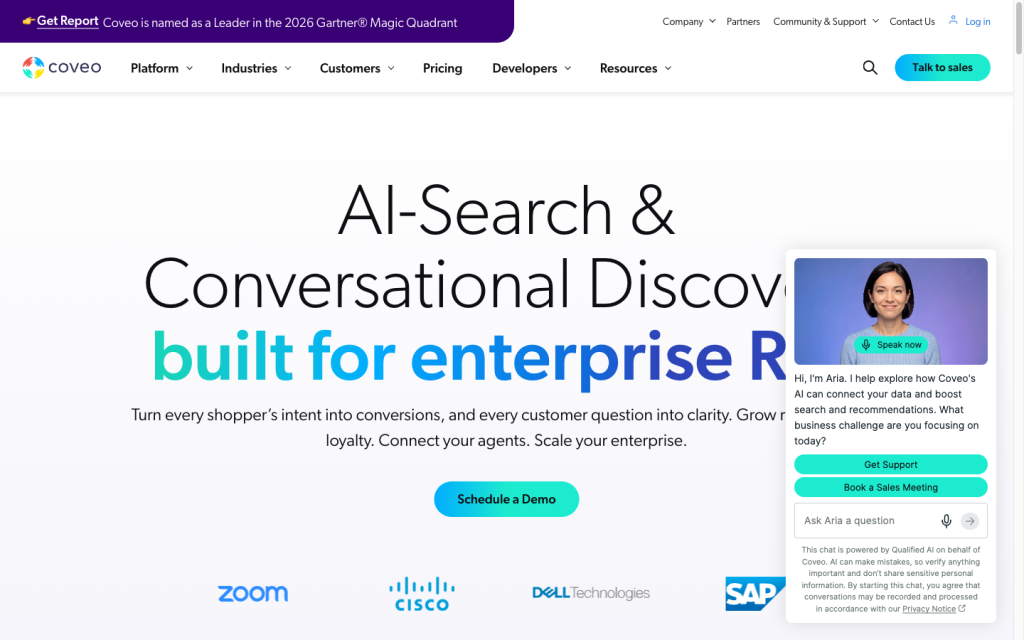
Coveo product image
coveo.com
On this page

Coveo is a configurable enterprise AI search and relevance platform for organizations that need secure retrieval across multiple repositories and interfaces. It combines unified indexing, relevance tuning, cited generative answers, and analytics with broad connector and API options. The tradeoff is enterprise complexity: pricing is quote-based, and connector-specific permissions, data freshness, and implementation requirements need careful evaluation.

What is Coveo?

Coveo is a cloud-based enterprise search and relevance platform. It indexes cloud and on-premises repositories into a unified index, then provides search, relevance controls, machine-learning capabilities, analytics, and generative answers. It can power embedded interfaces or custom applications through APIs and UI libraries, and its scope includes service, website, and commerce experiences.

Retrieval and answers

Coveo combines unified-index search, configurable query pipelines, AI ranking, and generative answering. Relevance Generative Answering uses relevant indexed content chunks and displays citations that can open indexed items. Search Agent adds multi-turn retrieval and answer-generation rounds. Query pipelines can apply rules, filters, thesaurus entries, featured results, ranking expressions, triggers, A/B tests, and machine-learning associations. Answers are not guaranteed: the Answer API can return no answer, and conversational search has stated query, turn, daily follow-up, and conversation lifetime limits.

Connectors and content access

Coveo supports native and generic ingestion for enterprise repositories, including SharePoint, Salesforce, ServiceNow, Slack, Confluence, Jira, Google Drive, SAP, Zendesk, Box, Amazon S3, databases, file systems, web sources, and APIs. Push, REST API, and GraphQL sources extend coverage where a native connector is unavailable. Refresh updates modified items, rescan detects changes including deletions, and rebuild fully reindexes a source. Connector behavior is not uniform: refresh schedules, deletion handling, authentication, licensing, and permission fidelity all require connector-level validation.

Governance and administration

Coveo maps a querying user's identity across indexed systems and removes confidential items from results, with deny-by-default behavior for identities not explicitly allowed. Its Administration Console covers sources, fields, indexing pipeline extensions, analytics, members, groups, API keys, and configuration through privilege-based access. Operational controls include source logs, pipeline testing, source notifications, analytics dashboards, GenAI measures such as citation click-through rate, and Search Agent inspection. Some connectors preserve original item permissions, while others support source-level permissions.

Buyer fit

Coveo is best suited to organizations that need configurable, permission-aware search across multiple private repositories, especially when search must be embedded in intranets, help centers, agent workspaces, Salesforce or ServiceNow environments, or custom products. Its strengths are relevance tuning, analytics, cited answers, and extensible integration options. It is a weaker fit for teams looking for a simple self-serve employee chatbot, fixed transparent pricing, uniform real-time synchronization, or identical permission handling across every connector.

Buyer scenarios

Where the product fits — and where to be careful

Governed search across enterprise repositories

Need
A configurable search layer spanning secured content systems and custom or embedded experiences.
Why it fits
Coveo indexes multiple private repositories, applies identity and permission controls at query time, and offers relevance controls, analytics, cited answers, and APIs or embedded interfaces.
Watch out
Connector-specific refresh, licensing, and permission behavior vary; generic integrations need source-specific implementation and validation.

Strong fit

Cited answers for service or workplace experiences

Need
Grounded answers and search experiences for employee, customer-service, or product interfaces.
Why it fits
Coveo supports answer generation over indexed content, cited results, multi-turn Search Agent retrieval, and relevance tuning.
Watch out
Answer generation can return no answer, and conversational search has query, turn, daily follow-up, and conversation-lifetime limits.

Good fit with implementation planning

Pros & Cons

Pros

  • Unified indexing across cloud and on-premises repositories with broad native and generic connector options.
  • Cited generative answers and multi-turn Search Agent retrieval are built around indexed enterprise content.
  • Strong administrative controls, query-pipeline tuning, analytics, and source monitoring.
  • Query-time identity mapping and deny-by-default handling support secured search experiences.

Cons

  • Pricing is primarily quote-based, and generative capabilities are add-ons.
  • Connector refresh, licensing, and permission fidelity vary by source; ServiceNow permission support is partial.
  • Implementation and learning can be non-trivial, while conversational search and answer generation have operational limits.
Editorial score breakdown

Editorial scores

Editorial score
3.8
Administration and measurement
4.0

Coveo provides query-time identity mapping, deny-by-default behavior, privilege-based administration, source monitoring, configurable analytics, and security and residency options. Permission behavior remains connector-dependent.

Search and answers
4.0

Coveo combines unified-index search, relevance controls, cited generative answers, and multi-turn Search Agent retrieval. Answer availability and conversational usage limits prevent a higher score.

Usability, support & value
3.0

User feedback is generally positive on support and enterprise value, but the aggregate is predominantly mixed and highlights setup, learning, and licensing tradeoffs.

Content and permissions
4.0

Coveo offers more than 30 native and universal connectors, generic ingestion APIs, and defined refresh, rescan, and rebuild operations. Connector-specific permission fidelity and freshness limitations require validation.

Customer sentiment

Coveo customer reviews and sentiment

Based on 37 public customer reviews. Source mix: 18 from infotech.com, 10 from trustradius.com, 5 from aws.amazon.com, 3 from softwareadvice.com, and 1 from gartner.com.

Customer sentiment is analyzed separately and does not determine the Reviews.vc editorial score.

37 public reviews analyzed
Positive
32%12 reviews
Mixed
65%24 reviews
Negative
3%1 reviews
Theme and findingMentionsPositiveNegative
Ease of use
Routine setup and configuration are often approachable, but advanced customization and complex testing can require specialist expertise.
221612
Administration and measurement
Analytics and dashboards are valuable for measuring search and tests, though deeper segmentation, cross-analysis, and self-service reporting can be difficult.
18185
Search and answers
AI-driven retrieval, personalization, and recommendations improve relevance and discovery, with some limits around response capacity and further AI/ML refinement.
16163
Support
Support teams are frequently described as responsive and knowledgeable, but documentation, use-case guidance, and best-practice materials are uneven.
15134
Integrations
Connectors and enterprise-system integrations are a strength, although implementation documentation and development or mobile integration can be challenging.
12102

Mentions count unique reviews. One review can count as both positive and negative for the same theme when it describes a mixed experience.

This analysis reflects public customer reviews we could identify and access at the time of collection; the displayed source mix may influence the patterns shown.

Review sentiment over time

PeriodnPositiveMixedNegative
2017 Q39090
2022 Q4Limited sample1010
2026 Q25050
2026 Q3Limited sample1100

Only periods containing dated reviews are shown; gaps between labels mean no dated reviews were available for those periods.

Pricing and contract model

Coveo pricing is quote-based and primarily scales with queries and indexed items. Service, Website, Workplace, and Commerce plan families are available; generative capabilities are described as paid add-ons.

Public pricing example

Salesforce Pro+ for Sales Cloud

From $990
Per month

Published Salesforce Sales Cloud entry price. This is product-specific and not a general Coveo deployment price.

  • Subscriptions are described as annual, three-year, or annual-evergreen agreements paid annually in advance.
  • Relevance Generative Answering, Generative Product Discovery, and Conversational Product Discovery are add-ons.

Integrations

Documented connections and access methods for Coveo.

CRM

Salesforce Native

Messaging & collaboration

Slack Native

Developer/API

Coveo APIs Public API

AI protocol

Coveo MCP Server Protocol

Document storage

Microsoft SharePoint Native

Other

ServiceNow Native
  • Connector availability varies by platform plan. Some connectors require add-ons or the Crawling Module, while generic sources require source-specific implementation and permission validation.

What's new

Recent product and company updates

  • 2026-03-23

    Coveo redefines ecommerce discovery with search-native conversational product discovery

    Coveo launched Conversational Product Discovery as an add-on for Coveo for Commerce.

    Source
  • 2026-07-30

    Coveo reports first quarter fiscal 2027 financial results

    Coveo reported Q1 fiscal 2027 results, including production Conversational Search deployments with five customers and the launch of Merchandising Copilot.

    Source

FAQ

Is Coveo pricing public?
Coveo uses a request-pricing or business-email process rather than a general self-serve plan table. Pricing primarily scales with queries and indexed items.
What content sources can Coveo index?
Coveo supports native and generic sources including Amazon S3, Box, Confluence, Dropbox Business, Google Drive, Jira, Salesforce, SAP, ServiceNow, SharePoint, Slack, web and Sitemap sources, YouTube, Zendesk, REST API, Push, and GraphQL API.
How does Coveo handle permissions?
At query time, Coveo maps the querying user's identity across indexed systems and removes confidential items from results. Permission behavior varies by connector; some connectors use source-level permissions rather than original item permissions.
How does Coveo refresh indexed content?
Refresh checks modified items, rescan recrawls content to detect changes including deletions, and rebuild clears and fully reindexes a source. Connector-specific limitations apply, and large rebuilds can take hours or days.
Review transparency Corrections policy
Change history
  1. 2026-09-18 Initial publication First published version of this review.
44 sources analyzed
  1. Coveo documentation: enterprise search docs.coveo.com
  2. Relevance Generative Answering docs.coveo.com
  3. Coveo integrations www.coveo.com
  4. Manage your sources docs.coveo.com
  5. Query-time permission enforcement docs.coveo.com
  6. About the Administration Console docs.coveo.com
  7. Coveo pricing www.coveo.com
  8. Refresh source content docs.coveo.com
  9. Coveo redefines ecommerce discovery with search-native conversational product discovery ir.coveo.com
  10. Coveo reports first quarter fiscal 2027 financial results ir.coveo.com

Showing 10 of 44 sources · 34 additional sources analyzed

Feedback on this article

Was this review helpful?

Private editorial feedback. It does not change product ratings or rankings.

Rate Coveo

Rate your experience
  • Administration and measurement
  • Search and answers
  • Usability, support & value
  • Content and permissions