
CodeRabbit logo

CodeRabbit

CodeRabbit provides AI-assisted pull-request review with repository context, configurable controls, and support for major Git platforms.

Editorial score

4.0 /5
How we scored it

Is CodeRabbit worth it?

Nick Oscar
Editor, Reviews.vc · Updated November 8, 2026
Good For

Comprehensive and incremental pull-request review flows cover a broad set of code-quality and security categories.

Caution

A skipped review can count as passing for a required CodeRabbit check.

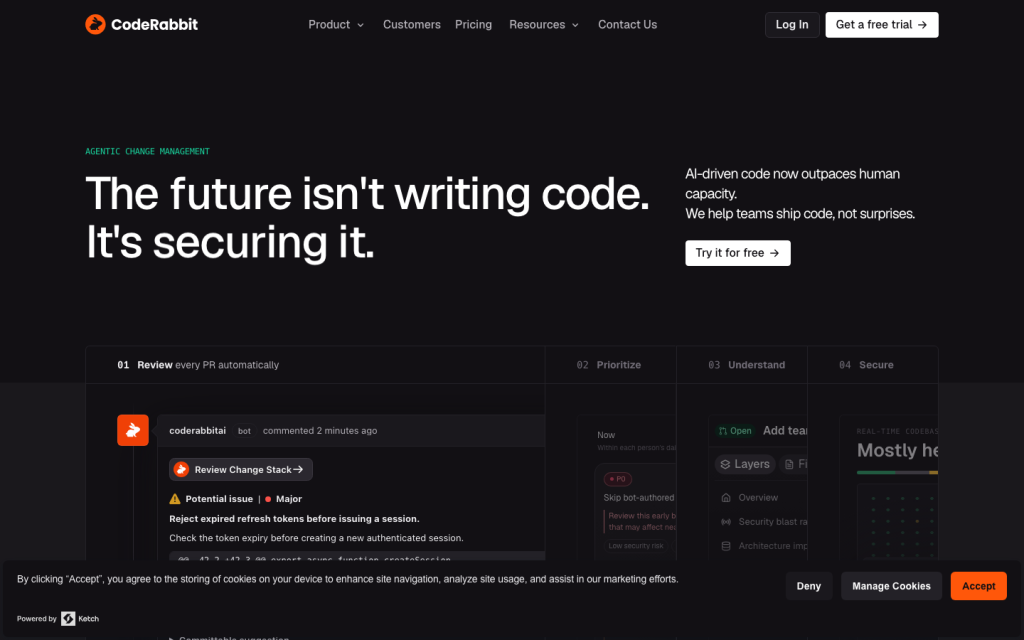
CodeRabbit product image
coderabbit.ai
On this page

CodeRabbit is an AI-assisted code review tool for teams that want an automated first pass on pull requests without losing human ownership of merge decisions. It’s strongest in supported Git workflows that benefit from repository-aware analysis, configurable review rules, and explicit pre-merge controls. Teams should validate skipped-check behavior, custom-check limits, and content-handling requirements before a broad rollout.

What is CodeRabbit?

CodeRabbit is an AI-assisted code review product for pull requests and existing code. It operates across supported Git workflows, IDEs, and a CLI, positioning automated review as a first pass before human decisions.

Review capabilities

New pull requests receive comprehensive reviews, while later commits receive incremental reviews. Output can include summaries, findings, improvement suggestions, and one-click fixes across security, reliability, correctness, performance, and maintainability concerns. Reviews can use repository context beyond the changed diff, but language proficiency varies by language, and Deep Scan coverage may be partial.

Context and review controls

Teams can add glob-scoped path instructions, include or exclude files with path filters, and create read-only pre-merge checks. Custom checks can use pull request metadata, linked issues, Git history, code search, sandbox commands, public web lookups, and connected MCP tools. They cannot run the project test suite, install dependencies, execute arbitrary repository code, or post line-specific comments.

Workflow and governance

CodeRabbit supports GitHub, GitLab, Bitbucket, and Azure DevOps, with additional IDE and CLI review surfaces. It offers status checks, pre-merge checks, automatic approvals, approval risk limits, and approval policy patterns. Teams should note that a skipped review can still pass a required CodeRabbit check and that a CodeRabbit approval does not merge the pull request.

Buyer fit

CodeRabbit fits pull-request-based engineering teams that want automated first-pass review, configurable standards, and supported Git-host integrations. It is less suitable for teams that require comprehensive bug-finding guarantees or cannot accept the applicable cloud-content handling model. Review IDE privacy details, plan limits, usage-based charges, and deployment requirements before rollout.

Buyer scenarios

Where the product fits — and where to be careful

Pull-request teams standardizing review

Need
Reduce first-pass review work while applying team-specific standards.
Why it fits
Comprehensive and incremental pull-request reviews, repository context, configurable path guidance, and pre-merge checks suit teams that want an automated first-pass layer in supported Git workflows.
Watch out
Custom checks are read-only and cannot run project test suites, install dependencies, execute arbitrary repository code, or modify the main review.

Strong fit for teams seeking configurable automated review alongside human review.

Teams with controlled merge workflows

Need
Add automated checks without replacing existing pull-request governance.
Why it fits
Supported Git platforms, status and approval controls, IDE and CLI surfaces, and Enterprise deployment options support broader engineering workflows.
Watch out
A skipped review counts as passing for a required CodeRabbit check, and CodeRabbit approval does not merge a pull request.

Fit when teams validate required-check behavior and keep human merge governance in place.

Pros & Cons

Pros

  • Comprehensive and incremental pull-request review flows cover a broad set of code-quality and security categories.
  • Repository context, path guidance, filters, and custom checks give teams meaningful review configuration.
  • Supports major Git-host environments plus IDE and CLI review surfaces.
  • Status checks, approval policies, and pre-merge checks support controlled pull-request workflows.

Cons

  • A skipped review can count as passing for a required CodeRabbit check.
  • Custom pre-merge checks cannot run project tests, install dependencies, or execute arbitrary repository code.
  • IDE use can send full file content and review metadata, with a warning that secrets may be uploaded.
Editorial score breakdown

Editorial scores

Editorial score
4.0
Context and review controls
4.0

Repository-aware review, path instructions, filters, linked context, and read-only custom checks provide strong control. Custom-check sandbox restrictions and plan-limited multi-repository context are important limits.

Code review capabilities
4.0

CodeRabbit offers comprehensive and incremental pull-request analysis, broad review categories, summaries, suggestions, and one-click fixes. Language proficiency varies, and scan status or coverage does not guarantee that no vulnerabilities remain.

Usability, support & value Not scored

User-review evidence was insufficient to score usability, support, or value.

Workflow and governance
4.0

Supported Git platforms, IDE and CLI surfaces, status checks, pre-merge checks, and approval controls create a strong workflow fit. A skipped review can pass a required check, and product approval does not merge a pull request.

Pricing and contract model

CodeRabbit lists Free and Open Source access, paid per-developer plans, a 14-day Advanced trial for new organizations, and contact-sales Enterprise pricing. Usage-based reviews and on-demand security products may be billed separately.

PlanPriceIncludes
Free
Free
No charge
Listed access tier.
Open Source
Free
No charge
Open-source projects receive Team features with no paid subscription required, subject to separate rate limits.
Essentials
$24 per developer per month billed annually, or $30 month-to-month
Monthly
Paid plan with usage-based reviews available as an add-on.
Team
$48 per developer per month billed annually, or $60 month-to-month
Monthly
Paid plan with usage-based reviews available as an add-on.
Advanced
$72 per developer per month billed annually, or $90 month-to-month
Monthly
Paid plan with usage-based reviews available as an add-on.
  • New organizations start with a 14-day Advanced trial.
  • CodeRabbit Security Scan and CodeRabbit Agent are billed separately as on-demand products.

Integrations

Documented connections and access methods for CodeRabbit.

Browser extension

VS Code-based IDEs Embedded

Other

Git hosting platforms Native
CodeRabbit CLI Native
  • Issue-tracker, Jenkins, Slack, and external connector options are also described, but this list focuses on the primary review surfaces and Git-host environments.

What's new

Recent product and company updates

  • 2026-11-05

    GitLab group webhook migration

    GitLab group webhook migration was released.

    Source

FAQ

How much does CodeRabbit cost?
Free and Open Source access are listed. Essentials costs $24 per developer per month when billed annually or $30 month-to-month; Team is $48 or $60, and Advanced is $72 or $90. Enterprise requires contacting sales.
What does CodeRabbit review?
It reviews pull requests and later commits for areas including security and privacy, stability, data integrity, functional correctness, performance, and maintainability. It can return summaries, findings, suggestions, and one-click fixes.
Which development environments does CodeRabbit support?
It supports GitHub, GitLab, Bitbucket, and Azure DevOps environments, plus IDE reviews in VS Code-based editors and local or CI/CD reviews through its CLI.
How can teams control CodeRabbit reviews?
Teams can use path instructions and filters, custom pre-merge checks, and controls for status checks, automatic approvals, approval-risk limits, and approval policies.
What code privacy consideration applies to IDE reviews?
IDE documentation states that full file content and review metadata may be sent, and warns that secrets may be uploaded.
Review transparency Corrections policy
Change history
  1. 2026-11-08 Initial publication First published version of this review.
29 sources analyzed
  1. Code Review Overview docs.coderabbit.ai
  2. Pull Request Review docs.coderabbit.ai
  3. Plans docs.coderabbit.ai
  4. Platforms Overview docs.coderabbit.ai
  5. IDE and CLI Review docs.coderabbit.ai
  6. Path Instructions docs.coderabbit.ai
  7. Custom Pre-Merge Checks docs.coderabbit.ai
  8. Pre-Merge Checks docs.coderabbit.ai
  9. IDE Privacy docs.coderabbit.ai
  10. Changelog docs.coderabbit.ai

Showing 10 of 29 sources · 19 additional sources analyzed

Feedback on this article

Was this review helpful?

Private editorial feedback. It does not change product ratings or rankings.

Rate CodeRabbit

Rate your experience
  • Context and review controls
  • Code review capabilities
  • Usability, support & value
  • Workflow and governance