Salesforce logo

Salesforce

Salesforce delivers a CRM-native prospecting and sales-engagement workflow, but it is not a quantified standalone contact database.

Editorial score

3.3 /5
How we scored it

Is Salesforce worth it?

Nick Oscar
Editor, Reviews.vc · Updated August 9, 2026
Good For

CRM-native workflow spans lead routing, account prioritization, outreach, opportunity management, and forecasting.

Caution

Salesforce does not publish quantified global contact, verified-email, direct-dial, or record-freshness coverage.

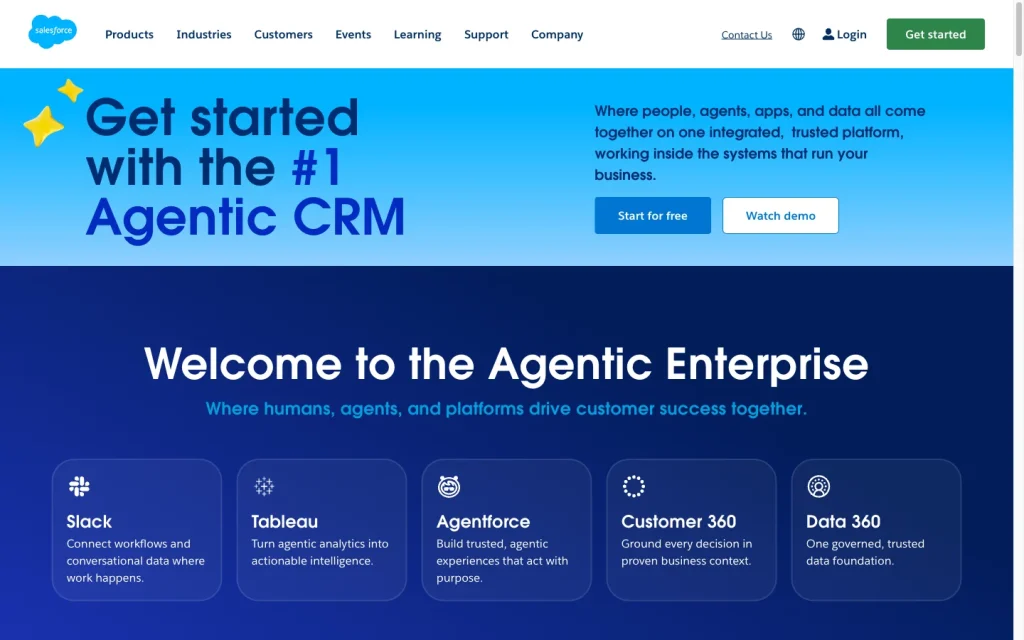
Salesforce product image
salesforce.com
On this page

Salesforce is a broad CRM and sales-automation platform whose Agentforce Sales, Data 360, Agentforce Prospecting, and Sales Engagement products support account prioritization, lead management, multistep outreach, pipeline management, and forecasting. Its advantage is a CRM-native workflow that can combine operational, engagement, and connected external data; it is not positioned as a prebuilt, quantified global contact-data provider.


What is Salesforce?

Salesforce is a cloud-based CRM and sales automation platform. Agentforce Sales centralizes customer, company, and deal data for prospecting, engagement, pipeline and opportunity management, quoting, forecasting, analytics, enablement, and sales performance management. Key prospecting components include Agentforce Prospecting, Sales Engagement, and Data 360.

Agentforce Prospecting prioritizes contacts and accounts using Salesforce activity and third-party research insights. Sales Engagement provides cadences, work queues, email and call productivity tools, meeting booking, and conversation intelligence. Prospecting Center is being retired, with existing customer access available until April 2027.

Data coverage

Salesforce’s coverage is centered on CRM records: accounts, contacts, leads, opportunities, activities, pipeline, and forecasting. Account prioritization can use firmographic and technographic data, funding and hiring patterns, web intent, conversations, emails, external sources, and company materials.

Data 360 can ingest, connect, federate, harmonize, and enrich CRM and external data. Identity Resolution creates unified profiles, and enriched fields or related external records can be returned to CRM objects. Salesforce does not publish a quantified native global contact database, verified-email or direct-dial coverage, or universal freshness and accuracy metrics.

Prospecting workflow

A Salesforce prospecting workflow can start with Data 360 connecting or federating operational and external data, then harmonizing records into unified profiles and segments. Agentforce Prospecting can then prioritize accounts and contacts based on activity history, Salesforce data, and third-party research context.

Teams can route and manage leads in Agentforce Sales, then enroll leads, contacts, and person accounts in Sales Engagement cadences. Reps work from queues and the sales console with email productivity tools, meeting booking, call insights, transcripts, follow-up notifications, activity dashboards, and lead or opportunity scoring.

Who is Salesforce best for?

Salesforce is best suited to existing Salesforce customers and mid-market or enterprise revenue teams that want CRM-native prospect prioritization, lead and account workflows, multistep outreach, and connected sales, marketing, operations, and data processes.

It is a weaker fit for buyers seeking a lightweight, low-administration outbound tool or a ready-to-use prospect database with published global record counts, verification rates, direct-dial coverage, and freshness metrics. Data 360, identity resolution, scoring, permissioning, and cadences require configuration, while Einstein Sales Scoring requires historical data.

Buyer scenarios

Where the product fits — and where to be careful

Existing Salesforce revenue organization

Need
Prioritize accounts, route leads, run repeatable outreach, and keep seller work in the CRM.
Why it fits
Strong fit because Agentforce Sales, Agentforce Prospecting, Sales Engagement, and Data 360 operate within the Salesforce environment.
Watch out
Configuration, permissions, data preparation, and historical data requirements can add operational work.

Good fit for established Salesforce teams that need an integrated sales workflow.

Buyer seeking a standalone outbound database

Need
Build lists from a transparently quantified global B2B contact database with published verification and direct-dial coverage.
Why it fits
Limited fit because the available evidence centers on CRM and connected data rather than a vendor-owned, quantified contact corpus.
Watch out
External data providers may be required, adding cost and integration work.

Consider alternatives if a ready-to-use contact database is the primary requirement.

Pros & Cons

Pros

  • CRM-native workflow spans lead routing, account prioritization, outreach, opportunity management, and forecasting.
  • Data 360 can unify CRM and external data through connectors, federation, identity resolution, and enrichment.
  • Sales Engagement adds cadences, work queues, meeting booking, email and call productivity, and conversation intelligence.
  • Broad API and connectivity options support data movement and integrations across enterprise systems.

Cons

  • Salesforce does not publish quantified global contact, verified-email, direct-dial, or record-freshness coverage.
  • A full deployment can require configuration, historical CRM data, administrative resources, and add-on spending.
  • User-review evidence is strongly negative on support, value for money, and ease of use.
  • Prospecting Center is being retired, so buyers should plan around the current Agentforce and Data 360 capabilities.
Editorial score breakdown

Editorial scores

Editorial score
3.3
Coverage
3.0

Salesforce covers core CRM objects and many account-prioritization signals, while Data 360 connects and unifies external data. The evidence does not establish quantified proprietary global B2B contact coverage, verified contact channels, or freshness metrics.

Data quality
3.0

Identity Resolution, enrichment provenance, and data-copy controls support record management, but published universal accuracy or freshness guarantees are not established. The available user-review evidence on data quality is negative but limited to two mentions.

Workflow & integrations
5.0

The platform supports an end-to-end flow from connected data and prioritized accounts through lead routing, cadences, rep work queues, activity capture, scoring, and CRM reporting. It also offers broad API, data-movement, and enterprise connectivity options.

Support & value
2.0

Publishable user-review evidence is predominantly negative: support received 16 negative mentions, and value for money received 17 negative mentions out of 19. Those themes indicate recurring support and value concerns.

Customer sentiment

Salesforce customer reviews and sentiment

Based on 40 public customer reviews. Source mix: 30 from trustpilot.com, 8 from softwareadvice.com, and 2 from getapp.com.

Customer sentiment is analyzed separately and does not determine the Reviews.vc editorial score.

40 public reviews analyzed
Positive
10%4 reviews
Mixed
15%6 reviews
Negative
75%30 reviews
Theme and findingMentionsPositiveNegative
Ease of use
Reviewers frequently describe the platform as complex, non-intuitive, and slow to navigate, with setup and routine tasks requiring substantial training or configuration.
22121
Value for money
Many reviewers feel the product becomes costly through upgrades, additional licenses, implementation work, or restrictive contracts, especially for smaller businesses.
19217
Support
Reviewers commonly report difficulty reaching knowledgeable human support, delayed or absent responses, and unresolved account, login, billing, or cancellation issues.
16116
Prospecting workflow
When properly configured, reviewers find the platform useful for centralizing lead and customer information, managing pipelines and follow-ups, and improving sales-team organization; however, some report workflow friction and performance issues.
1073
Data quality
Reviewers report serious concerns about losing access to, or having deleted, historical business and client data during account or migration issues.
202

Mentions count unique reviews. One review can count as both positive and negative for the same theme when it describes a mixed experience.

This analysis reflects public customer reviews we could identify and access at the time of collection; the displayed source mix may influence the patterns shown.

Review sentiment over time

PeriodnPositiveMixedNegative
2025 Q45005
2026 Q18107
2026 Q27007
2026 Q310019

Only periods containing dated reviews are shown; gaps between labels mean no dated reviews were available for those periods.

Pricing and contract model

Salesforce publishes starting prices for its sales editions and Sales Engagement. Total deployment cost can also include Data 360, Agentforce usage, implementation, support, and external data providers.

PlanPriceIncludes
Free Suite
$0 per user per month
monthly
Listed entry-level sales suite.
Starter Suite
$25 per user per month
monthly
Listed sales suite edition.
Pro Suite
$100 per user per month
monthly
Listed sales suite edition.
Enterprise
$175 per user per month
monthly
Listed sales edition.
Unlimited
$350 per user per month
monthly
Listed sales edition; includes Sales Engagement.
Agentforce 1 Sales
$550 per user per month
monthly
Listed sales edition; includes Sales Engagement.
Sales Engagement
Starts at $50 per user per month
billed annually
Available separately for eligible editions and included with Unlimited and Agentforce 1 Sales.
  • Agentforce Flex Credits are listed at $500 per 100,000 credits, and conversations at $2 per conversation.
  • An Agentforce User License is listed at $5 per user per month and requires Flex Credits.

Integrations

Documented connections and access methods for Salesforce.

Automation

MuleSoft Native

Messaging & collaboration

Slack Native

Developer/API

Salesforce APIs Public API

Productivity suite

Outlook and Gmail Native

Data warehouse/BI

Snowflake Native
Databricks Native

Marketplace

AgentExchange Native

Data import/export

Google Cloud and Amazon S3 Native
  • Connector availability can vary by Salesforce product and edition.

What's new

Recent product and company updates

  • 2026-05-11

    Salesforce announces Summer 2026 product release

    Salesforce announced its Summer 2026 product release, with availability stated for June 15, 2026.

    Source

FAQ

How much does Salesforce sales software cost?
Listed sales-edition prices range from Free Suite at $0 per user per month to Agentforce 1 Sales at $550 per user per month. Sales Engagement starts at $50 per user per month billed annually.
Does Salesforce provide a global B2B contact database?
The available evidence does not establish a quantified native global B2B contact database, verified-email or direct-dial coverage, or published freshness statistics. Salesforce instead centers on CRM records and connected external data.
What integrations and APIs does Salesforce support?
Salesforce supports connectivity involving Slack, MuleSoft, Snowflake, Databricks, Google Cloud, Amazon S3, Tableau, and more. Its APIs include REST, SOAP, Bulk API 2.0, Composite Graph, Pub/Sub, Change Data Capture, and Connect API.
Who is Salesforce best suited for?
It is best suited to existing Salesforce customers and mid-market or enterprise teams that need CRM-native prioritization, lead and account workflows, multistep outreach, and integrated data across revenue functions.
Change notes Corrections policy
  1. 2026-08-09 Initial publication First published version of this review.
Sources analyzed (26)
  1. Agentforce Sales guide salesforce.com accessed 2026-08-09
  2. Sales Cloud agents help.salesforce.com accessed 2026-08-09
  3. Sales Engagement pricing salesforce.com accessed 2026-08-09
  4. Data 360 glossary guide help.salesforce.com accessed 2026-08-09
  5. Prospecting Center help.salesforce.com accessed 2026-08-09
  6. Sales pricing salesforce.com accessed 2026-08-09
  7. Agentforce pricing salesforce.com accessed 2026-08-09
  8. Data 360 connectors and integrations help.salesforce.com accessed 2026-08-09
  9. Integration patterns architect.salesforce.com accessed 2026-08-09
  10. Salesforce announces Summer 2026 product release salesforce.com accessed 2026-08-09

Showing 10 of 26 sources · 16 additional sources analyzed

Feedback on this article

Did this Review help you evaluate Salesforce?

Private editorial feedback. It does not change product ratings or rankings.

Rate Salesforce

Rate your experience
  • Coverage
  • Data quality
  • Workflow & integrations
  • Support & value