
Synthflow logo

Synthflow

Synthflow is an enterprise AI voice-agent platform for connected inbound and outbound call workflows.

Editorial score

3.8 /5
How we scored it

Is Synthflow worth it?

Nick Oscar
Editor, Reviews.vc · Updated September 18, 2026
Good For

Supports both open-ended prompt-based agents and controlled visual flows.

Caution

Enterprise contracts start at $30,000 annually, limiting fit for small self-serve buyers.

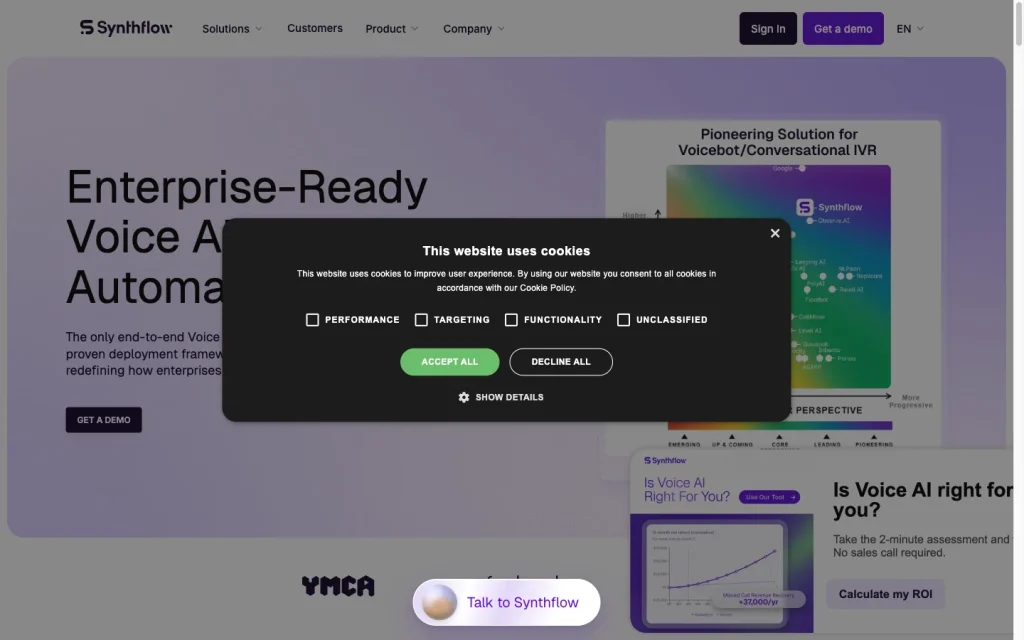
Synthflow product image
synthflow.ai
On this page

Synthflow is an enterprise AI voice-agent platform for inbound and outbound phone automation. Its strongest use case is connected operational workflows: teams can combine prompt-based or visual flow agents with retrieval, HTTP actions, CRM and calendar integrations, messaging, call transfers, and analytics.

The platform has substantial testing and operational controls, though simulation behavior and hourly analytics introduce practical limits. With enterprise contracts starting at $30,000 annually, it is best suited to organizations with enough call volume, integration needs, or workflow complexity to justify a managed deployment.

What is Synthflow?

Synthflow is a managed, cloud-hosted AI voice-agent platform for enterprise phone automation. Teams can configure agents for inbound and outbound calls, embeddable voice experiences, and use cases such as appointment scheduling, lead qualification, reminders, routing, data collection, and support triage. Chat agents can also be delivered via API, widget, SMS, or WhatsApp.

It is a workflow platform rather than a standalone text-to-speech API: agent building, retrieval, actions, handoff, simulations, analytics, and exports are part of the product. Enterprise contracts start at $30,000 per year.

Conversation design and control

Synthflow offers two conversation-building approaches. Prompt Builder suits simpler, open-ended Q&A and rapid prototypes, while the visual Flow Designer gives teams node-based control over collection, branching, jumps, booking, transfers, actions, and call completion.

Conversation variables can feed prompts, branches, external actions, transfers, SIP headers, SMS, and webhooks. Knowledge bases can use imported Zendesk Help Center articles for retrieval-backed responses, and the platform supports speech recognition, text-to-speech, and interactions in 50+ languages. For complex work, its guidance favors splitting behavior between multiple agents or using Flow Designer instead of loading a single agent with more than 20 tool calls.

Telephony, workflow actions, and handoff

Reusable and custom actions let agents transfer live calls, make HTTP requests, exchange messages during calls, book time, and extract fields. Custom HTTP actions support GET, POST, PUT, PATCH, and DELETE with configurable authentication, headers, payloads, variables, and result handling.

Telephony coverage includes inbound calls, outbound batch calling, SIP/PBX connectivity, and warm or cold human handoffs. Batch calls can be scheduled with concurrency controls and weekly calling windows, for up to 1,000,000 recipients per batch. Transfers can target phone numbers, SIP URIs, dynamic destinations, or conditional phone books; in-call SMS and WhatsApp can also pass information into later workflow logic.

Testing, analytics, and controls

Test Center supports repeatable scenario simulations with success criteria, pass/fail explanations, transcripts, recordings, and run history. This is useful for regression-style checks, but transfers and real-time bookings are represented in transcripts rather than executed during simulations.

Runtime tooling includes analytics for volume, duration, status, end reasons, performance, actions, and sentiment; call, chat, API, and webhook logs; live monitoring; CSV exports; and post-call webhooks. Analytics refresh hourly. Enterprise teams can export daily call data to Amazon S3, Google BigQuery, or SFTP. Recording and transcript retention can be disabled or set to 30 days, and listed PII can be redacted, though redaction is not retroactive, does not affect live audio, and may not be fully accurate.

Who should consider Synthflow?

Synthflow is ideal for organizations with recurring customer phone workflows and a need to connect voice automation to CRM, calendars, telephony, contact centers, or SIP/PBX systems. It’s a great fit for contact centers, BPOs, healthcare operations, agencies, white-label partners, CRM or SaaS vendors, and enterprise operations teams.

It’s less suited to buyers looking for a basic text-to-speech API, a low-cost static auto-attendant, or a small self-serve package. The sales-led enterprise model, starting at $30,000 annually, makes deployment scope and integration requirements central to the buying decision.

Buyer scenarios

Where the product fits — and where to be careful

Contact centers and operations teams automating recurring calls

Need
Automate qualification, scheduling, service triage, reminders, routing, and data collection while retaining human escalation.
Why it fits
Its inbound and outbound agents, visual workflow logic, CRM and calendar connections, call transfers, and analytics align with repeated customer interactions at operational scale.
Watch out
Enterprise contracts start at $30,000 annually, while SIP/PBX access and some integrations can depend on the account agreement.

Strong fit

CRM, SaaS, agency, and BPO teams building connected voice workflows

Need
Connect voice automation to existing CRM, calendar, telephony, or SIP/PBX systems.
Why it fits
Flow Designer, custom HTTP actions, webhooks, API access, messaging, and white-label-oriented operational use cases support embedded or connected voice workflows.
Watch out
Complex agent behavior should be divided across agents or modeled in Flow Designer; prompting guidance recommends fewer than 20 tool calls per agent.

Good fit where enterprise deployment is justified

Pros & Cons

Pros

  • Supports both open-ended prompt-based agents and controlled visual flows.
  • Provides strong telephony coverage, custom HTTP actions, batch calling, and warm or cold transfers.
  • Includes simulations, logs, analytics, webhooks, monitoring, exports, and retention controls.
  • Connects to CRM, calendar, automation, telephony, and contact-center systems.
  • Supports multilingual interactions in 50+ languages.

Cons

  • Enterprise contracts start at $30,000 annually, limiting fit for small self-serve buyers.
  • Test simulations do not execute real transfers or real-time bookings.
  • Analytics refresh hourly rather than continuously.
  • PII redaction is not retroactive, does not affect live audio, and may not be fully accurate.
Editorial score breakdown

Editorial scores

Editorial score
3.8
Testing and observability
4.0

Synthflow provides substantial operational tooling: repeatable simulations, transcripts and recordings, centralized logs, live monitoring, analytics, webhooks, exports, retention settings, and PII redaction controls. Limits include simulated transfers and bookings in tests, hourly analytics refreshes, and bounded redaction behavior.

Telephony and actions
4.0

The platform supports inbound and outbound calling, high-volume batch calls, reusable and custom HTTP actions, messaging, booking, SIP/PBX connectivity, and configurable warm or cold handoffs with contextual summaries.

Conversation capabilities
4.0

Prompt Builder and Flow Designer cover flexible and deterministic conversational patterns, with variables, retrieval-backed knowledge bases, real-time speech capabilities, multilingual interactions, and transfer logic. Complex work requires careful flow design or splitting behavior across agents.

Usability, support & value
3.0

Accepted user feedback is limited but mixed-to-positive: ease of use received a positive mention, while value-for-money feedback includes both positive and negative sentiment. The enterprise starting price can be a material fit consideration.

Customer sentiment

Synthflow customer reviews and sentiment

Based on 6 public customer reviews. Source mix: 5 from tooliverse.ai, and 1 from gartner.com.

Customer sentiment is analyzed separately and does not determine the Reviews.vc editorial score.

6 public reviews analyzed
Positive
67%4 reviews
Mixed
33%2 reviews
Negative
0%0 reviews
Theme and findingMentionsPositiveNegative
Conversation capabilities
Voice conversations are praised for human-like quality and low latency, but pause handling and Eastern European language accents can need improvement.
432
Value for money
Operational cost savings are a benefit, though pricing tiers may be expensive for small startups.
211
Telephony and actions
The platform can automate inbound sales inquiries and provide real-time customer assistance.
110
Ease of use
The no-code builder enables teams to create a working bot quickly without coding.
110
Integrations
GHL integration supports automated appointment booking.
110

Mentions count unique reviews. One review can count as both positive and negative for the same theme when it describes a mixed experience.

This analysis reflects public customer reviews we could identify and access at the time of collection; the displayed source mix may influence the patterns shown.

Pricing and contract model

Synthflow lists Enterprise contracts starting at $30,000 annually. Final pricing is scoped to call volume, concurrency, telephony setup, integrations, security needs, and launch support.

PlanPriceIncludes
Enterprise
Starting at $30,000
annually
Enterprise contract with deployment-specific scope.
  • Exact rates, allowances, thresholds, and invoice terms depend on the agreement.
  • Legacy per-minute figures are not included because the current pricing page presents Enterprise pricing.

Integrations

Documented connections and access methods for Synthflow.

CRM

CRM and support platforms Native

Automation

Zapier and Make Native

Developer/API

Platform API and webhooks Public API

AI protocol

Model Context Protocol Protocol

Productivity suite

Calendars Native

Other

Telephony and contact centers Native
  • The catalog lists 200+ app connections; availability can depend on account type or agreement.
  • SIP/PBX integration is an Enterprise feature.

What's new

Recent product and company updates

  • 2026-09-04

    September 2026 product release

    Released API-managed outbound campaigns, Advanced Synthflow LLM, Business Hours, cross-subaccount analytics, an 8x8 Contact Center integration, and Five9/RingCX number import.

    Source
  • 2026-06-23

    AVANT Communications partnership

    Announced an exclusive strategic partnership with AVANT Communications.

    Source

FAQ

What does Synthflow cost?
Enterprise contracts start at $30,000 annually. Final pricing is scoped around call volume, concurrency, telephony, integrations, security needs, and launch support.
Can Synthflow handle inbound and outbound calls?
Yes. It supports inbound and outbound voice agents, including scheduled outbound batch calling with concurrency controls and weekly calling windows.
How does Synthflow transfer calls to people?
Human transfers can use E.164 numbers, SIP URIs, dynamic destinations, and conditional phone books. Warm and cold transfer behavior and contextual summaries are supported.
How can teams test Synthflow agents?
Test Center supports repeatable scenario simulations, success criteria, pass/fail explanations, transcripts, recordings, and run history. Transfers and real-time bookings are simulated rather than executed in this environment.
Review transparency Corrections policy
Change history
  1. 2026-09-18 Initial publication First published version of this review.
33 sources analyzed
  1. Synthflow Pricing synthflow.ai
  2. AI Transparency docs.synthflow.ai
  3. Create an Agent docs.synthflow.ai
  4. Actions Overview docs.synthflow.ai
  5. Call Transfers docs.synthflow.ai
  6. Simulations docs.synthflow.ai
  7. Collect Analytics docs.synthflow.ai
  8. Synthflow Integrations synthflow.ai
  9. Changelog feedback.synthflow.ai
  10. Synthflow AI and AVANT Partner synthflow.ai

Showing 10 of 33 sources · 23 additional sources analyzed

Feedback on this article

Was this review helpful?

Private editorial feedback. It does not change product ratings or rankings.

Rate Synthflow

Rate your experience
  • Testing and observability
  • Telephony and actions
  • Conversation capabilities
  • Usability, support & value