
Qodo logo

Qodo

Qodo provides context-aware AI code review and governance for pull-request workflows.

Editorial score

4.0 /5
How we scored it

Is Qodo worth it?

Nick Oscar
Editor, Reviews.vc · Updated November 8, 2026
Good For

Uses repository, historical, requirement, and organizational context for pull-request review.

Caution

Cross-repository analysis and pull-request-history indexing have beta or provider-specific limits.

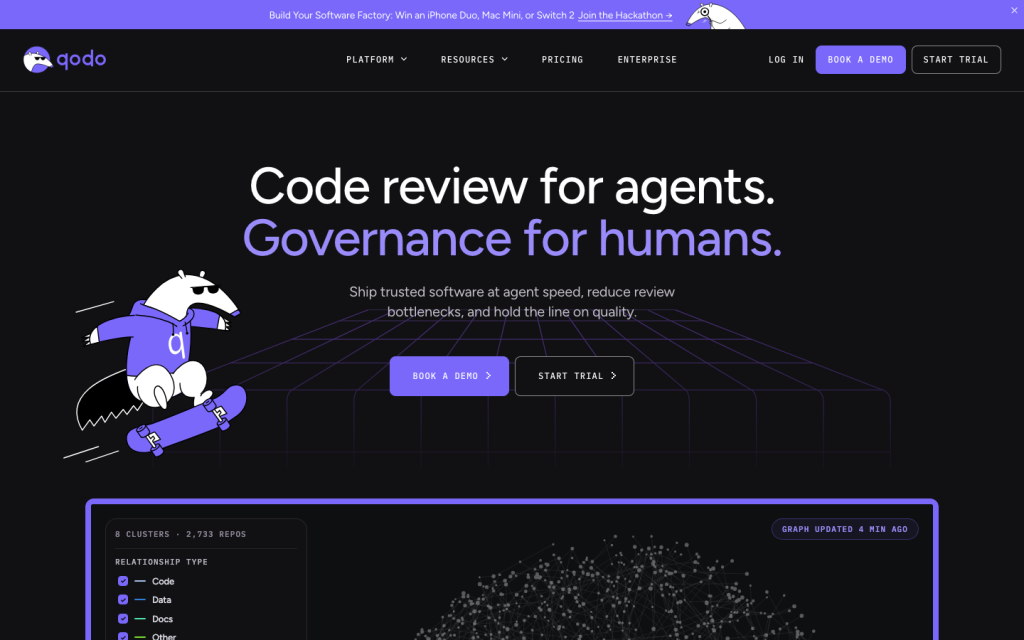
Qodo product image
qodo.ai
On this page

Qodo is an AI code review and governance platform for pull request workflows. It combines repository and historical context with linked requirements, standards, configurable feedback, and Git provider integrations. It’s a strong fit for teams that need centralized review controls and human-approved remediation; beta features and provider-specific differences should be validated in the target environment.

What is Qodo?

Qodo is an AI code-quality and governance platform centered on pull-request review in Git workflows. Its review system uses repository structure, history, dependencies, linked tickets and requirements, and organizational standards rather than assessing a diff alone. For local or pre–pull-request review, Qodo now directs users to its Agentic Toolbox after retiring its native IDE plugins.

Code review capabilities

Qodo’s specialized review agents can identify logic errors, edge cases, anti-patterns, organization rule violations, requirement gaps, UX deviations, cross-repository conflicts, and skill-related issues. Findings explain the issue, why it matters, and how to fix it, and include a severity ranking. Qodo can generate commit-ready suggestions for eligible inline, single-file findings of five lines or fewer; a user must review and explicitly apply each change. Cross-repository conflicts are in beta, and Qodo does not publish a precise, up-to-date language-by-language depth matrix.

Context and review controls

Qodo combines code intelligence, historical review data, organizational standards, and repository knowledge in its Context Engine. Teams can set standards across repository, project, group, organization, workspace, and monorepo subproject scopes. Controls include feedback location, severity thresholds and routing, suppression of lower-severity issues, verbosity, and exclusions for selected files, branches, and pull requests. Pull request history indexing is in beta and currently available for GitHub and GitLab, though provider capabilities differ.

Workflow and governance

Reviews can run automatically when a pull request is opened, reopened, or marked ready for review, on every push when enabled, or manually with /agentic_review. Findings can be discussed, dismissed, marked as resolved, or marked as no longer relevant. Qodo supports major Git providers and Gerrit, with provider-specific workflow differences. Enterprise administration adds roles, SSO, audit logs, analytics, BYOK, private deployment options, an SLA, and dedicated customer success. Merge blocking can be configured through CI/CD actions using Qodo-added labels, rather than applying automatically by default.

Who should consider Qodo?

Qodo fits engineering teams that review pull requests in Git-hosted workflows and want context-aware feedback plus centrally managed standards. It’s particularly relevant for organizations with multi-repository systems – although cross-repository analysis is in beta – or those with role-based administration and private deployment requirements. Buyers should treat it as an additional review layer with clear human approval boundaries, not as a broad code-completion product or a deterministic linting and SAST replacement.

Buyer scenarios

Where the product fits — and where to be careful

Teams standardizing contextual pull-request review

Need
Contextual review and shared engineering standards across Git-hosted pull requests
Why it fits
Its pull-request review uses repository, historical, requirement, and organizational context, while centralized standards and configurable feedback support team-wide controls.
Watch out
Cross-repository conflict analysis is beta, provider feature parity varies, and Qodo is not a replacement for deterministic linting or SAST.

Strong fit

Organizations with governance and deployment requirements

Need
Administrative controls, private deployment choices, and human-reviewed remediation
Why it fits
Enterprise options include roles, SSO, audit logs, BYOK, single-tenant SaaS, on-premises deployment, and air-gapped deployment.
Watch out
Many governance and deployment capabilities are Enterprise-oriented; merge blocking requires customer-configured CI/CD actions rather than being a universal default.

Strong fit for Enterprise buyers

Pros & Cons

Pros

  • Uses repository, historical, requirement, and organizational context for pull-request review.
  • Offers configurable standards, severity routing, noise reduction, and scoped exclusions.
  • Supports automated and manual review triggers across major Git providers and Gerrit.
  • Enterprise options include roles, SSO, audit logs, BYOK, and private deployment choices.

Cons

  • Cross-repository analysis and pull-request-history indexing have beta or provider-specific limits.
  • Merge blocking requires customer-configured CI/CD actions rather than applying automatically by default.
  • Native VS Code, Visual Studio Professional, and JetBrains plugins are retired.
  • A precise current language-by-language review-depth matrix is not published.
Editorial score breakdown

Editorial scores

Editorial score
4.0
Context and review controls
4.0

Qodo offers strong contextual review and output controls across multiple configuration scopes. Pull-request-history indexing is beta and provider availability varies.

Code review capabilities
4.0

Qodo provides strong pull-request analysis spanning bugs, standards, requirements, UX deviations, and bounded suggested fixes. Cross-repository conflicts are beta, and language-depth coverage is not precisely specified.

Usability, support & value Not scored

User-review evidence was insufficient to score usability, support, or value.

Workflow and governance
4.0

Qodo supports strong review triggers, finding lifecycle controls, multi-provider workflows, and Enterprise governance options. Provider differences apply, and merge blocking requires configured CI/CD actions.

Pricing and contract model

Qodo offers a 14-day free trial, Pro Team pricing from $30 per month with pooled usage credits, and custom-priced Enterprise plans for 30+ users.

PlanPriceIncludes
Free trial
Free for 14 days
14 days
Unlimited reviews and credits; no credit card required.
Pro Team
From $30
per month
Usage-based workspace plan with pooled credits at $0.015 per credit; base credits renew monthly and overage uses the same rate up to a configurable spending cap.
  • Billing is usage-based rather than seat-based.
  • Available credit packs are 2,000, 4,000, and 16,000 credits.

Integrations

Documented connections and access methods for Qodo.

AI protocol

Agentic Toolbox Protocol

Other

GitHub Native
GitLab Native
Bitbucket Native
Azure DevOps Native
Jira Native
Confluence, Notion, and Figma Native
  • Native Qodo IDE plugins for VS Code, Visual Studio Professional, and JetBrains were retired on October 30, 2026 and are not listed as active integrations.

What's new

Recent product and company updates

  • 2026-11-02

    Qodo 3.2 release

    Qodo 3.2 added repository access filtering, related-pull-request context, configurable rule-import sources, and fix-loop optimization.

    Source

FAQ

How is Qodo priced?
Every workspace starts with a 14-day free trial with unlimited reviews and credits and no credit card. Pro Team starts at $30 per month with pooled workspace credits at $0.015 per credit; Enterprise pricing is custom for organizations with 30+ users.
What can Qodo review in a pull request?
Qodo can surface logic errors, edge cases, anti-patterns, organizational-rule violations, requirement gaps, UX deviations, cross-repository conflicts, and skill-related issues. Cross-repository conflict analysis is beta.
Which Git environments does Qodo support?
Qodo lists GitHub Cloud, GitHub Enterprise, GitLab Cloud, GitLab Self-Managed, Bitbucket Cloud, Bitbucket Data Center, Azure DevOps Cloud, and Gerrit. Feature availability varies by provider.
How can teams control Qodo review feedback?
Teams can apply hierarchical standards, set severity thresholds and routing, select summary or inline feedback, suppress lower-severity findings, and exclude selected files, branches, or pull requests.
What deployment and access options are available?
Enterprise administration includes roles, SSO, audit logs, BYOK, single-tenant SaaS, on-premises deployment, and air-gapped deployment options.
Review transparency Corrections policy
Change history
  1. 2026-11-08 Initial publication First published version of this review.
27 sources analyzed
  1. Qodo platform overview docs.qodo.ai
  2. Code review overview docs.qodo.ai
  3. Context Engine docs.qodo.ai
  4. Review standards docs.qodo.ai
  5. Use Qodo in pull requests docs.qodo.ai
  6. Qodo pricing www.qodo.ai
  7. Integrations docs.qodo.ai
  8. Agentic Toolbox overview docs.qodo.ai
  9. Qodo IDE plugin deprecation docs.qodo.ai
  10. Qodo changelog docs.qodo.ai

Showing 10 of 27 sources · 17 additional sources analyzed

Feedback on this article

Was this review helpful?

Private editorial feedback. It does not change product ratings or rankings.

Rate Qodo

Rate your experience
  • Context and review controls
  • Code review capabilities
  • Usability, support & value
  • Workflow and governance