
Greptile logo

Greptile

Greptile is an AI code-review agent that analyzes pull requests using repository context and configurable review workflows.

Editorial score

4.0 /5
How we scored it

Is Greptile worth it?

Nick Oscar
Editor, Reviews.vc · Updated November 8, 2026
Good For

Uses a repository graph to reason across functions, dependencies and related code rather than only changed lines.

Caution

Credit use rises with Plus, Apex and TREX, requiring teams to forecast usage-based spend.

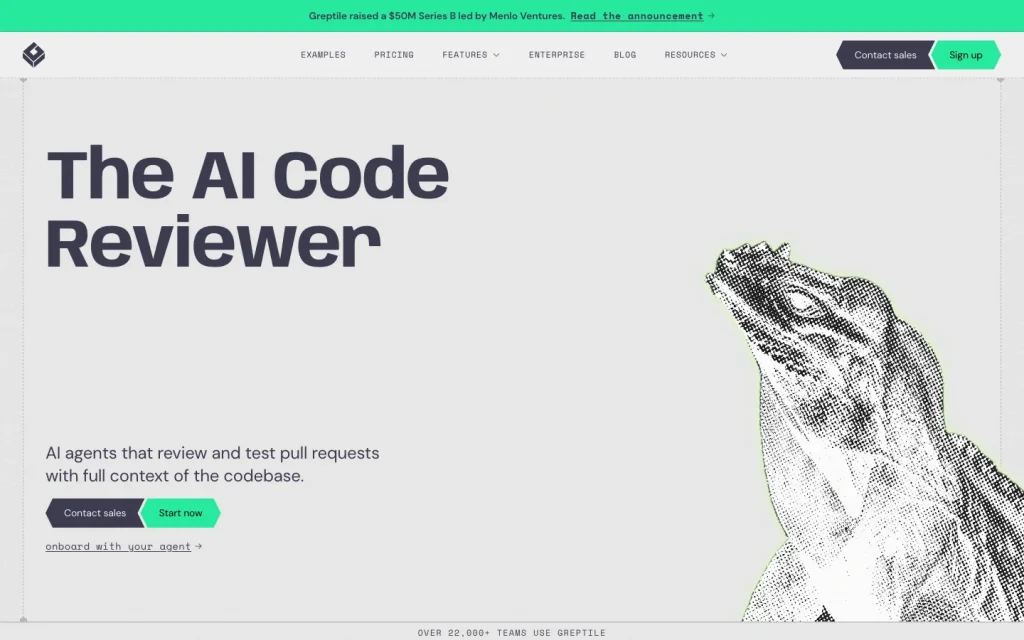
Greptile product image
greptile.com
On this page

Greptile is an AI code-review agent for pull requests that uses repository context to surface findings and suggested fixes. It’s a strong fit for teams that want configurable review depth, source-control workflow integration, and flexible deployment options, but buyers should plan for credit-based consumption and carefully evaluate cloud data settings.

What is Greptile?

Greptile is an AI code-review agent for pull requests. It connects to a source-control repository, builds a graph of functions, classes and dependencies, then posts pull-request findings and suggested fixes. The product also includes a CLI for branch reviews, MCP access for coding assistants, and TREX for sandboxed end-to-end testing.

Code review capabilities

Greptile analyzes pull requests for logic, security, performance, architectural, style, and syntax issues. The Base, Plus, Apex, and Auto review tiers vary in review depth, and findings can include summaries, inline comments, suggested fixes, and handoffs to coding agents. TREX can run selected or custom application flows in a sandbox and attach recordings or failure artifacts. Its published production-test metrics measure review time and addressed comments, rather than independently validating defect-detection accuracy.

Context and review controls

The repository graph lets Greptile reason beyond changed lines, following functions, classes, imports, and dependencies; related repositories can also contribute context. Teams can configure strictness, comment types, ignored paths, pull-request filters, directory-scoped rules, natural-language instructions, and review tiers. Reactions and replies can reinforce preferred patterns or suppress routinely ignored suggestions. Cross-repository context and knowledge-base features remain subject to access controls and organization-level availability limits.

Workflow and governance

Reviews can run when a pull request opens, changes, or rebases, or be configured for manual-only use. The CLI offers machine-readable output for scripts and agent workflows. Greptile supports cloud and self-hosted deployment, including Docker Compose, Kubernetes, and air-gapped environments; Enterprise includes SSO/SAML and role-based access control. Beta auto-approval is limited to low-risk pull requests with a clean 5/5 review and can be restricted by risk, author, branch, label, file, and repository filters.

Buyer fit

Starter suits one active developer with 50 monthly credits. Pro is aimed at teams that want shared prepaid credits, unlimited developers and agents, repository context, analytics, and integrations without seat fees. Enterprise is the right option for self-hosting, enterprise or self-managed source control, SSO/SAML, role-based access control, and custom commercial terms. Buyers should model credit use by review tier and TREX usage, and cloud customers should evaluate code-caching and AI training settings.

Buyer scenarios

Where the product fits — and where to be careful

Individual developer evaluating AI pull-request review

Need
A no-cost way to add automated pull-request review to personal repositories.
Why it fits
Starter provides one active developer, unlimited repositories and 50 monthly credits; Greptile can review pull requests with repository context and provide suggested fixes.
Watch out
Higher review tiers and TREX consume additional credits, so usage should be monitored.

Good fit for a developer who wants a free entry point and contextual PR feedback.

Team with controlled development infrastructure

Need
Automated review across team repositories with enterprise deployment or access-control requirements.
Why it fits
Pro offers unlimited developers and agents without seat fees, shared prepaid credits, cross-repository context, team analytics, ticketing integrations and coding-agent integrations. Enterprise adds self-hosting, SSO/SAML and role-based access control.
Watch out
Enterprise and self-managed source-control options may require Enterprise access. Cloud teams should assess code-caching and AI-training settings.

Strong fit when repository context, deployment choice and identity controls are purchase priorities.

Pros & Cons

Pros

  • Uses a repository graph to reason across functions, dependencies and related code rather than only changed lines.
  • Covers logic, security, performance and architectural findings, with configurable review tiers and finding controls.
  • Supports event-driven or manual reviews, self-hosting options, enterprise identity controls and a broad range of source-control providers.
  • TREX adds sandboxed end-to-end testing with test evidence such as recordings or failure artifacts.

Cons

  • Credit use rises with Plus, Apex and TREX, requiring teams to forecast usage-based spend.
  • Cross-repository context and knowledge-base features have access and organization-level availability limits.
  • Auto-approval remains beta and is limited to low-risk pull requests with a clean 5/5 review.
  • Cloud customers should assess code-caching and AI-training settings, including the training opt-out.
Editorial score breakdown

Editorial scores

Editorial score
4.0
Context and review controls
4.0

Greptile combines a repository graph and related-repository context with strictness, comment, path, filter, directory-rule, instruction and tier controls. Access and organization-level limits apply to some cross-repository and knowledge-base capabilities.

Code review capabilities
4.0

Greptile provides contextual pull-request analysis across logic, security, performance and architecture, with suggested fixes, configurable depth and optional sandboxed testing. Published outcome metrics do not independently establish defect-detection accuracy.

Usability, support & value Not scored

We did not have sufficient verified customer feedback to score usability, support or value.

Workflow and governance
4.0

Greptile supports automatic and manual review triggers, CLI and MCP workflows, cloud or self-hosted deployment, and Enterprise SSO/SAML with role-based access control. Auto-approval has explicit beta and low-risk boundaries.

Pricing and contract model

Greptile has a free Starter tier, usage-based Pro credits priced at $1 each and custom-priced Enterprise contracts. A 14-day Pro trial is advertised.

PlanPriceIncludes
Starter
Free
monthly
One active developer, 50 credits per month and unlimited repositories.
Pro
$1 per prepaid credit
usage-based
Unlimited developers and agents with no seat fees; credits are shared across the organization.

Public pricing example

Review and TREX usage

1 / 3 / 10 credits
per use

Base reviews use 1 credit, Plus uses 3 credits and Apex uses 10 credits. A TREX run costs 3 additional credits.

  • Credit consumption varies by review tier and TREX use.

Integrations

Documented connections and access methods for Greptile.

Messaging & collaboration

Slack Native

Developer/API

GitHub Native
GitLab Native
Bitbucket Native

AI protocol

MCP Protocol

Productivity suite

Linear Native
  • Several enterprise and self-managed source-control providers require Enterprise access.
  • Perforce with P4 Code Review requires on-premises Greptile.

What's new

Recent product and company updates

  • 2026-10-19

    Greptile Series B announcement

    Greptile announced a $50 million Series B led by Menlo Ventures and said Deedy Das joined its board.

    Source

FAQ

How is Greptile priced?
Greptile offers a free Starter plan with one active developer and 50 monthly credits. Pro uses prepaid credits at $1 per credit, while Enterprise uses custom pricing.
What can Greptile review?
Greptile reviews pull requests for logic, security, performance, architectural, syntax and style issues. It can also provide PR summaries, inline comments and suggested fixes; TREX adds sandboxed testing.
Which source-control environments does Greptile support?
Supported providers include GitHub Cloud, GitLab.com, Bitbucket Cloud, Cursor Origin beta, GitHub Enterprise Server, GitHub Enterprise Cloud with data residency, GitLab Self-Managed, Bitbucket Data Center, Gitea and Perforce with P4 Code Review. Some enterprise and self-managed options require Enterprise access.
What controls are available for Greptile reviews?
Teams can configure strictness, comment types, ignored paths, PR filters, directory-scoped rules and context, natural-language instructions, and review tiers. Style and syntax findings can be reduced or disabled.
How does Greptile handle code in cloud and self-hosted deployments?
Cloud customers should account for encrypted code caching and de-identified data use for AI training unless an administrator opts out. Greptile says it does not collect or process self-hosted customer data for machine-learning purposes unless the customer explicitly configures this.
Review transparency Corrections policy
Change history
  1. 2026-11-08 Initial publication First published version of this review.
17 sources analyzed
  1. Introduction greptile.com
  2. Code review key features greptile.com
  3. Pricing greptile.com
  4. Code providers greptile.com
  5. Apps overview greptile.com
  6. MCP overview greptile.com
  7. First pull-request review greptile.com
  8. Greptile CLI greptile.com
  9. Security greptile.com
  10. Series B greptile.com

Showing 10 of 17 sources · 7 additional sources analyzed

Feedback on this article

Was this review helpful?

Private editorial feedback. It does not change product ratings or rankings.

Rate Greptile

Rate your experience
  • Context and review controls
  • Code review capabilities
  • Usability, support & value
  • Workflow and governance