
Hebbia logo

Hebbia

Hebbia is an enterprise AI-analysis platform for finance-focused research, traceable findings and connected data.

Editorial score

4.0 /5
How we scored it

Is Hebbia worth it?

Nick Oscar
Editor, Reviews.vc · Updated November 7, 2026
Good For

Structured, multi-step analysis across full documents with citations and source checking.

Caution

No public tiers or dollar pricing are available.

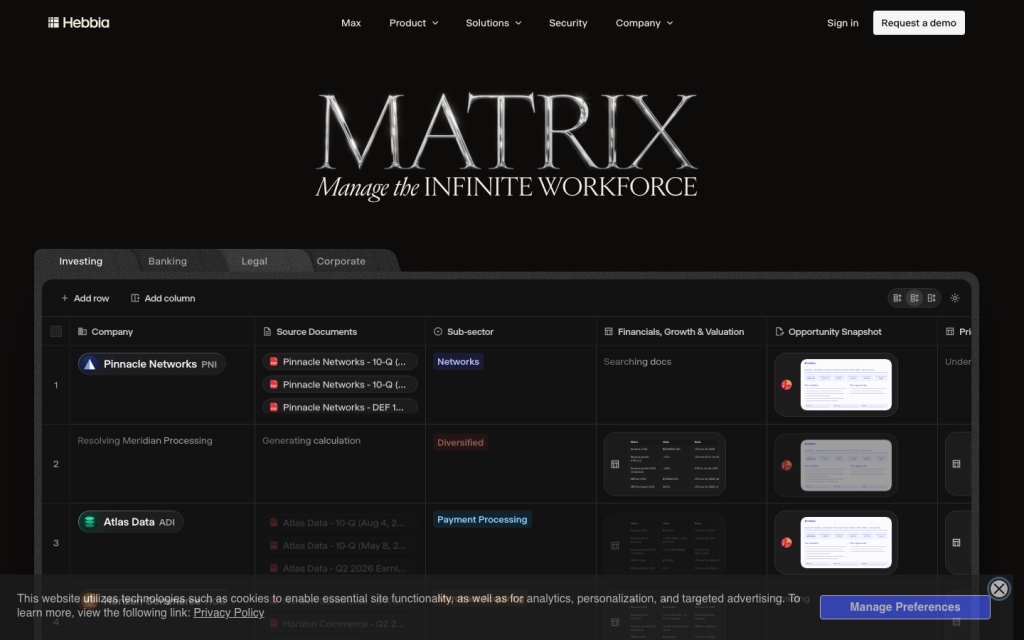
Hebbia product image
hebbia.com
On this page

Hebbia is a specialized enterprise AI analysis platform for institutional finance and other high-consequence professional workflows. Its Matrix product combines structured, cross-document analysis with traceable findings, while Max extends work into deal research, models, presentations, and agents. It’s best suited for teams that need connected proprietary and financial data rather than broad, low-cost employee search.

What is Hebbia?

Hebbia is enterprise intelligence and AI analysis software for institutional finance and related professional work. Matrix handles structured cross-document analysis, while Max supports deal research, dashboards, financial models, presentations, and agents. The platform combines private workplace content and internal systems with filings and licensed financial and research sources.

Retrieval and answers

Matrix breaks complex requests into analytical steps, processes full documents, and synthesizes answers with citations. Headless Hebbia supplies relevant evidence to model calls and lets users check findings against source material. Retrieval can account for relationships among sources, customer terminology, and classifications. Universal benchmarks for accuracy, recall, and citation completeness are not provided.

Connectors and content

Hebbia connects enterprise storage, warehouses, CRMs, data rooms, filings, market data, and licensed research sources. The catalog includes SharePoint, Google Drive, Snowflake, Databricks, Salesforce, Datasite, FactSet, PitchBook, and SEC filings. API and MCP access extend the platform to external surfaces and workflows.

Governance and deployment

Hebbia provides SSO, MFA, encryption, security logs, regional processing, and dedicated-tenant deployment. Customer data is isolated and is not used to train Hebbia or provider models; access is auditable. Databricks and Octus have stated user-permission or entitlement behavior, but equivalent details for every connector – along with refresh schedules, retention settings, and analytics – are not specified.

Who should consider Hebbia?

Hebbia is best suited to investors, private equity and credit teams, hedge funds, investment banks, corporate development teams, law firms, and professional services organizations working on diligence, underwriting, monitoring, and source-grounded deliverables. It is less suited to buyers seeking a low-cost, self-serve employee search tool across ordinary SaaS applications.

Buyer scenarios

Where the product fits — and where to be careful

Institutional diligence and underwriting

Need
Analyze high volumes of deal, company, contract and financial material with traceable outputs.
Why it fits
Matrix supports structured cross-document analysis, source-linked findings and human checkpoints; Max supports research, models, presentations and agents.
Watch out
Public pricing is not shown, and connector-specific synchronization, revocation timing and permission behavior are not fully detailed.

Strong fit

Financial research and monitoring

Need
Combine proprietary and external financial sources for recurring research and monitoring.
Why it fits
The catalog spans data rooms, filings, market and research providers, CRM systems, warehouses and enterprise storage.
Watch out
The product is oriented to institutional finance and professional workflows rather than low-cost, self-serve company-wide knowledge search.

Strong fit for specialized teams

Pros & Cons

Pros

  • Structured, multi-step analysis across full documents with citations and source checking.
  • Broad finance-oriented catalog spanning enterprise storage, warehouses, data rooms, filings and research providers.
  • Enterprise controls include SSO, MFA, encryption, auditability, regional processing and dedicated tenants.
  • Supports traceable outputs for diligence, underwriting, research and deal workflows.

Cons

  • No public tiers or dollar pricing are available.
  • Universal retrieval-accuracy and citation-completeness benchmarks are not provided.
  • Permission fidelity, refresh behavior and administrative controls are not fully detailed for every connector.
Editorial score breakdown

Editorial scores

Editorial score
4.0
Administration and measurement
4.0

Hebbia provides enterprise security and deployment controls, including SSO, MFA, encryption, security logs, isolated customer environments, regional processing and dedicated tenants. Connector-wide permission and operational detail is incomplete.

Search and answers
4.0

Matrix supports multi-step analysis over full documents, citations and source checking, with relationship-aware retrieval. No universal accuracy or citation-completeness benchmarks are available.

Usability, support & value Not scored

User-review evidence was insufficient for a publishable score.

Content and permissions
4.0

Hebbia has a broad catalog covering enterprise content, finance data, research providers, data rooms and filings, plus API and MCP access. Permission and refresh behavior is not fully specified across every connector.

Pricing and contract model

Hebbia does not show public tiers or dollar prices. Fees are set in an Order Form.

  • The pricing page offers a demo request.
  • Order Terms generally renew annually unless an Order Form states otherwise.

Integrations

Documented connections and access methods for Hebbia.

CRM

Salesforce and DealCloud Native

AI protocol

Hebbia API and MCP Protocol

Productivity suite

Microsoft Office Embedded

Document storage

Enterprise file storage Native

Data warehouse/BI

Snowflake and Databricks Native
  • The catalog also includes financial, research, data-room and regulatory-filing sources.

What's new

Recent product and company updates

  • 2026-11-05

    Knowledge graphs in Hebbia

    Hebbia launched knowledge graphs that link structured and unstructured firm data, with source-linked facts, effective-dated versions and access controls.

    Source
  • 2026-10-01

    Introducing Headless Hebbia

    Hebbia introduced Headless Hebbia with API and MCP access for step-by-step retrieval and analysis.

    Source

FAQ

Is Hebbia pricing public?
No public tier or dollar price is shown. Fees are set in an Order Form.
What content can Hebbia analyze?
Hebbia combines private documents and internal systems with public filings, licensed financial and research sources, data warehouses and external feeds.
How does Hebbia handle access controls?
Published Matrices inherit Project permissions. Hebbia also provides isolated customer environments, auditable access controls, SSO and MFA; Octus and Databricks access follows the user's respective entitlements or permissions.
How current are Hebbia's product updates?
Hebbia launched knowledge graphs on November 5, 2026, with source-linked facts and effective-dated versions.
Review transparency Corrections policy
Change history
  1. 2026-11-07 Initial publication First published version of this review.
23 sources analyzed
  1. Hebbia Product hebbia.com
  2. Matrix hebbia.com
  3. Security hebbia.com
  4. Data Processing Addendum hebbia.com
  5. Integrations hebbia.com
  6. Pricing hebbia.com
  7. Master Subscription Agreement hebbia.com
  8. Introducing Headless Hebbia hebbia.com
  9. Knowledge graphs in Hebbia hebbia.com
  10. Max hebbia.com

Showing 10 of 23 sources · 13 additional sources analyzed

Feedback on this article

Was this review helpful?

Private editorial feedback. It does not change product ratings or rankings.

Rate Hebbia

Rate your experience
  • Administration and measurement
  • Search and answers
  • Usability, support & value
  • Content and permissions