
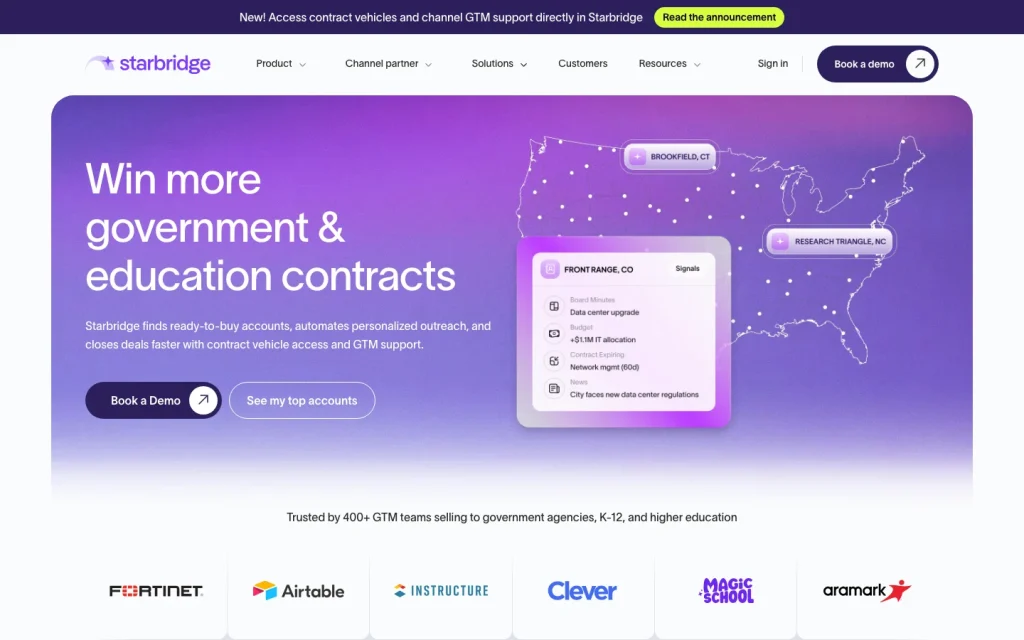
Teams selling to government and education buyers often lose time piecing together contacts, procurement activity, and early buying signals. Starbridge brings those inputs into one account-intelligence workflow and connects them to Salesforce, HubSpot, Slack, and browser-based research. The main tradeoff is breadth: teams should expect onboarding and process setup before the full data and workflow surface becomes useful.
Is Starbridge worth it?
Broad public-sector coverage across federal, state, local, and education segments.
The product can feel broad and terminology-heavy for new users.

What is it?
Starbridge is a public-sector sales intelligence platform built to help go-to-market teams find and act on government buying signals. The product centers on RFPs, buyer contacts, company intelligence, public-spend data, and workflow tools that push those signals into sales systems.
Data coverage
Starbridge’s coverage is strongest where public-sector selling depends on monitoring many sources at once: bid portals, FOIA/purchase-order data, meeting minutes, budget data, grants, news, job postings, and strategic plans. It also documents coverage across federal, state, local, and education markets, with especially clear positioning around SLED use cases.
For buyers, the value is less about a single dataset and more about a combined feed of procurement opportunities, account context, and decision-maker signals. The remaining question is depth at the edges, especially around how far federal coverage goes versus its clearer state, local, and education emphasis.
Workflow and integrations
Starbridge is unusually workflow-oriented for a niche public-sector intelligence product. Native Salesforce and HubSpot syncs are the anchor, with Slack, a Chrome extension, ChatGPT and Claude workflows, plus Zapier-connected tools such as Apollo.io, Freshdesk, Notion, and Zendesk.
That matters for teams that want signals to move into CRM, support, research, and outbound motions without too much manual work. Buyers should still plan the routing, field mapping, deduplication, and account-level hygiene they want before rollout.
Who it's for
Starbridge is best for revenue teams selling into K-12, higher education, and state and local government. It fits organizations that need public-sector account intelligence to live close to CRM workflows and that can benefit from centralized monitoring of RFPs, buying signals, and contacts.
It is a weaker fit for buyers who want a simple point solution with minimal training or who are not actively selling into public-sector accounts.
Buyer scenarios
Where the product fits — and where to be careful
Public-sector pipeline teams
- Need
- A team selling into schools, districts, universities, or local agencies needs a single place to monitor RFPs, buying signals, and account context.
- Why it fits
- Starbridge is a strong fit because it centralizes public-sector signals and pushes them into CRM-connected workflows.
- Watch out
- Teams should plan for some onboarding and workflow setup to get value from the full breadth of data.
It’s a good fit if the team can operationalize the signal feed within existing sales processes.
RevOps teams standardizing CRM handoff
- Need
- Revenue operations wants public-sector intelligence to sync into Salesforce or HubSpot without manual re-entry.
- Why it fits
- Starbridge fits because it has native CRM integrations and workflow surfaces beyond the browser.
- Watch out
- Integration configuration and dedupe/routing decisions may require careful setup.
It’s a strong fit when CRM hygiene and repeatable routing matter.
Pros & Cons
Pros
- Broad public-sector coverage across federal, state, local, and education segments.
- Combines RFPs, buyer contacts, buying signals, and public-spend intelligence in one system.
- Native bi-directional Salesforce and HubSpot integrations.
- Additional workflow surfaces through Slack, Chrome extension, and AI workflows.
- Customer reviews are especially positive on data coverage, support, and practical usefulness.
Cons
- The product can feel broad and terminology-heavy for new users.
- Some reviewers note friction with integration sync and workflow handoffs.
- The interface and learning curve may require training for advanced use.
Reviews.vc scores
Starbridge documents coverage across federal, state, local, K-12, and higher education markets, monitors more than 300,000 public-sector entities, and combines RFPs, buyer contacts, contracts, public spend, meeting records, grants, and early buying signals in one platform.
Across 30 public customer reviews, data quality received 11 positive mentions and one negative mention. Buyers commonly report accurate, current contact and account intelligence, while one review noted occasional unreliable AI-generated connections from public-meeting data.
Starbridge combines native Salesforce and HubSpot sync, Slack and browser surfaces, ChatGPT and Claude workflows, and Zapier-connected tools including Apollo.io, Freshdesk, Notion, and Zendesk. Customer feedback is mostly positive, with some remaining sync-field and handoff friction.
Customer feedback points to responsive, hands-on support and guided onboarding that help buyers adopt the full breadth of the platform. The learning curve is real, but support appears to reduce friction for most users.
Starbridge alternatives

- Best for
- Government and education signal-to-CRM execution
- Key tradeoff
- The product can feel broad and terminology-heavy for new users.

- Best for
- Federal capture and award tracking
- Key tradeoff
- Search and navigation can be difficult when working through large result sets

- Best for
- Spend, contract, and incumbent research
- Key tradeoff
- User reviews are mixed on data quality, with complaints about stale, late, duplicate, or missing records.

- Best for
- State and local account research
- Key tradeoff
- Reviewed public documentation gives limited detail on plan-level integration and workflow entitlements.
| Product | Reviews.vc score | Best for | Key tradeoff |
|---|---|---|---|
![]() | 4.5/5 | Government and education signal-to-CRM execution | The product can feel broad and terminology-heavy for new users. |
![]() | 4.0/5 | Federal capture and award tracking | Search and navigation can be difficult when working through large result sets |
![]() | 3.8/5 | Spend, contract, and incumbent research | User reviews are mixed on data quality, with complaints about stale, late, duplicate, or missing records. |
![]() | 4.0/5 | State and local account research | Reviewed public documentation gives limited detail on plan-level integration and workflow entitlements. |
Starbridge customer reviews and sentiment
Based on 30 public customer reviews. Source mix: 30 from g2.com.
| Theme and finding | Mentions | Positive | Negative |
|---|---|---|---|
Data coverage Buyers value broad public-sector coverage that centralizes hard-to-find contacts, RFPs, procurement history, funding, and early buying signals; a few want outreach capabilities or wider integrations to complete the workflow. | 23 | 22 | 1 |
Ease of use The platform is often seen as intuitive and efficient for research, but its breadth, specialized public-sector terminology, and evolving UI can create a learning curve and make training or setup harder. | 19 | 14 | 8 |
Integrations CRM integrations, especially Salesforce and HubSpot, are generally described as seamless and useful for bringing research into existing workflows, though users cite sync-field friction and missing or broader integration needs. | 15 | 13 | 5 |
Support Support is consistently viewed as responsive, accessible, and hands-on in onboarding, troubleshooting, and tailoring workflows; one reviewer wanted stronger support during initial setup. | 14 | 13 | 1 |
Data quality Buyers report accurate, current contact, firmographic, and intent data that improves CRM hygiene and targeting, while one reviewer flagged occasional AI-generated connections from public-meeting data as unreliable. | 11 | 11 | 1 |
Mentions count unique reviews. One review can count as both positive and negative for the same theme when it describes a mixed experience.
This analysis reflects public customer reviews we could identify and access at the time of collection; the displayed source mix may influence the patterns shown.
Pricing and contract model
Starbridge does not publish public price tiers. The buying motion is demo-led and appears quote-based.
Integrations
Documented connections and access methods for Starbridge.
CRM
Automation
Messaging & collaboration
AI protocol
Productivity suite
Browser extension
Other
FAQ
Who is Starbridge best for?
Does Starbridge integrate with CRM or capture workflows?
- 2026-07-21 Comparison Added alternatives comparison from 12 Best Public Sector Sales Intelligence Platforms in 2026.
- 2026-07-21 updated Added 20 more customer reviews to the analysis.
Older revisions (1)
- 2026-07-20 updated Review updated
Sources analyzed (62)
- Starbridge | Win more public-sector contracts starbridge.ai accessed 2026-07-20
- Integration | Starbridge starbridge.ai accessed 2026-07-20
- Public Spend Intelligence | Starbridge starbridge.ai accessed 2026-07-20
- Starbridge Help Center - Starbridge Help Center hc.starbridge.ai accessed 2026-07-20
- January 2026: Feed Customization and Ask Starbridge Chat - Starbridge Help Center hc.starbridge.ai accessed 2026-07-20
- Starbridge secures $42M Series A funding | Dealroom.co app.dealroom.co accessed 2026-07-20
- David Sacks' Craft leads $42M Series A in govtech startup Starbridge | TechCrunch techcrunch.com accessed 2026-07-20
- Owl Ventures www.owlvc.com accessed 2026-07-20
- Buying Signals Monitor | Starbridge starbridge.ai accessed 2026-07-20
- Contact & Company Data | Starbridge starbridge.ai accessed 2026-07-20
Showing 10 of 62 sources · 52 additional sources analyzed
Leave Review