
Bland AI logo

Bland AI

Bland AI provides configurable voice agents for connected inbound and outbound phone workflows.

Editorial score

4.0 /5
How we scored it

Is Bland AI worth it?

Nick Oscar
Editor, Reviews.vc · Updated September 18, 2026
Good For

Node-based Pathways support branching, state, tools, extraction, and guardrails.

Caution

The most sophisticated controls are presented as higher-tier or enterprise capabilities.

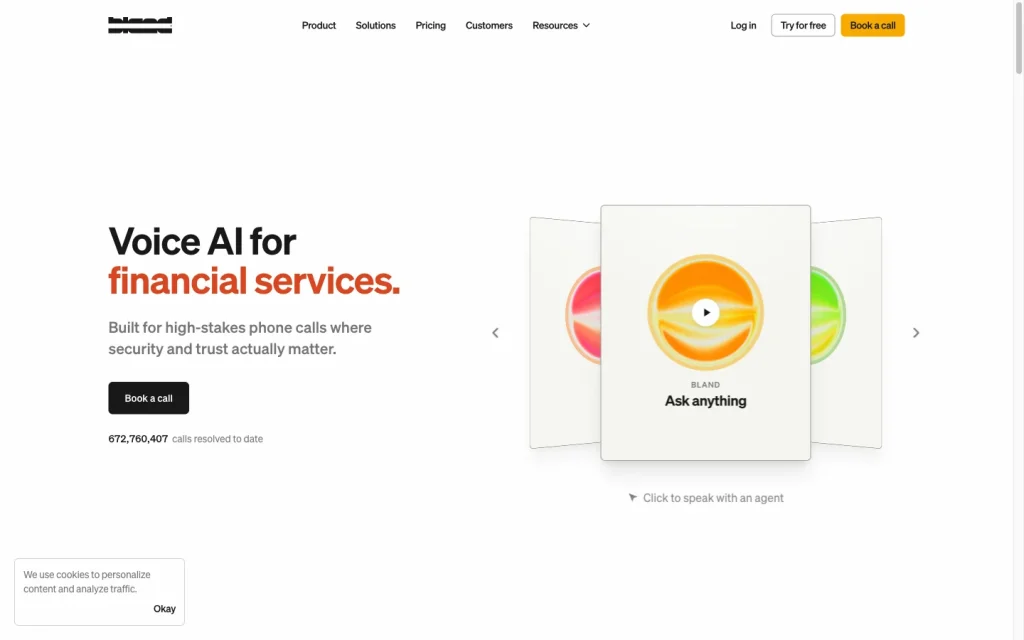
Bland AI product image
bland.ai
On this page

Bland AI is a configurable enterprise platform for deploying inbound and outbound voice agents in connected business workflows. Its strongest coverage is in structured conversation design, telephony controls, external tools, human handoff, testing, and operational visibility. It is a more natural fit for technical or operations-led teams than for buyers looking for a simple, consumer-style phone assistant.

What is Bland AI?

Bland AI is an enterprise voice-AI platform for production inbound and outbound phone agents. It combines telephony, speech recognition, language model interaction, speech synthesis, workflow orchestration, and API controls. Teams can use it for connected phone workflows rather than as a standalone text-to-speech tool or a managed call center outsourcer.

Conversation capabilities

Conversational Pathways use nodes to control dialogue, branching, state, tool calls, variable extraction, and guardrails. Knowledge bases can draw on files, direct text, or scraped website URLs during a conversation. Per-contact memory can retain summaries, structured facts, and recent cross-channel messages, with reset and deletion controls. Outbound calls also offer language selection, multilingual or auto-detect modes, interruption thresholds, and a setting to block interruptions.

Telephony and actions

Bland can place and receive calls, operate in IVR mode, and use tools or webhook nodes to retrieve external data or trigger actions while a call is live. Its call controls include dialing settings, maximum duration, recordings, transfers, and webhooks. It also supports inbound configuration, SIP routing, number porting, and an enterprise Custom Code Node for JavaScript. Active calls can transfer to another number, and guardrails can route a caller to a human.

Testing and operations

The platform includes assertion-based scenarios, templates, simulations, batch runs, flakiness analysis, and failed-test analysis. Teams can evaluate batches of real calls, manage pathway versions, promote from staging to production, run canaries, and roll back. Operational controls include active-call listening, transcript streams, recordings, event streams, tool logs, alarms, webhooks, and audit logs. Recording is opt-in at the Send Call API level, and retention, transcript redaction, and zero-retention processing are configurable.

Who should consider Bland AI?

Bland is best suited to enterprise operations, customer service, intake, scheduling, dispatch, lead qualification, and IVR-replacement teams with complex or high-volume phone workflows. Healthcare, insurance, financial services, logistics, and telecommunications are among its target sectors. Technical teams can use APIs, JavaScript, CLI, MCP, webhooks, SIP, and custom tools, with vendor-managed cloud, customer VPC, on-premises, and air-gapped infrastructure options. It is less clearly suited to a nontechnical buyer seeking a no-configuration consumer phone assistant.

Buyer scenarios

Where the product fits — and where to be careful

Operations teams automating high-volume phone workflows

Need
Automate intake, scheduling, dispatch, customer service, lead qualification, or IVR-replacement calls while retaining escalation paths.
Why it fits
Pathways, knowledge bases, tools, inbound and outbound calling, IVR support, transfers, and CRM or telephony connections fit connected business phone workflows.
Watch out
The more sophisticated controls are presented as higher-tier or enterprise capabilities, so teams should map required deployment and control features to their plan.

Strong fit

Technical and regulated organizations

Need
Deploy phone agents with business-system connections, operational controls, and flexible infrastructure.
Why it fits
APIs, JavaScript, CLI, MCP, webhooks, SIP, custom tools, customer VPC, on-premises, and air-gapped options support technical and regulated deployments.
Watch out
A nontechnical buyer seeking a no-configuration consumer phone assistant is less clearly served by the available product detail.

Strong fit when technical implementation capacity is available

Pros & Cons

Pros

  • Node-based Pathways support branching, state, tools, extraction, and guardrails.
  • Inbound, outbound, IVR, SIP, transfer, webhook, and custom-code controls cover complex phone workflows.
  • Scenario testing, real-call evaluation, release controls, logs, alarms, and audit logs provide substantial operational tooling.
  • Published usage-based plans give buyers a clear starting point before custom enterprise deployment needs arise.

Cons

  • The most sophisticated controls are presented as higher-tier or enterprise capabilities.
  • A nontechnical buyer seeking a no-configuration consumer phone assistant is less clearly served.
  • Usability, support, and value cannot be scored because publishable user-review evidence is insufficient.
Editorial score breakdown

Editorial scores

Editorial score
4.0
Testing and observability
4.0

Bland provides scenario and simulation testing, real-call evaluations, release controls, call-level telemetry, alarms, audit logs, and configurable retention and redaction controls.

Telephony and actions
4.0

Bland supports inbound and outbound calls, IVR interaction, SIP and number controls, API tools, webhooks, JavaScript, and transfers to human agents.

Conversation capabilities
4.0

Node-based Pathways combine branching, state, tools, extraction, guardrails, knowledge retrieval, memory, multilingual controls, and human-transfer routes.

Usability, support & value Not scored

User-review evidence was insufficient: the available aggregate is not publishable.

Pricing and contract model

Bland publishes usage-based per-connected-minute plans with optional monthly platform fees, plus custom Enterprise pricing.

PlanPriceIncludes
Start
$0.14 per connected minute
Usage-based
No platform fee; transfer minutes are $0.05.
Build
$299 per month + $0.12 per connected minute
Monthly plus usage
Transfer minutes are $0.04.
Scale
$499 per month + $0.11 per connected minute
Monthly plus usage
Transfer minutes are $0.03.
Agent Phone
$29.99 per month
Monthly
Includes unlimited voice minutes and SMS to the US and Canada, subject to daily and concurrency limits.
  • Connected-minute charges apply to the Start, Build, and Scale plans.

Integrations

Documented connections and access methods for Bland AI.

CRM

Salesforce and HubSpot Native

Automation

Zapier, Make, and Pipedream Native

Messaging & collaboration

Slack and Notion Native

Developer/API

REST API and webhooks Public API

AI protocol

MCP server Protocol

Productivity suite

Cal.com and Calendly Native

Other

Telephony platforms Native

What's new

Recent product and company updates

  • 2026-06-16

    Bland surpasses $100M funding with new Series C

    Bland announced a $50 million Series C led by Dell Technologies Capital and stated that total funding surpassed $100 million.

    Source
  • 2026-03-26

    Bland unveils Norm

    Bland announced Norm, an AI assistant intended to build production-ready voice agents from a single prompt.

    Source
  • 2026-01-01

    January product updates

    January updates included Watchtower, node-level testing, Merge Pathways, native triggers, and a HubSpot integration with two-way sync and event-driven automations.

    Source

FAQ

How is Bland AI priced?
Bland uses usage-based per-minute pricing with optional monthly platform fees. Start is $0.14 per connected minute with no platform fee; Build is $299 per month plus $0.12 per connected minute; Scale is $499 per month plus $0.11 per connected minute. Enterprise pricing is custom.
Can Bland AI handle inbound and outbound calls?
Yes. Bland supports production inbound and outbound phone agents, including inbound numbers and configuration, SIP routing, outbound dialing settings, IVR mode, recording controls, and webhooks.
Can a Bland AI call be handed to a person?
Yes. Active calls can transfer to another phone number, and guardrails can end a call, transfer it to a human, or move it to a specified pathway node.
What testing tools does Bland AI provide?
Bland provides assertion-based scenarios, simulation sets, batch execution, failure analysis, real-call evaluations, pathway versions, staging or production promotion, canary deployments, and rollback.
Review transparency Corrections policy
Change history
  1. 2026-09-18 Initial publication First published version of this review.
20 sources analyzed
  1. Bland AI bland.ai
  2. Bland Voice bland.ai
  3. Bland AI documentation docs.bland.ai
  4. Pricing bland.ai
  5. Billing docs.bland.ai
  6. Integrations bland.ai
  7. Trust & Security bland.ai
  8. Bland surpasses $100M funding with new Series C prnewswire.com
  9. Bland unveils Norm prnewswire.com
  10. January product updates bland.ai

Showing 10 of 20 sources · 10 additional sources analyzed

Feedback on this article

Was this review helpful?

Private editorial feedback. It does not change product ratings or rankings.

Rate Bland AI

Rate your experience
  • Testing and observability
  • Telephony and actions
  • Conversation capabilities
  • Usability, support & value