Dubverse logo

Dubverse

Dubverse is a multilingual voice and localization platform for dubbing, subtitles, text-to-speech and API delivery.

Editorial score

3.5 /5
How we scored it

Is Dubverse worth it?

Nick Oscar
Editor, Reviews.vc · Updated September 18, 2026
Good For

Broad multilingual studio coverage with 60+ languages and 500+ speakers listed.

Caution

Voice, language and cloning coverage varies by model and workflow.

Dubverse product image
dubverse.ai
On this page

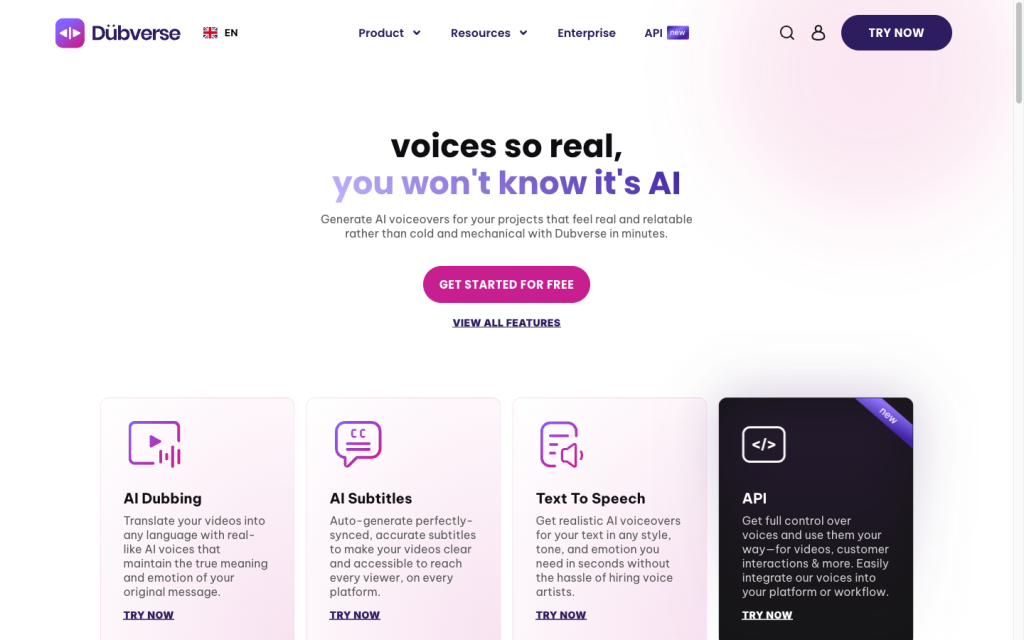
Dubverse is a multilingual AI voice and localization platform for dubbing, subtitles, translation, and text-to-speech. Its studio combines transcript editing, speaker assignment, and export, while its API supports programmatic WAV generation, streaming, and callbacks.

It is best suited to informational, training, support, and explainer workflows. Its broad language coverage and editing tools are compelling, but model-specific voice availability, incomplete public pronunciation controls, and mixed user feedback on support and value merit attention.

What is Dubverse?

Dubverse combines AI video dubbing, subtitles, translation, text-to-speech, and transcript editing in a studio built around DUB, SUB, and SAY projects. Teams can assign speakers, edit translations, and download finished media, while developers can generate speech through a REST TTS API.

It is aimed at informational, educational, training, support, software walkthrough, and explainer content. Entertainment and movie use are a weaker fit when production requires publish-ready output without review.

Voices and language coverage

Dubverse lists 60+ languages and 500+ speakers for its studio, with a catalog that includes Indian regional languages, English variants, German, and other options. API coverage is model-specific: neo.one supports 10+ languages, candy.two supports 8+ languages, and swift.call supports Hindi and English.

DubX adds multi-speaker emotional voice cloning in specific workflows and languages. That offers useful breadth for multilingual content, but buyers should confirm their chosen model, language, and cloning workflow rather than assume every capability applies across the full catalog.

Control and editing

Director Mode lets users select speakers and apply templated or custom voice and translation instructions at the project or segment level for selected languages. The editor also supports translation edits, transliteration, glossary management, find and replace, speaker assignment, range redo, repeat segments, and voice/video synchronization.

Model controls vary: neo.one and swift.call offer basic emotion control, while candy.two adds advanced emotion and emphasis control. The public API supports instructions and sample-rate settings, but does not provide a full published schema for phonemes, SSML, pitch, rate or pronunciation dictionaries.

Delivery, exports and API

Studio delivery covers MP3, MP4, and SRT for DUB projects; SRT or burned-subtitle MP4 for SUB projects; and WAV or MP3 for SAY. Paid configurations also include VTT and XML options. The API returns WAV, supports streaming and non-streaming generation, callbacks, and configurable sample rates for neo.one.

Large projects can take longer to download: files over 600 MB or projects longer than 10 minutes may be delayed. Trial and Supreme users also have download limits, and API access may be restricted after a usage cap is exceeded until billing is resolved.

Who should consider Dubverse?

Dubverse is a strong candidate for localization teams, creators, publishers, and production groups producing multilingual training, product, support, educational, and explainer material. It also suits developers embedding TTS into e-learning, news, accessibility, websites, apps, IVR, and selected voicebot workflows.

India-focused teams benefit from Hindi and regional-language coverage alongside English and selected global languages. Buyers with film-grade requirements, universal real-time agent coverage, or fully specified cloning permissions should validate the relevant workflow before committing.

Buyer scenarios

Where the product fits — and where to be careful

Multilingual content and localization teams

Need
Translate, subtitle and dub training, support, product or explainer content.
Why it fits
Dubbing, subtitles, editable transcripts, speaker assignment and MP3, MP4, SRT, VTT or XML-style deliverables suit multilingual informational content workflows.
Watch out
Entertainment and movie work should not assume publish-ready output without review.

Strong fit

Developers embedding speech

Need
Add bulk or application-based TTS to websites, apps, IVR, e-learning, news or voicebot experiences.
Why it fits
The TTS API supports text input, streaming or non-streaming operation, callbacks, configurable sample rate and WAV output for embedded speech workflows.
Watch out
swift.call real-time voicebot support is limited to Hindi and English, and API access can be restricted after a usage cap is exceeded until an invoice is settled.

Good fit with model-specific limits

Pros & Cons

Pros

  • Broad multilingual studio coverage with 60+ languages and 500+ speakers listed.
  • Combines dubbing, subtitles, translation, transcript editing and TTS in one workflow.
  • Useful project and segment editing controls, including glossary, transliteration and Director Mode.
  • Flexible studio exports plus a streaming-capable WAV TTS API.
  • Two-day no-card trial and usage-based API options.

Cons

  • Voice, language and cloning coverage varies by model and workflow.
  • Public API controls do not include a full published phoneme, SSML, pitch or rate schema.
  • Pricing billing-period presentation is inconsistent.
  • User feedback is mixed, with recurring support, delivery and value concerns.
Editorial score breakdown

Editorial scores

Editorial score
3.5
Audio workflow and delivery
4.0

Dubverse supports studio exports across audio, video and subtitle formats, plus a WAV API with streaming and callbacks. Download and usage limits keep it below exceptional delivery flexibility.

Speech capabilities
4.0

The studio lists 60+ languages and 500+ speakers, with multilingual catalogs and model-specific API options. Coverage and cloning availability vary by model, language and workflow.

Pronunciation and style control
4.0

Director Mode, emotion controls, glossary tools, transliteration, segment editing and synchronization provide substantial workflow control. Universal phoneme, SSML and full prosody controls are not published.

Usability, support & value
2.0

User feedback is mixed: ease-of-use mentions are evenly split, while support and value-for-money mentions skew negative. This is recurring evidence of support and value tradeoffs.

Customer sentiment

Dubverse customer reviews and sentiment

Based on 20 public customer reviews. Source mix: 15 from trustpilot.com, and 5 from appsumo.com.

Customer sentiment is analyzed separately and does not determine the Reviews.vc editorial score.

20 public reviews analyzed
Positive
35%7 reviews
Mixed
20%4 reviews
Negative
45%9 reviews
Theme and findingMentionsPositiveNegative
Speech capabilities
Multilingual dubbing is useful for some workflows, but reviewers report uneven language handling, robotic voices, and poor lip sync.
1285
Ease of use
Some find the platform simple and efficient, while others encounter confusing UX, login failures, lag, and slow refreshes.
1055
Support
Support responsiveness is inconsistent: some issues are addressed quickly, but multiple reviewers report delayed, unanswered, or unhelpful responses.
826
Audio workflow and delivery
The product can produce multilingual dubbed videos quickly, but re-upload requirements and out-of-sync dubbing can disrupt delivery.
514
Value for money
Value depends heavily on plan fit: one reviewer finds it affordable, while others cite restrictive limits, unclear tier mapping, and weak output for paid plans.
514

Mentions count unique reviews. One review can count as both positive and negative for the same theme when it describes a mixed experience.

This analysis reflects public customer reviews we could identify and access at the time of collection; the displayed source mix may influence the patterns shown.

Review sentiment over time

PeriodnPositiveMixedNegative
2024 Q3Limited sample1100
2024 Q4Limited sample2002
2025 Q4Limited sample1001
2026 Q2Limited sample1001

Only periods containing dated reviews are shown; gaps between labels mean no dated reviews were available for those periods.

Pricing and contract model

Dubverse offers credit-based studio plans and per-character API pricing. A two-day trial requires no credit card, and Enterprise pricing is custom. Plan cards and comparison tables present billing periods inconsistently.

PlanPriceIncludes
Pro
$18/month
monthly
50 credits; the plan page lists up to 60 video minutes.
Supreme
$30/month
monthly
50 credits; the plan page lists up to 150 video minutes.
neo.one API
$0.08 per 1,000 characters
usage-based
neo.one API pricing; 5,000 characters are free.
candy.two API
$0.25 per 1,000 characters
usage-based
candy.two API pricing; 5,000 characters are free.
  • Studio pricing uses credits: dubbing uses 4 credits per minute, subtitles 1 credit per minute and SAY/TTS 2 credits per minute.
  • The pricing page shows six-month billing on plan cards and also lists monthly, half-yearly and yearly options in comparison tables.

Integrations

Documented connections and access methods for Dubverse.

Developer/API

Dubverse Text-to-Speech API Public API

Other

Canva and sharing destinations Other
  • No comprehensive public integration directory is listed.

What's new

Recent product and company updates

  • 2026-04-08

    Dubverse joins Exotel

    Dubverse announced that its founders and technical team joined Exotel through a team acquisition, while Dubverse would continue as an independent product with no changes to subscriptions, pricing, platform access or ongoing services.

    Source

FAQ

Does Dubverse offer a free trial?
Yes. Dubverse offers a two-day free trial without a credit card. Studio plans use credits, while API use is priced per character.
How many languages and speakers does Dubverse offer?
The studio FAQ lists 60+ languages and 500+ speakers. API model coverage varies: neo.one supports 10+ languages, candy.two supports 8+ languages, and swift.call supports Hindi and English.
Does Dubverse support voice cloning?
DubX supports multi-speaker emotional voice cloning in specified workflows and languages. swift.call supports runtime cloning for Hindi and English voicebot use; cloning is not presented as universal across all voices and languages.
What can I export from Dubverse?
DUB projects export MP3, MP4 and SRT; SUB projects export SRT or burned-subtitle MP4; and SAY exports WAV and MP3. Paid configurations also list VTT and XML options.
Review transparency Corrections policy
Change history
  1. 2026-09-18 Initial publication First published version of this review.
25 sources analyzed
  1. Dubverse FAQs dubverse.ai
  2. Dubverse Pricing dubverse.ai
  3. Dubverse Models Overview docs.dubverse.ai
  4. Text-to-Speech API Reference docs.dubverse.ai
  5. DubX and Director Mode help.dubverse.ai
  6. How to Download Your Projects help.dubverse.ai
  7. Usage and Billing docs.dubverse.ai
  8. Dubverse joins Exotel dubverse.ai
  9. Dubverse Text-to-Speech dubverse.ai
  10. Dubverse Languages dubverse.ai

Showing 10 of 25 sources · 15 additional sources analyzed

Feedback on this article

Was this review helpful?

Private editorial feedback. It does not change product ratings or rankings.

Rate Dubverse

Rate your experience
  • Audio workflow and delivery
  • Speech capabilities
  • Pronunciation and style control
  • Usability, support & value