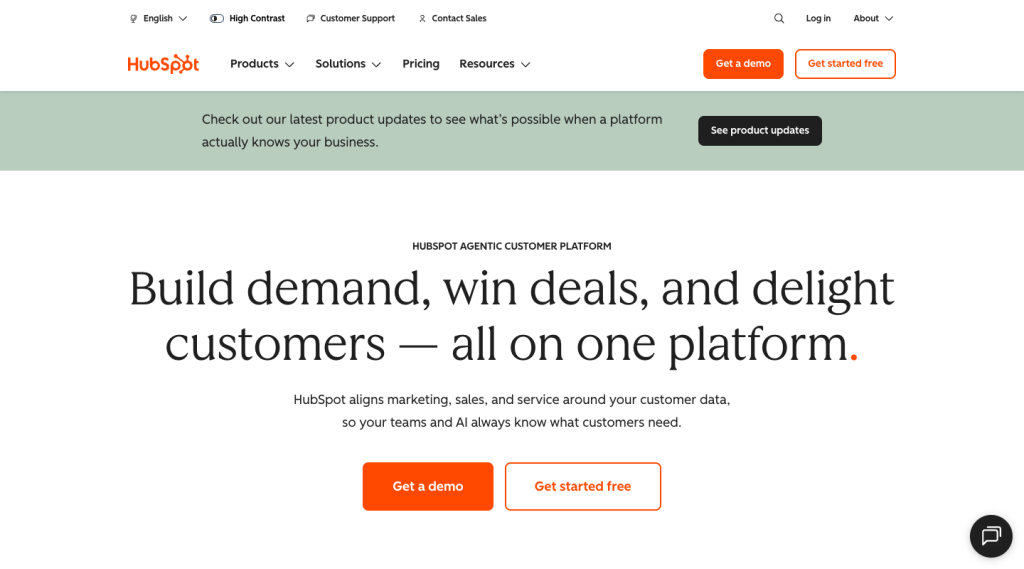
HubSpot is a CRM-centered customer platform for connecting marketing, sales, service, and revenue workflows around shared customer data. Its Smart CRM, Breeze AI capabilities, automation, reporting, marketplace, APIs, and agent-oriented tools give cross-functional GTM teams broad scope, but the product’s growing configuration, tiering, credit use, and administration needs make disciplined rollout important.
Is HubSpot worth it?
Shared CRM foundation spanning marketing, sales, service, reporting, and revenue workflows.
Advanced workflows and complex sales processes can require significant administration, higher tiers, or workarounds.

What is it?
HubSpot is a multi-hub customer platform built around Smart CRM. Its documented coverage includes contact and company management, pipelines, marketing and sales automation, customer service, reporting, prospecting, quote-to-cash operations, and connected applications. It is best understood as a shared operating system for GTM teams rather than a narrowly focused point solution.
The platform can suit organizations that want marketing, sales, and service teams working from common records and processes. That breadth also means a buyer should define which hubs, roles, data model, and workflow outcomes are actually required before rollout.
Data and signals
HubSpot’s data layer includes CRM records, custom objects, events, calculations, conversations, reporting, and data-management controls. Its enrichment offering draws on public sources, third-party vendors, and internet-derived information for contact and company profiles; HubSpot documents enrichment for new records and ongoing updates when new data is available.
Buyer-intent inputs can include company domains, online identifiers, timestamps, and visited URL paths. Breeze and Data Agent can use CRM context, conversations, deal history, documents, learned content sources, and selected web information. That creates a useful customer-context base for GTM work, but buyers needing proven enrichment accuracy or dedicated intent-data depth should validate those measures in their own data.
AI workflows and activation
Breeze is HubSpot’s AI layer for finding information, creating content, completing tasks, and automating workflows. Documented capabilities include Assistant, agents, custom assistants, knowledge vaults, embedded AI features, and Data Agent research across CRM data, conversations, calls, emails, documents, and web information.
For sales teams, Prospecting Agent can identify companies from triggers, source contacts, and support research and outreach plays. Its activation options include personalized multichannel sequences or adaptive email, with controls for timing, sender, email limits, delays, and brand voice. Customer Agent can resolve inquiries and qualify leads across channels, with escalation when human judgment is needed. Buyers should account for beta status, permissions, subscription requirements, and credit consumption rather than assuming every AI function is available or autonomous by default.
Integrations and analytics
HubSpot supports a broad ecosystem through Marketplace apps, connected-app objects, data sync, custom workflow actions, public APIs, webhooks, and MCP servers. These options can bring third-party data into records, properties, segments, pipelines, workflows, and exports where the connected application supports those behaviors.
Analytics coverage includes configurable dashboards and reporting across marketing, sales, and service data, with documented custom reporting for deal progression and revenue attribution. Data Studio, data-warehouse integrations, scheduled triggers, and some data-quality automation are tier-dependent. Integration design remains a buyer responsibility: directionality, authorization scopes, data ownership, and plan requirements vary by connection.
Who it's for
HubSpot fits GTM organizations seeking a shared CRM-centered platform for coordinated marketing automation, sales prospecting and pipeline work, service workflows, reporting, and connected customer data. It is also relevant for teams with developer or integration needs, given its marketplace, APIs, custom actions, webhooks, and MCP tooling.
It is a less straightforward fit for teams that need only one narrowly scoped GTM function or have limited capacity for governance and administration. Customer feedback suggests that centralization can be valuable, while advanced workflows, complex integrations, and expanding requirements may demand extra configuration and ongoing operational ownership.
Buyer scenarios
Where the product fits — and where to be careful
Unifying a marketing, sales, and service operating model
- Need
- A GTM team needs shared customer records, automation, pipeline management, service context, and reporting across functions.
- Why it fits
- HubSpot brings documented CRM, marketing, sales, service, reporting, and connected-app workflows into one customer platform.
- Watch out
- Advanced workflows and complex processes may require higher tiers, administration, and deliberate data governance.
Good fit if the team has a clear cross-functional operating model and assigns ongoing platform ownership.
Building controlled AI-assisted prospecting
- Need
- A sales team wants research and personalized outreach informed by CRM context, interactions, documents, and selected web information.
- Why it fits
- HubSpot Data Agent and Prospecting Agent support documented research, trigger-based prospecting, and configurable outreach controls.
- Watch out
- Prospecting features may be in beta and can depend on credits, subscriptions, permissions, and sender configuration.
Good fit for teams willing to pilot with defined guardrails, output review, and usage monitoring.
Pros & Cons
Pros
- Shared CRM foundation spanning marketing, sales, service, reporting, and revenue workflows.
- Broad documented automation and AI-assisted research, outreach, and customer-service workflows.
- Large integration ecosystem, public APIs, webhooks, and MCP surfaces.
- Configurable reporting, dashboards, and customer-data controls
Cons
- Advanced workflows and complex sales processes can require significant administration, higher tiers, or workarounds.
- AI agent availability, permissions, beta status, and credit consumption vary by capability.
- Customer reviews describe polarized usability and inconsistent post-sale support.
- Total spend can rise with hubs, seats, contacts, onboarding, credits, and external applications.
Editorial scores
HubSpot has a strong CRM-centered data foundation: documented records span contacts, companies, deals, service, commerce, marketing, content, and activity data, with enrichment, buyer-intent inputs, conversations, and connected-app data. Buyers should validate enrichment quality and coverage for their markets because independent accuracy and match-rate benchmarks were not established.
Breeze supports documented AI assistance, research, content, agents, and workflow automation, including prospecting, customer inquiry handling, and configurable outreach controls. The breadth is strong, though some functions are beta and usage can depend on credits, subscriptions, permissions, and setup.
HubSpot offers strong documented activation paths through native and marketplace connections, CRM synchronization, workflows, public APIs, webhooks, reporting, and MCP access. Connection behavior, governance, and plan requirements should still be checked app by app.
Customer feedback is mixed. Reviewers often value centralized CRM workflows and basic automation, but report that the platform can become cluttered or difficult to learn as complexity grows; support and value perceptions are also inconsistent.
HubSpot customer reviews and sentiment
Based on 86 public customer reviews. Source mix: 47 from trustpilot.com, 16 from softwareadvice.com, 8 from tr-web.stage.trustradius.com, 6 from g2.com, 5 from trustradius.com, and 4 from getapp.com.
Customer sentiment is analyzed separately and does not determine the Reviews.vc editorial score.
| Theme and finding | Mentions | Positive | Negative |
|---|---|---|---|
Ease of use Usability is polarized: some find core CRM and Service Hub workflows intuitive, while others find the broader platform cluttered, slow, and difficult to learn as complexity grows. | 41 | 20 | 24 |
Value for money Buyers frequently report escalating costs from feature-tier paywalls and restrictive annual contracts, though some view the platform as comprehensive or affordable at the right scale. | 39 | 12 | 27 |
Workflow flexibility The platform can centralize teams, pipelines, and basic automation effectively, but advanced workflows, integrations, and complex sales processes often require workarounds, extra tiers, or significant administration. | 32 | 23 | 11 |
Support Support experiences are inconsistent: several reviewers cite delayed or unresponsive post-sale help, while a smaller group reports helpful assistance during implementation and issue resolution. | 21 | 4 | 17 |
Content and output quality HubSpot Academy content is widely seen as useful, practical, and accessible for onboarding, but reviewers want shorter, more current, and more advanced real-world instruction. | 15 | 14 | 12 |
Mentions count unique reviews. One review can count as both positive and negative for the same theme when it describes a mixed experience.
This analysis reflects public customer reviews we could identify and access at the time of collection; the displayed source mix may influence the patterns shown.
Review sentiment over time
| Period | n | Positive | Mixed | Negative |
|---|---|---|---|---|
| 2024 Q4Limited sample | 4 | 0 | 4 | 0 |
| 2026 Q1 | 24 | 1 | 7 | 16 |
| 2026 Q2 | 15 | 1 | 2 | 12 |
| 2026 Q3 | 8 | 0 | 1 | 7 |
Only periods containing dated reviews are shown; gaps between labels mean no dated reviews were available for those periods.
Pricing and contract model
HubSpot pricing is published by hub and bundle. Free CRM is available with no expiration; paid costs vary by selected products, billing, seats, contacts, onboarding, credits, and usage.
| Plan | Price | Includes |
|---|---|---|
Starter Customer Platform | $7/month per seat annual upfront payment with annual commitment; limited-time new-customer offer | annual upfront payment with annual commitment; limited-time new-customer offer |
Starter Customer Platform | $10/month per seat monthly payment with no annual commitment; limited-time new-customer offer | $10 per seat per month when paid monthly with no annual commitment; a limited-time offer for new customers. |
Sales Hub Professional | Starts at $90/month per seat monthly billing with annual commitment | Starts at $90 per seat per month with monthly billing and an annual commitment; a one-time Professional onboarding fee is documented. |
Sales Hub Enterprise | $98/month per seat annual billing | $98 per seat per month when billed annually. |
Integrations
Documented connections and access methods for HubSpot.
CRM
Automation
Messaging & collaboration
Developer/API
AI protocol
Productivity suite
Document storage
Other
Recent signals
Product and company changes worth checking
- 2026-06-30 · product release
June 2026 Product Updates
June updates highlighted expanded Buyer Intent signals, workflow flexibility and object support, higher CRM association limits, and Salesforce synchronization updates.
Source - 2026-06-16 · product release
Introducing Revenue Hub: Quote to cash, finally in one place
HubSpot announced Revenue Hub, bringing quoting, contracts, billing, and payments into one platform.
Source
FAQ
How much does HubSpot cost?
Which GTM workflows does HubSpot support?
How does HubSpot use AI in GTM workflows?
What does HubSpot integrate with?
Who is HubSpot best for?
- 2026-07-24 updated Review updated
Sources analyzed (42)
- AI CRM Software | HubSpot Smart CRM www.hubspot.com accessed 2026-07-23
- Breeze AI Tools for Marketing, Sales & Service | HubSpot www.hubspot.com accessed 2026-07-23
- AI Data Agent for Marketing, Sales & Service | HubSpot www.hubspot.com accessed 2026-07-23
- Understand Breeze knowledge.hubspot.com accessed 2026-07-23
- Get started with data enrichment knowledge.hubspot.com accessed 2026-07-23
- HubSpot MCP Server developers.hubspot.com accessed 2026-07-23
- Integrate AI tools with the HubSpot MCP server developers.hubspot.com accessed 2026-07-23
- Investor FAQs | HubSpot ir.hubspot.com accessed 2026-07-23
- Manage HubSpot Credits knowledge.hubspot.com accessed 2026-07-23
- 2026-03 API reference - HubSpot docs developers.hubspot.com accessed 2026-07-23
Showing 10 of 42 sources · 32 additional sources analyzed

Leave Review