
pWin.ai logo

pWin.ai

pWin.ai gives GovCon teams a grounded, compliance-focused workflow for RFP, RFI, and questionnaire responses.

Editorial score

4.0 /5
How we scored it

Is pWin.ai worth it?

Nick Oscar
Editor, Reviews.vc · Updated September 18, 2026
Good For

Strong end-to-end workflow for complex RFP planning, drafting, and review.

Caution

Public pricing, billing terms, and self-serve purchase details are unavailable.

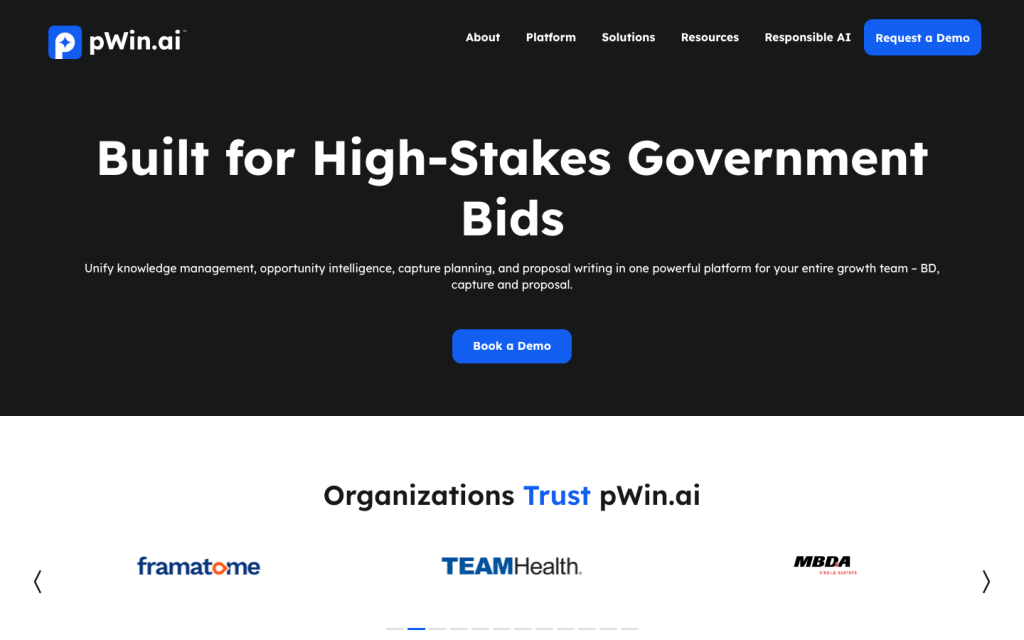
pWin.ai product image
pwin.ai
On this page

pWin.ai is built for government and commercial contractors managing complex RFP, RFI, and questionnaire responses. Its strongest capabilities are capture-to-proposal workflows: planning against evaluation criteria, retrieving approved organizational content, drafting long-form responses, and running compliance and citation reviews. It is a particularly focused option for GovCon teams, while contact-led pricing, limited public API detail, and unproven formal freshness governance remain important buying considerations.

What is pWin.ai?

pWin.ai is a SaaS platform for government and commercial contractors that connects capture intelligence, opportunity planning, a customer-controlled knowledge repository, and response generation. It supports solicitation ingestion, requirements mapping, long-form RFP proposals, and RFI and questionnaire responses for BD, capture, and proposal teams.

Response workflows

For long-form proposals, teams build a Content Plan that covers evaluation factors, priorities, win themes, discriminators, solution approaches, evidence, and writing direction. The Annotated Outline Builder maps requirements to planned sections, then multi-pass drafting creates review-ready content. Teams can regenerate sections when strategy changes and use compliance, citation, hallucination, Shipley Strategy, and readiness reports during review.

For RFIs, pWin.ai extracts and maps questions to sections, retrieves relevant capabilities and past performance, and generates draft answers. Word export and a Microsoft Word add-in support work in Word. Public materials do not establish native government-portal submission or final-submission packaging.

Knowledge and answer controls

pWin.ai generates proposal output from customer-controlled Knowledge Repository materials and solicitation or project files rather than external web sources. The repository can include past proposals and RFPs, capabilities content, CPARS, monthly reports, and resumes. Proposal Chat and generated content can display excerpts, references, and page-level citations.

Compliance, citation, and hallucination reports add review controls, while customers remain responsible for validating completeness, accuracy, and compliance. Formal expiration policies, source-owner controls, and automatic content refresh are not established.

Collaboration and integrations

Collaboration is structured around shared planning, approval gates, human review, color-team reports, shared prompts, and visible revision history. Access controls are defined at both the project and item levels, with identity federation and protected team content.

Connected environments include Microsoft Word, Excel, SharePoint, customer CRM systems, TechnoMile Growth Suite, and Azure. pWin.ai is available through Azure Marketplace and supports Azure commercial, Azure Government, and GCC High environments. Public materials provide limited detail on task assignment, workload management, external collaboration, and developer APIs.

Buyer fit

pWin.ai is best suited to government contractors pursuing complex federal bids, particularly BD, capture, proposal, and growth teams that need compliance-focused RFP workflows and reusable approved organizational content. It also works well for commercial contractors and teams with high RFI or questionnaire volume.

It is less aligned with buyers who require transparent self-serve pricing, broad public API coverage, native government-portal submission, or formal content freshness governance.

Buyer scenarios

Where the product fits — and where to be careful

GovCon teams pursuing complex federal RFPs

Need
A controlled workflow for capture, proposal planning, drafting, compliance review, and institutional-content reuse.
Why it fits
Content Plans, annotated outlines, requirement mapping, grounded drafting, and color-team reports align directly with compliance-heavy federal proposal work.
Watch out
Public materials do not establish native government-portal submission, comprehensive support for every proposal file type, or final-submission packaging.

Strong fit

Commercial or government teams handling RFI volume

Need
Faster, grounded responses to RFIs and questionnaires.
Why it fits
The RFI workflow extracts and maps questions, retrieves capabilities and past performance, and generates draft responses.
Watch out
Pricing is contact-led, and public materials do not establish a broad public API catalog or formal repository freshness governance.

Good fit

Pros & Cons

Pros

  • Strong end-to-end workflow for complex RFP planning, drafting, and review.
  • Customer-controlled repository, citations, and review reports support grounded response work.
  • Microsoft Word, SharePoint, CRM, TechnoMile, and Azure connections fit common GovCon environments.
  • RFI and questionnaire workflows extend the platform beyond long-form proposals.

Cons

  • Public pricing, billing terms, and self-serve purchase details are unavailable.
  • Formal content freshness and source-owner governance are not established.
  • Public materials provide limited detail on task orchestration, external collaboration, and developer APIs.
  • Native government-portal submission and final-submission packaging are not established.
Editorial score breakdown

Editorial scores

Editorial score
4.0
Collaboration and integrations
4.0

Shared planning, approval gates, color-team reports, access controls, revision history, and connections to Word, SharePoint, CRM, TechnoMile, Excel, and Azure provide strong support for target proposal teams. Task orchestration and public API depth are less clear.

Response workflows
4.0

Content Plans, annotated outlines, requirements mapping, multi-pass drafting, section regeneration, review reports, Word support, and a separate RFI workflow form a strong workflow for GovCon-style responses.

Knowledge and answer controls
4.0

Customer-controlled repository grounding, excerpts, references, page-level citations, review reports, and human validation gates provide strong answer controls. Formal freshness and source-lifecycle governance are not established.

Usability, support & value Not scored

User-review evidence was insufficient to score usability, support, or value.

Pricing and contract model

pWin.ai does not publish paid pricing tiers or a numeric entry price. It uses a contact-led buying motion and describes evaluation options including a 90-day RFP QuickPilot and an RFI free trial.

  • Annual and monthly billing, minimum commitments, renewal, and cancellation terms are not stated.
  • A 90-day RFP QuickPilot uses the customer's own data and real RFPs.

Integrations

Documented connections and access methods for pWin.ai.

CRM

Customer CRM Native
TechnoMile Growth Suite Native

Productivity suite

Microsoft Word Native
Microsoft Excel Native

Document storage

Microsoft SharePoint Native

Marketplace

Microsoft Azure Marketplace Embedded
  • No public developer API inventory is established.

What's new

Recent product and company updates

  • 2025-06-02

    GenAI Software Company pWin.ai Raises $10M in Seed Funding

    pWin.ai announced a $10 million seed financing round and released an RFI and questionnaire product.

    Source
  • 2025-10-29

    Transforming Proposal Generation: pWin.ai Recognized by Gartner

    The 2025 Gartner Market Guide for RFP Response Management Applications was published on this date. pWin.ai says the report named it a Representative Vendor.

    Source
  • 2026-02-10

    Teaming Up With TechnoMile

    TechnoMile announced a strategic partnership, reseller relationship, and Growth Suite integration with pWin.ai.

    Source

FAQ

Does pWin.ai publish pricing?
pWin.ai does not list public paid tiers or a numeric entry price. Buying is contact-led, with evaluation options that include a 90-day RFP QuickPilot and an RFI free trial.
What response workflows does pWin.ai support?
pWin.ai supports long-form RFP proposal workflows plus RFI and questionnaire responses. Its RFP workflow includes planning, requirement mapping, drafting, review reports, and Word output.
How does pWin.ai ground proposal content?
Generated proposal content uses customer-controlled Knowledge Repository materials and solicitation or project files. The platform provides source excerpts, references, page-level citations, and review reports.
Can teams work in Microsoft Word?
Yes. pWin.ai provides Word export and a Microsoft Word add-in that brings drafting and review capabilities into Word and can surface cited source materials.
Who is pWin.ai best for?
pWin.ai is best aligned with government contractors and GovCon BD, capture, and proposal teams handling complex, compliance-heavy federal bids. It also supports commercial contractors and RFI or questionnaire teams.
Review transparency Corrections policy
Change history
  1. 2026-09-18 Initial publication First published version of this review.
20 sources analyzed
  1. pWin.ai www.pwin.ai
  2. About pWin.ai www.pwin.ai
  3. RFP www.pwin.ai
  4. RFIs www.pwin.ai
  5. Ironclad Security www.pwin.ai
  6. GenAI Software Company pWin.ai Raises $10M in Seed Funding www.pwin.ai
  7. Transforming Proposal Generation: pWin.ai Recognized by Gartner www.pwin.ai
  8. Teaming Up With TechnoMile www.pwin.ai
  9. pWin.ai Named by the Washington Business Journal as One of Greater Washington's Startups to Watch in 2026 www.pwin.ai
  10. Partnerships www.pwin.ai

Showing 10 of 20 sources · 10 additional sources analyzed

Feedback on this article

Was this review helpful?

Private editorial feedback. It does not change product ratings or rankings.

Rate pWin.ai

Rate your experience
  • Collaboration and integrations
  • Response workflows
  • Knowledge and answer controls
  • Usability, support & value