Clay logo

Clay

Clay combines multi-source enrichment, workflow automation, and a large integration surface for GTM teams that need scalable research and CRM syncing.

Editorial score

4.3 /5
How we scored it

Is Clay worth it?

Nick Oscar
Editor, Reviews.vc · Updated July 21, 2026
Good For

Broad documented enrichment across contact, company, intent, and research use cases.

Caution

The platform has a significant learning curve for complex workflows and reusable setups.

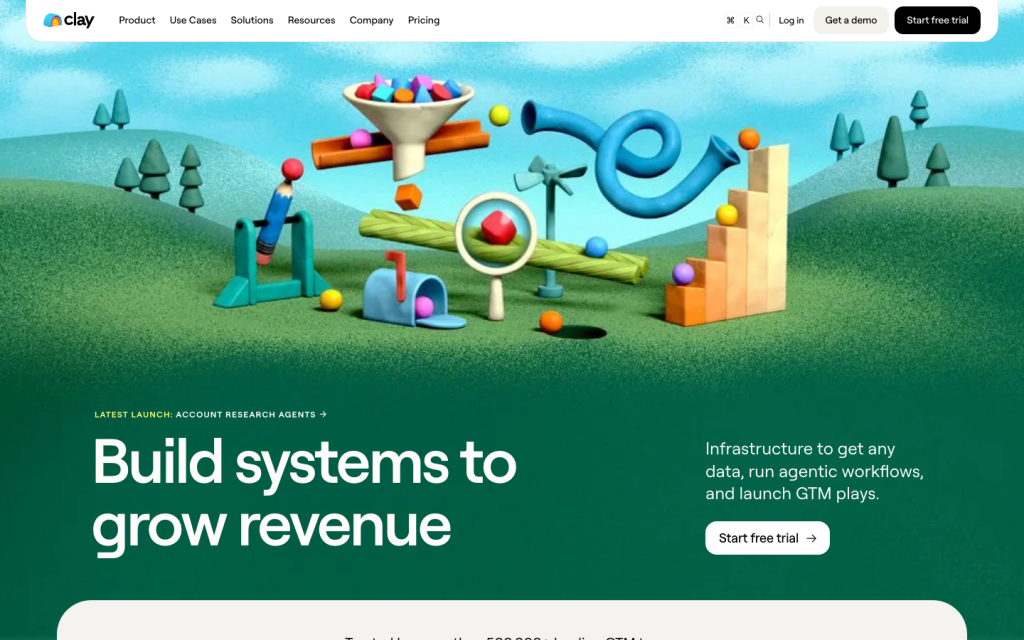
Clay product image

Clay is a strong fit for teams that need scalable enrichment, research, and GTM automation in one workspace. Its official docs show broad provider coverage, multiple workflow and CRM connections, and a product model that uses tables, waterfalls, and automated actions. User reviews are mixed overall, but they consistently praise the breadth of enrichment while flagging learning curve and credit-based value concerns.


What is it?

Clay is a GTM-focused data enrichment and automation platform. It combines tables, enrichment workflows, AI-assisted research, and downstream actioning so teams can gather prospect or account data, enrich it from multiple sources, and push the results into operational systems.

Enrichment coverage

Clay’s coverage is strongest where a buyer wants layered enrichment rather than a single static database. The product documents work and personal email lookup, phone enrichment, LinkedIn-related contact data, firmographics, technographics, funding, hiring, intent, and custom research from websites or documents. Waterfall enrichment is a core strength because it can query multiple providers in sequence to fill a data point when the first source misses.

For buyers, that means Clay is best when the goal is to maximize fill rates and combine multiple data types in one workflow. It is less about a single narrow enrichment use case and more about building repeatable research and enrichment systems.

Automation and integrations

Clay’s automation model is broad and practical. It can sync data to systems such as Salesforce, HubSpot, and Snowflake; trigger enrichments on new leads; schedule recurring refreshes; and support webhooks, Make, Zapier, HTTP API usage, and an MCP surface for AI tools. The verified integration inventory also includes several CRMs, sales-engagement tools, collaboration apps, and warehouse destinations.

For teams with established GTM tooling, this reduces the need for brittle point-to-point exports. The tradeoff is that more powerful setups can take time to design well, especially when combining multiple providers, logic, and downstream actions.

Who it's for

Clay is best for growth, marketing, sales, and RevOps teams that need high-volume enrichment and structured GTM automation. It is especially suitable when a team wants to centralize research, scoring, and CRM updates in one environment rather than using separate tools for lookup, orchestration, and export.

The main watch-out is operational complexity: teams without a clear workflow owner may struggle to get full value from the system, and the credit model can make spend harder to predict during heavy usage.

Buyer scenarios

Where the product fits — and where to be careful

RevOps team standardizing enrichment across the funnel

Need
The team wants a repeatable way to enrich leads, accounts, and CRM records while pushing results into their system of record.
Why it fits
Clay fits well because it combines enrichment, workflow logic, and CRM sync into one operating surface.
Watch out
Complex setups can be hard to maintain, and heavy usage may make credit consumption harder to forecast.

Strong fit if the team has a clear owner for build and maintenance.

Growth team building outbound research at scale

Need
The team needs to research prospects, fill in missing data, and launch automations that support outbound and pipeline generation.
Why it fits
Clay is a strong fit because it supports waterfall enrichment, AI-assisted research, and outbound-oriented integrations.
Watch out
Teams expecting a simple lookup tool may find the platform broader and more technical than they need.

It’s a good fit when the goal is scalable GTM systems rather than one-off prospecting.

Pros & Cons

Pros

  • Broad documented enrichment across contact, company, intent, and research use cases.
  • Waterfall enrichment can query multiple providers sequentially to improve coverage.
  • Large, verified integration surface across CRMs, data warehouses, collaboration tools, and automation platforms.
  • Useful for GTM teams that want to combine enrichment, workflow automation, and CRM sync.
  • Customer reviews frequently praise time savings and broad data coverage.

Cons

  • The platform has a significant learning curve for complex workflows and reusable setups.
  • User reviews show recurring concerns about cost predictability under the credit-based model.
  • Some advanced automation and integration behaviors can be difficult to configure or debug.
  • Reviewed materials provide only a partial snapshot of Clay's dynamic integration catalog.
Editorial score breakdown

Editorial scores

Editorial score
4.3
Enrichment coverage
5.0

Clay shows exceptional breadth across verified providers and enrichment modes, including contact data, firmographics, technographics, intent signals, and custom web research.

Data quality
4.0

Official evidence shows multiple coverage controls and review feedback is strongly positive on filling data gaps, but independent benchmark data on accuracy and completeness is not provided.

Automation & integrations
5.0

Clay documents a wide verified ecosystem spanning native CRM, data warehouse, productivity, messaging, API, webhook, and protocol connections, plus workflow automation surfaces.

Usability & value
3.0

The product appears powerful and useful, but reviews point to a learning curve and concerns about credit consumption and cost predictability.

From our complete category comparison

Clay alternatives

See the full comparison
Clay
4.3/5
Reviewed here
Best for
Custom enrichment automation
Key tradeoff
The platform has a significant learning curve for complex workflows and reusable setups.
Best for
Contact enrichment complement
Key tradeoff
User reviews frequently raise concerns about stale or inaccurate contact data.
Best for
Outbound prospecting complement
Key tradeoff
User reviews frequently mention stale, missing, duplicate, or inaccurate data.
Best for
Government and education signal-to-CRM execution
Key tradeoff
The product can feel broad and terminology-heavy for new users.
ProductEditorial scoreBest forKey tradeoff
ClayReviewed here
4.3/5Custom enrichment automationThe platform has a significant learning curve for complex workflows and reusable setups.
ZoomInfo
3.5/5Contact enrichment complementUser reviews frequently raise concerns about stale or inaccurate contact data.
Apollo.io
3.5/5Outbound prospecting complementUser reviews frequently mention stale, missing, duplicate, or inaccurate data.
Starbridge
4.5/5Government and education signal-to-CRM executionThe product can feel broad and terminology-heavy for new users.
Customer sentiment

Clay customer reviews and sentiment

Based on 26 public customer reviews. Source mix: 11 from trustpilot.com, 9 from g2.com, 5 from trustradius.com, and 1 from capterra.com.

Customer sentiment is analyzed separately and does not determine the Reviews.vc editorial score.

26 public reviews analyzed
Positive
23%6 reviews
Mixed
38%10 reviews
Negative
38%10 reviews
Theme and findingMentionsPositiveNegative
Workflow automation
Automation consolidates prospect research, enrichment, scoring, and CRM/outreach tasks, substantially reducing repetitive manual work; however, complex flows can be difficult to predict or reuse.
19148
Value for money
Users see time-saving ROI, but many find the credit-based model expensive and unpredictable, especially when unintended runs, retries, or auto-updates consume credits.
18615
Enrichment coverage
Broad multi-source enrichment, including waterfall email lookup, web research, intent signals, and CRM data enrichment, helps users fill data gaps and research prospects at scale.
13130
Ease of use
The spreadsheet-style interface and natural-language capabilities make common enrichment work approachable, but complex setups, integrations, table structures, and unclear errors can create friction.
1295
Learning curve
Clay’s flexibility and breadth create a meaningful learning curve, particularly for advanced workflows, prompts, integrations, and reusable tables; templates and guidance can ease adoption.
12310

Mentions count unique reviews. One review can count as both positive and negative for the same theme when it describes a mixed experience.

This analysis reflects public customer reviews we could identify and access at the time of collection; the displayed source mix may influence the patterns shown.

Review sentiment over time

PeriodnPositiveMixedNegative
2025 Q3Limited sample2020
2025 Q4Limited sample2011
2026 Q16024
2026 Q2Limited sample4013

Only periods containing dated reviews are shown; gaps between labels mean no dated reviews were available for those periods.

Pricing and contract model

Clay publicly lists tiered pricing and a separate trial. The public plans are Free, Launch, Growth, and custom Enterprise.

PlanPriceIncludes
Free
$0
monthly or annual availability not explicitly specified
Free plan with unlimited seats and tables, multi-provider waterfalls, Claygent, and a built-in sequencer, plus 100 data credits and 500 actions per month.
Launch
Starting at $167/month
monthly; annual options are also displayed
Launch is a paid entry plan with phone lookup, job-change signals, email outreach integrations, 2,500 data credits, and 15,000 actions per month.
Growth
Starting at $446/month
monthly; annual options are also displayed
Growth adds CRM auto-sync and enrichment, HTTP webhooks API, ad-audience pushes, web intent tracking, priority support, 6,000 data credits, and 40,000 actions per month.

Integrations

Documented connections and access methods for Clay.

CRM

Salesforce Native
HubSpot Native
Dynamics 365 CRM Native
Pipedrive Native

Automation

Salesloft Native
Outreach Native
Marketo Native
Zapier Via automation

Messaging & collaboration

Gong Native
Slack Native

Developer/API

Clay HTTP API Public API
Clay webhooks Public API

AI protocol

Clay MCP Protocol

Productivity suite

Google Sheets Native

Document storage

Notion Native

Data warehouse/BI

Snowflake Native
Google BigQuery Native

Data import/export

Airtable Native
Typeform Native

Other

People Data Labs Native

Recent signals

Product and company changes worth checking

  • 2026-07-06 · product release

    Product Roundup Week of Jun 29, 2026

    Clay published a product roundup noting a revamped SMB search experience for Google Maps and Openmart.

    Source
  • 2026-01-28 · ownership change

    Clay’s Second Tender Offer in Nine Months Values the Company at $5B

    Clay announced a second employee tender offer allowing employees to sell up to $55 million of shares at a $5 billion valuation.

    Source

FAQ

How much does Clay cost?
Clay publicly lists Free, Launch, Growth, and Enterprise options. The public pricing page shows Free at $0, Launch and Growth as starting plans with published rates, and Enterprise as custom pricing.
Who is Clay best for?
Clay is ideal for GTM, RevOps, sales, and growth teams that need enrichment, research, and automation in a single workflow. It’s especially useful when a team wants to combine multiple providers, automate CRM updates, and operationalize prospect research at scale.
Change notes Corrections policy
  1. 2026-07-21 Comparison Added alternatives comparison from 12 Best Public Sector Sales Intelligence Platforms in 2026.
  2. 2026-07-21 updated Review updated
Sources analyzed (43)
  1. Data Enrichment clay.com accessed 2026-07-21
  2. Inbound enrichment | clay.com clay.com accessed 2026-07-21
  3. Clay Waterfall: maximize your coverage of contact info | Clay.com clay.com accessed 2026-07-21
  4. Does Clay have an API? - Clay Docs university.clay.com accessed 2026-07-21
  5. Plans & billing university.clay.com accessed 2026-07-21
  6. HTTP API - Clay Docs university.clay.com accessed 2026-07-21
  7. SEC FORM D sec.gov accessed 2026-07-21
  8. How good is Clay’s data quality? - FAQ | Clay.com clay.com accessed 2026-07-21
  9. Integrations | Clay.com clay.com accessed 2026-07-21
  10. Clay | Build systems to grow revenue clay.com accessed 2026-07-21

Showing 10 of 43 sources · 33 additional sources analyzed

Leave Review
Rate your experience
  • Enrichment coverage
  • Data quality
  • Automation & integrations
  • Usability & value