
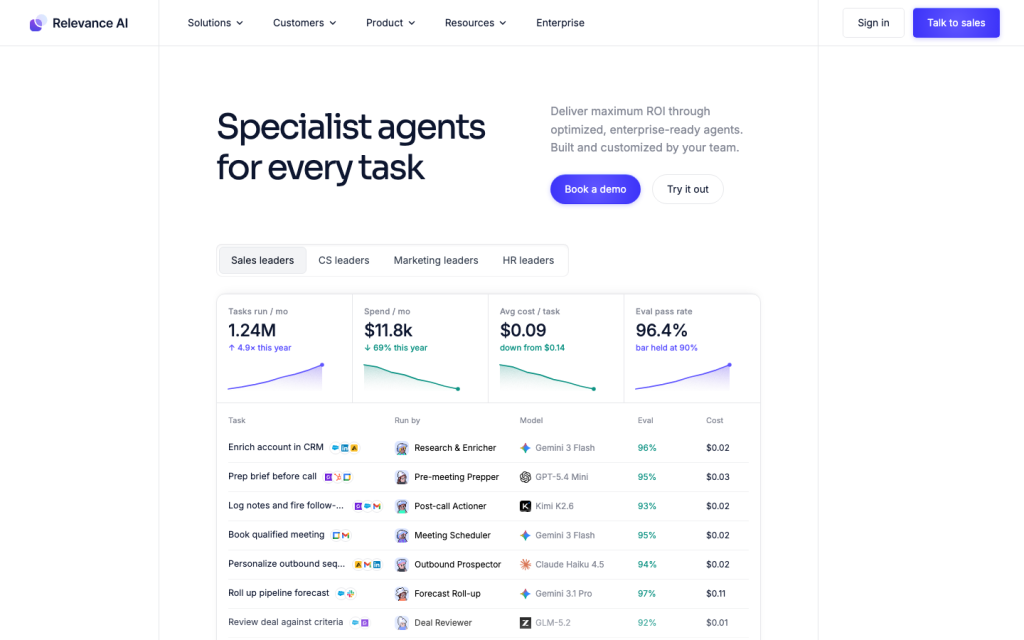
Relevance AI is a low/no-code platform for building AI agents, reusable tools, and visual multi-agent Workforces. It combines agent-led execution with workflow controls such as triggers, schedules, branching, approvals, monitoring, and a catalog of more than 2,000 integrations. It’s best suited to teams automating multi-step operational work with AI, rather than buyers seeking self-hosted or strictly deterministic single-app automation.

Is Relevance AI worth it?
Visual Workforces coordinate specialized agents with fixed, conditional, or AI-directed handoffs.
Usage is metered through separate Actions and Vendor Credits, so buyers should model expected tool and model consumption.

What is Relevance AI?
Relevance AI is a low- and no-code platform for creating AI agents, reusable action-oriented tools, and coordinated multi-agent teams. Agents can plan and execute tasks with assigned tools, while tools combine inputs, sequential steps, and outputs such as LLM prompts, API calls, integrations, and code execution. Its visual Workforces connect specialists into multi-step processes, including fixed, conditional, and AI-selected handoffs.
Automation capabilities
Relevance AI supports launches from integration events, schedules, manual activation, webhooks, direct API requests, JavaScript SDKs, and tools. Builders can create sequential chains, conditional branches, code expressions, AI-prompted decisions, and sequential or parallel loops. Workforces add multi-agent routing, while approvals, fallback LLMs, task histories, monitoring, notifications, and loop error handling provide operational controls for agent workflows.
Workflow and integrations
The platform offers more than 2,000 integrations and supports prebuilt actions and triggers across business systems. Examples include Slack, Google Calendar, HubSpot, and Notion. Teams can extend workflows with HTTP webhooks, direct API tool steps, custom API keys, and Python or JavaScript SDKs. The workflow experience centers on a drag-and-drop Workforce canvas for connecting agents, tools, and conditions and monitoring handoffs, routing, approvals, and failures.
Who Relevance AI is for
Relevance AI fits builders, GTM operators, engineers, teams, agencies, and enterprise groups that want AI agents to handle multi-step work such as support, sales qualification, data analysis, scheduling, lead processing, reporting, onboarding, and internal operations. The free plan offers a low-friction way to explore agents, while paid tiers add broader Workforce, scheduling, collaboration, analytics, testing, and governance capabilities. It is less suitable for buyers that require self-hosting, or for simple low-cost automation where fixed deterministic behavior is the primary requirement.
Buyer scenarios
Where the product fits — and where to be careful
GTM or operations team automating multi-step work
- Need
- Connect business apps and coordinate AI agents for recurring operational processes.
- Why it fits
- Strong fit for teams that need triggers, tools, agent routing, schedules, approvals, and a visual builder.
- Watch out
- Estimate Action and Vendor Credit consumption and validate plan-gated capabilities.
Recommended for AI-led, multi-step business workflows.
Buyer needing deterministic or self-hosted automation
- Need
- Run tightly controlled fixed workflows or operate the system in a self-hosted environment.
- Why it fits
- Limited fit where model behavior must be fully deterministic or self-hosting is a requirement.
- Watch out
- Prompts, permissions, model behavior, and fallbacks need thorough testing; self-hosting is not established here.
Consider alternatives if deterministic execution or self-hosting is non-negotiable.
Pros & Cons
Pros
- Visual Workforces coordinate specialized agents with fixed, conditional, or AI-directed handoffs.
- Broad automation controls include event, schedule, manual, webhook, API, SDK, and tool-based triggers.
- More than 2,000 integrations, plus custom API calls, webhooks, and SDKs, support connected workflows.
- Free, Pro, Team, and Enterprise options provide a clear starting path for individual builders through larger deployments.
Cons
- Usage is metered through separate Actions and Vendor Credits, so buyers should model expected tool and model consumption.
- Some trigger capabilities and operational controls vary by plan.
- AI-led workflows require careful prompt, permission, fallback, and testing design when deterministic behavior is required.
Editorial scores
Relevance AI supports varied triggers, sequential and branching logic, loops, approvals, multi-agent routing, scheduling, monitoring, notifications, and error-related controls.
The platform centers on LLM-powered agents that plan and execute with assigned tools, reusable knowledge, fallback models, and visual multi-agent Workforces with AI-directed handoffs.
Relevance AI offers more than 2,000 integrations alongside pre-built actions, custom API calls, HTTP webhooks, custom API keys, and Python and JavaScript SDKs.
Published Free, Pro, Team, and custom Enterprise plans make entry pricing clear, but separate Action and Vendor Credit meters, plan limits, and mixed value feedback require workload-based evaluation.
Relevance AI customer reviews and sentiment
Based on 17 public customer reviews. Source mix: 10 from g2.com, 6 from softwarereviews.com, and 1 from capterra.com.
Customer sentiment is analyzed separately and does not determine the Reviews.vc editorial score.
| Theme and finding | Mentions | Positive | Negative |
|---|---|---|---|
AI capabilities Buyers value flexible, specialized AI agents and multi-agent setups for tasks such as research, decision-making, and summarization, though outputs can require cleanup or careful configuration. | 13 | 12 | 3 |
Ease of use The platform is generally seen as approachable for building agents without coding, but initial onboarding, documentation, and navigation can be confusing as projects grow. | 13 | 11 | 4 |
Value for money Automation can save substantial manual time, but credit usage, tier planning, unexpected stoppages, and unusable prepaid credits can undermine perceived value. | 9 | 5 | 4 |
Integrations Buyers appreciate connecting common platforms and APIs to automate work, although some needed integrations are missing or require technical effort to build. | 8 | 6 | 2 |
Workflow building Visual, no-code workflow and multi-agent building is a major strength, but complex flows can be harder to configure, debug, and run smoothly. | 8 | 8 | 3 |
Mentions count unique reviews. One review can count as both positive and negative for the same theme when it describes a mixed experience.
This analysis reflects public customer reviews we could identify and access at the time of collection; the displayed source mix may influence the patterns shown.
Pricing and contract model
Relevance AI publishes Free, Pro, Team, and custom Enterprise plans. Usage combines Action allowances with Vendor Credits for model and tool costs.
| Plan | Price | Includes |
|---|---|---|
Free | $0 per month | Includes 200 Actions per month and a one-time Vendor Credit allocation; no credit card is required. |
Pro | Starts at $19 per month, billed annually | Includes 2,500 Actions per month and Vendor Credits; monthly billing is $29 per month. |
Team | Starts at $234 per month, billed annually | Includes 7,000 Actions per month and Vendor Credits; monthly billing is $349 per month. |
- Paid users can bring their own model or API keys.
- Feature availability and operational controls vary by plan.
- Not publicly disclosed: Enterprise.
Integrations
Documented connections and access methods for Relevance AI.
Automation
Developer/API
Document storage
- Salesforce, Snowflake, and Zendesk enterprise triggers are plan-gated.
Recent signals
Product and company changes worth checking
- 2026-06-12
Gemini 3.5 Flash and Confluence Knowledge Sync
Relevance AI recorded Gemini 3.5 Flash availability and Confluence Knowledge Sync in its June 12, 2026 changelog update.
Source
FAQ
How much does Relevance AI cost?
What can Relevance AI automate?
Does Relevance AI integrate with other apps?
Who is Relevance AI best for?
- 2026-07-26 Initial publication First published version of this review.
Sources analyzed (21)
- Relevance AI introduction relevanceai.com accessed 2026-07-26
- Workforces relevanceai.com accessed 2026-07-26
- Pricing relevanceai.com accessed 2026-07-26
- Integrations relevanceai.com accessed 2026-07-26
- Integrations introduction relevanceai.com accessed 2026-07-26
- Agent triggers relevanceai.com accessed 2026-07-26
- Tools relevanceai.com accessed 2026-07-26
- Plans relevanceai.com accessed 2026-07-26
- Changelog relevanceai.com accessed 2026-07-26
Showing 9 of 21 sources · 12 additional sources analyzed

Leave Review