
SciSpace logo

SciSpace

SciSpace combines scholarly search, PDF analysis, synthesis, extraction, citations, and exports for research workflows.

Editorial score

4.0 /5
How we scored it

Is SciSpace worth it?

Nick Oscar
Editor, Reviews.vc · Updated September 18, 2026
Good For

Combines scholarly search, PDF questioning, multi-paper synthesis, extraction, citation management, and exports in one workspace.

Caution

AI-generated output, citations, attribution, and suitability require independent validation before reliance.

SciSpace product image
scispace.com
On this page

SciSpace is an AI research workspace that brings scholarly discovery, PDF analysis, multi-paper synthesis, structured extraction, citations, and exports together in a single product. It’s a strong option for students, researchers, and authors who want to move from finding papers to quickly understanding and comparing them.

Its strongest capabilities are search and literature-review tools, citation-linked PDF answers, Deep Review source inspection, and flexible exports. The central trade-off is validation: generated outputs and citations require independent checking, and the platform is not a complete governance solution for reproducible systematic reviews.

What is SciSpace?

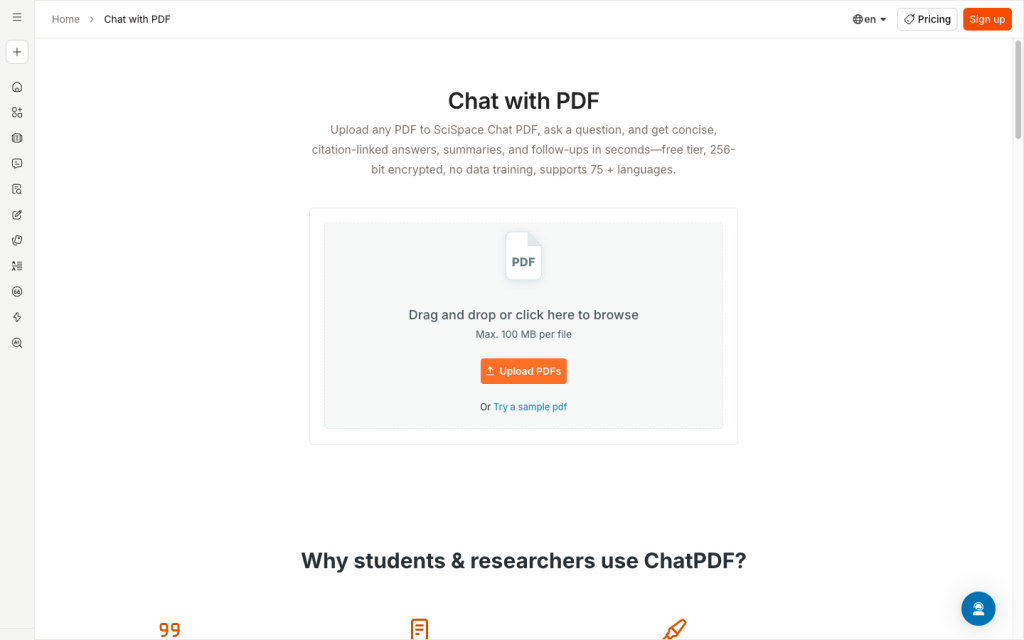
SciSpace is an AI-assisted academic research workspace for finding, reading, organizing, and writing about scientific literature. Its core modes combine scholarly search, private PDF analysis, multi-paper extraction, synthesis, citation tools, and writing utilities. Chat with PDF can answer questions about uploaded papers with citation-linked responses, while Extract Data identifies study details such as methods, results, tables, figures, and references.

The product is designed to accelerate research tasks rather than replace expert assessment. SciSpace requires users to independently validate output, attribution, accuracy, and suitability before relying on it.

Discovery and literature search

SciSpace supports semantic and text-based scholarly search across sources including Semantic Scholar, OpenAlex, Google Scholar, and other repositories. Researchers can filter results by publication year, journal, and open-access status; use Boolean operators; sort by relevance, date, or citation count; save and compare papers; and follow related-paper recommendations.

Its literature review tools add research gap identification and synthesis across selected material. Access to full text and reuse rights still depend on the underlying source, license, and user entitlement, so indexed coverage should not be treated as universal full-text access.

Citations and evidence traceability

SciSpace provides several ways to inspect supporting material. Chat with PDF links answers to relevant PDF sections, and anchored answers can show page-and-line citations with clickable source inspection. Deep Review returns source lists, highlighted passages, and excerpts tied to its analysis.

For reference work, Citation Generator supports more than 9,000 styles and exports to BibTeX and Word, with workflows for Zotero, Mendeley, and EndNote. These features make it easier to inspect provenance, but citations and generated claims still need to be checked against the original work.

Research workflow and exports

A typical SciSpace workflow starts with searching, filtering, sorting, saving, and organizing papers into libraries or folders. Researchers can then ask section-specific PDF questions, keep highlights and notes, use Deep Review to synthesize themes and gaps, and use Extract Data to compare studies across up to 50 parameters.

Outputs can be carried into notebooks and exported as CSV, Excel/XLSX, RIS, BibTeX/BIB, XML, and other document-oriented formats. This works well for exploratory reviews, narrative syntheses, and evidence matrices. It does not provide full systematic-review governance, such as dual screening, conflict resolution, immutable search logs, versioned protocols, or PRISMA reporting.

Who should consider SciSpace?

SciSpace fits students, researchers, professionals, thesis and dissertation writers, literature reviewers, and authors who need to analyze their own PDFs or manage references. It is especially useful when the goal is to move quickly from discovery to reading, synthesis, structured comparison, and citation export.

Teams can take advantage of its shared credit wallets and enterprise administration features. It is not suitable as an autonomous authority for scholarly, clinical, legal, medical, or other high-stakes decisions where unverified synthesis would replace expert judgment.

Buyer scenarios

Where the product fits — and where to be careful

Student, researcher, or author building a literature review

Need
Find relevant papers, understand PDFs, compare studies, identify gaps, and prepare citations.
Why it fits
Search, PDF questioning, Deep Review, data extraction, notebooking, citations, and exports cover a broad exploratory literature-review workflow.
Watch out
Generated answers, citations, and attribution require independent validation; it is not a replacement for scholarly or professional judgment.

Good fit

Research team needing managed access

Need
Coordinate research access and spending across a team while retaining administrative controls.
Why it fits
Enterprise offerings include admin-managed access, shared credit pools, usage monitoring, historic-spend reporting, SSO/SCIM, consolidated billing, and customizable integrations and limits.
Watch out
Teams should assess credit consumption, source-access rights, and required validation procedures before deployment.

Potential fit

Pros & Cons

Pros

  • Combines scholarly search, PDF questioning, multi-paper synthesis, extraction, citation management, and exports in one workspace.
  • Citation-linked answers, page-and-line guidance, source lists, excerpts, and PDF inspection support evidence checking.
  • Search filters, related-paper discovery, comparison, research-gap identification, and structured extraction support exploratory literature reviews.
  • Supports practical handoff formats including CSV, Excel/XLSX, RIS, BibTeX/BIB, XML, and Word-oriented outputs.
  • User feedback is strongly positive on support, with positive feedback also present for research workflows and ease of use.

Cons

  • AI-generated output, citations, attribution, and suitability require independent validation before reliance.
  • Source access, licensing, attribution requirements, and usage limits constrain full-text availability and reuse.
  • It lacks systematic-review governance such as dual screening, conflict resolution, immutable search logs, versioned protocols, and PRISMA reporting.
  • Monthly credits do not roll over, and user feedback on value for money is mixed.
Editorial score breakdown

Editorial scores

Editorial score
4.0
Evidence traceability
4.0

Citation-linked PDF answers, page-and-line citations, clickable inspection, Deep Review source lists and excerpts, and broad citation exports provide strong inspection paths. Users must still validate generated output against original material.

Research workflow
4.0

SciSpace supports search refinement, saved libraries, PDF reading, notes, Deep Review synthesis, extraction across up to 50 parameters, and multiple export formats. It is better suited to exploratory and narrative work than fully governed systematic reviews.

Source discovery
4.0

Semantic and text-based search spans named scholarly sources and supports filters, Boolean search, sorting, comparison, related papers, and research-gap identification. Underlying source access, licenses, and entitlements limit full-text availability and reuse.

Usability, support & value
4.0

Accepted user feedback is predominantly positive, with especially strong support sentiment and positive mentions of research workflows and ease of use. Value-for-money feedback is mixed, so fit depends on expected credit use and plan choice.

Customer sentiment

SciSpace customer reviews and sentiment

Based on 16 public customer reviews. Source mix: 16 from trustpilot.com.

Customer sentiment is analyzed separately and does not determine the Reviews.vc editorial score.

16 public reviews analyzed
Positive
88%14 reviews
Mixed
6%1 reviews
Negative
6%1 reviews
Theme and findingMentionsPositiveNegative
Support
Support is frequently described as fast, helpful, and effective, including for subscription cancellations and refunds; one review reports an inflexible refund outcome after an unnotified renewal.
12111
Value for money
Users appreciate discounts and goodwill credits, but unclear auto-renewal communication and restrictive refund handling can undermine perceived value.
523
Research workflows
SciSpace is seen as a useful, reliable research aid, including for literature-matrix building, though one user’s otherwise useful research experience was affected by billing.
330
Ease of use
The platform is described as user-friendly and easy to navigate for academic research.
220
Source discovery
Users find it helpful for quickly locating relevant articles for their work.
110

Mentions count unique reviews. One review can count as both positive and negative for the same theme when it describes a mixed experience.

This analysis reflects public customer reviews we could identify and access at the time of collection; the displayed source mix may influence the patterns shown.

Pricing and contract model

SciSpace lists free Basic access plus Premium, Advanced, Max, and Enterprise offerings. Monthly credits expire each billing cycle and do not roll over.

PlanPriceIncludes
Basic
Free
Monthly
Includes 100 monthly credits.
Premium
$12/month billed annually or $20/month billed monthly
Monthly or annual billing
Includes 1,200 monthly credits.
Advanced
$70/month billed annually or $90/month billed monthly
Monthly or annual billing
Includes 10,000 monthly credits.
Max
$160/month billed annually or $200/month billed monthly
Monthly or annual billing
Includes 40,000 monthly credits.
  • Subscriptions automatically renew unless canceled.
  • The separate SciSpace Editor product has distinct plans and prices.
  • A full refund is limited to cancellation within 24 hours and use of fewer than 300 credits.

Integrations

Documented connections and access methods for SciSpace.

Automation

Zapier Native

Developer/API

SciSpace API Public API

AI protocol

Claude and OpenAI tool use Protocol

Data import/export

Zotero Native
Mendeley Native
EndNote Other
  • Google Scholar, PubMed, LaTeX, Zotero Library, and Mendeley Library appear in the agent gallery; these surfaces are not treated here as proof of a native integration.

FAQ

What does SciSpace Premium cost?
Premium is listed at $12 per month when billed annually or $20 per month when billed monthly. Advanced is listed at $70 or $90 per month, and Max at $160 or $200 per month, respectively.
Which research sources does SciSpace search?
SciSpace lists Semantic Scholar, OpenAlex, Google Scholar, and other trusted repositories. Full-text availability and reuse remain subject to source access, licenses, and entitlements.
Can SciSpace provide citations for PDF answers?
Chat with PDF provides answers backed by citations from specific PDF sections. Its anchored-answer guidance describes page-and-line citations and clickable source inspection; users should verify output against the original PDF.
What can SciSpace export?
SciSpace supports exports including CSV, Excel/XLSX, RIS, BibTeX/BIB, XML, Word-oriented outputs, and DOCX in applicable workflows.
Review transparency Corrections policy
Change history
  1. 2026-09-18 Initial publication First published version of this review.
24 sources analyzed
  1. SciSpace Pricing scispace.com
  2. Chat with PDF scispace.com
  3. Extract Data scispace.com
  4. How SciSpace Search Works scispace.com
  5. How to Conduct a Literature Review Using SciSpace scispace.com
  6. How to Use Deep Review for Advanced Literature Analysis in SciSpace scispace.com
  7. Anchored Answers: How to Generate Page and Line Citations in Chat with PDF scispace.com
  8. SciSpace API Integrations Overview docs.api.scispace.com
  9. SciSpace Terms docs.google.com
  10. SciSpace Agent Credit Pricing & Usage Guide scispace.com

Showing 10 of 24 sources · 14 additional sources analyzed

Feedback on this article

Was this review helpful?

Private editorial feedback. It does not change product ratings or rankings.

Rate SciSpace

Rate your experience
  • Evidence traceability
  • Research workflow
  • Source discovery
  • Usability, support & value