
Elicit logo

Elicit

Elicit combines scholarly discovery, cited synthesis and systematic-review workflows for evidence-focused research teams.

Editorial score

4.0 /5
How we scored it

Is Elicit worth it?

Nick Oscar
Editor, Reviews.vc · Updated September 18, 2026
Good For

Searches a large scholarly corpus and a dedicated ClinicalTrials.gov corpus with semantic and Boolean options.

Caution

Full-text availability depends on open access, institutional access, browser-extension access or uploaded files.

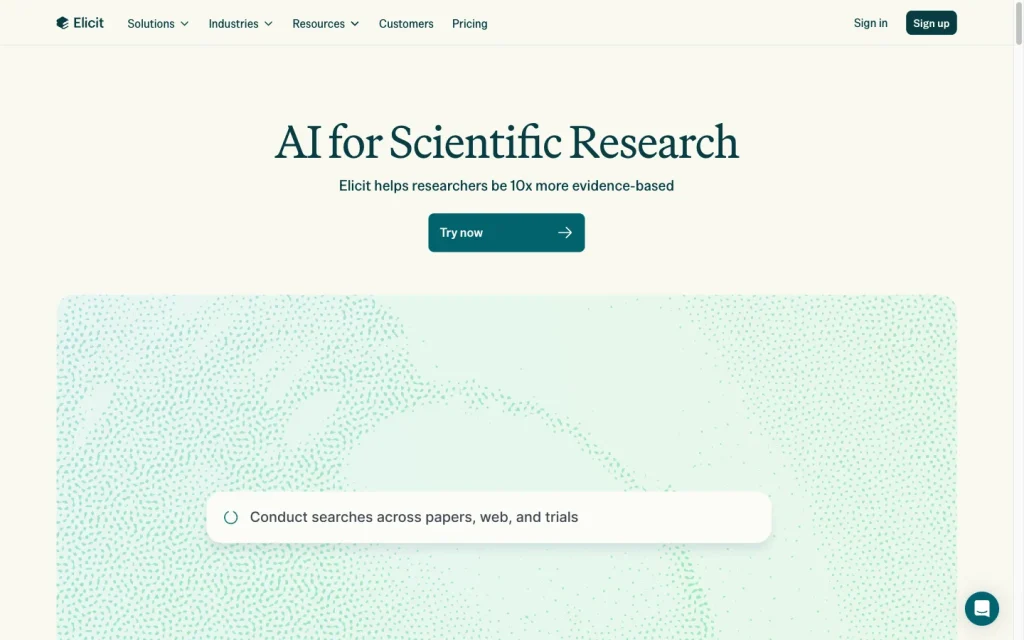
Elicit product image
elicit.com
On this page

Elicit is an AI research assistant built for scholarly discovery, evidence synthesis, and systematic review work. Its strongest capabilities are source-grounded reports, inspectable citations, screening and extraction workflows, and exports for evidence-focused teams. Coverage and full-text access have clear boundaries, so exhaustive specialist or gray literature searches may need complementary tools.

What is Elicit?

Elicit is an AI research assistant for scientific and evidence-based work. It combines scholarly search, paper screening, structured extraction, synthesis, and cited reports. Research Agent also supports broader web research, user collections, and uploaded materials, including scientific files.

Source discovery and coverage

Elicit supports semantic search for exploratory discovery and Boolean search for more precise systematic review queries. Its Gather workflow can combine natural-language, semantic, Boolean, trial-registry and uploaded-paper searches with de-duplication and search history. Academic coverage includes Semantic Scholar, OpenAlex, and PubMed, with ClinicalTrials.gov available separately. Full text is not universal, and specialist databases and gray literature may need supplemental searching.

Evidence traceability

Reports attach sentence-level citations to claims and let users inspect supporting quotes in source papers. Research Agent exposes its plan and consulted sources. In systematic reviews, teams can inspect screening rationales and supporting passages, view extraction quotations, and use audit trails for decisions, overrides, adjudications, and reviewer agreement metrics. These controls support inspection; users still need to evaluate output accuracy.

Research workflow

Research Reports move from question setup through academic search, screening, extraction, and synthesis to cited output. Systematic Reviews add staged gathering, title-and-abstract screening, optional full-text screening, and structured extraction. Users can edit criteria, override screening decisions, and pilot extraction fields. Exports include PDF, Word, CSV, Excel, RIS, and BIB; collaboration and capacity vary by plan.

Who Elicit is for

Elicit fits academic researchers, evidence-synthesis teams, and scientific R&D groups that need literature discovery, screening, and evidence table work. It is also useful for organizations that want to analyze imported PDFs or Zotero libraries alongside public scholarly sources. It is not a complete replacement for exhaustive specialist database or gray-literature searching, and Research Agent is designed for research assistance, extraction, and analysis rather than general-purpose writing or editing.

Buyer scenarios

Where the product fits — and where to be careful

Literature discovery and evidence synthesis

Need
Find, screen and synthesize scientific evidence efficiently.
Why it fits
Academic researchers and scientific R&D teams can search scholarly literature, synthesize findings and build evidence tables.
Watch out
Specialist databases, grey literature and inaccessible full text may require supplementary search tools or uploaded material.

Strong fit when scholarly discovery and source-grounded synthesis are the core needs.

Systematic-review teams

Need
Run structured screening and extraction with an auditable review process.
Why it fits
Teams can use screening, extraction, PRISMA support, reviewer oversight and exports for evidence-synthesis projects.
Watch out
Advanced collaboration, dual review and larger screening capacity vary by plan; strict protocols should account for disclosed coverage limits.

Strong fit for structured review work, with supplemental searching where protocols require it.

Pros & Cons

Pros

  • Searches a large scholarly corpus and a dedicated ClinicalTrials.gov corpus with semantic and Boolean options.
  • Provides sentence-level citations, supporting quotes, screening rationales and extraction quotations for inspection.
  • Supports end-to-end report and systematic-review workflows with structured exports.
  • Offers Zotero import plus API and MCP options for programmatic and connected research workflows.

Cons

  • Full-text availability depends on open access, institutional access, browser-extension access or uploaded files.
  • Specialist databases and grey literature can require supplemental searching.
  • Collaboration, review capacity and advanced controls vary by plan.
Editorial score breakdown

Editorial scores

Editorial score
4.0
Evidence traceability
4.0

Sentence-level citations, supporting quotes, source inspection, screening rationales, extraction quotations and audit trails create strong claim-to-source inspection. Output accuracy still requires user evaluation.

Research workflow
4.0

Research Reports, Systematic Reviews and Research Agent cover question setup, search, screening, extraction, synthesis and export. Plan-based capacity, collaboration differences and full-text access limits prevent a higher score.

Source discovery
4.0

Semantic, Boolean and parallel gathering workflows search approximately 138 million academic papers and a dedicated clinical-trials corpus. Elicit clearly identifies full-text limitations and gaps for specialist databases and grey literature.

Usability, support & value Not scored

User-review evidence was insufficient to score usability, support and value.

Pricing and contract model

Elicit has a free Basic plan, paid Pro and Scale plans, and custom-priced Enterprise. Published Pro and Scale figures are annual-billing equivalents; separate monthly dollar figures are not listed in the captured pricing table.

PlanPriceIncludes
Basic
Free
Unlimited paper search and summaries, with limited Research Agent and Research Report use.
Pro
$49 per user/month ($588 billed annually)
annual
Paid plan with access to applicable advanced research features and API access.
Scale
$169 per user/month ($2,028 billed annually)
annual
Paid plan with higher capacity and collaboration features.
  • Monthly and annual billing are available; annual plans receive a discount.
  • Usage is pooled monthly across applicable Research Agent, Reports and Systematic Literature Reviews, and unused usage does not roll over.

Integrations

Documented connections and access methods for Elicit.

Developer/API

Elicit API Public API

AI protocol

Model Context Protocol (MCP) Protocol

Productivity suite

Zotero Native

Data import/export

Data exports Native
  • Python, JavaScript, curl, CLI tools, Slack bots, internal dashboards and databases are supported workflow patterns through the API or MCP capabilities.

What's new

Recent product and company updates

  • 2026-09-17

    Library into research hub

    Elicit announced a shared research hub where Research Agent can search personal and shared collections, save papers to collections and use collections as project context.

    Source

FAQ

How much does Elicit cost?
Basic is free. Pro is listed at $49 per user/month and Scale at $169 per user/month when billed annually; Enterprise uses custom pricing. Monthly and annual billing are available.
What sources can Elicit search?
Elicit searches academic papers from Semantic Scholar, OpenAlex and PubMed, plus ClinicalTrials.gov. Research Agent can also work with broader-web sources, user collections and uploaded files.
Can I inspect citations in Elicit?
Reports provide sentence-level citations, and users can open a claim to view the exact supporting quote in a source paper. Systematic-review screening and extraction can also expose supporting quotations.
What can Elicit export?
Reports export as PDF or Word, tables as CSV or Excel, and references as RIS or BIB.
Review transparency Corrections policy
Change history
  1. 2026-09-18 Initial publication First published version of this review.
28 sources analyzed
  1. Elicit elicit.com
  2. Elicit pricing elicit.com
  3. Elicit's source for papers support.elicit.com
  4. Systematic reviews in Elicit support.elicit.com
  5. Elicit's Research Agent support.elicit.com
  6. Research Reports elicit.com
  7. Export your data from Elicit support.elicit.com
  8. Import papers from Zotero support.elicit.com
  9. The Elicit API elicit.com
  10. Library into research hub elicit.com

Showing 10 of 28 sources · 18 additional sources analyzed

Feedback on this article

Was this review helpful?

Private editorial feedback. It does not change product ratings or rankings.

Rate Elicit

Rate your experience
  • Evidence traceability
  • Research workflow
  • Source discovery
  • Usability, support & value