
Scite logo

Scite

Scite helps scholarly researchers search literature and inspect citation context with Smart Citations.

Editorial score

4.0 /5
How we scored it

Is Scite worth it?

Nick Oscar
Editor, Reviews.vc · Updated September 18, 2026
Good For

Searches citation statements extracted from full text alongside paper and metadata search.

Caution

It is a scholarly-literature and citation-context product, not a general-web search engine.

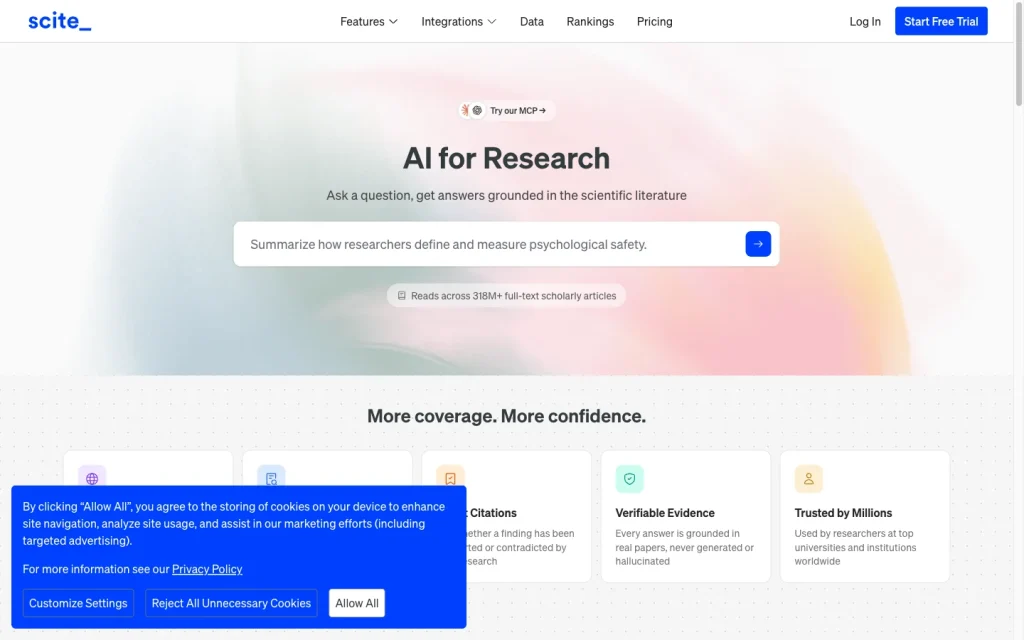
Scite product image
scite.ai
On this page

Scite is a scholarly research platform that helps users search the literature and see how papers are cited. Its Smart Citations classify citation statements as supporting, contrasting, or mentioning, while search, Collections, Reference Check, exports, API access, and AI tool connections support literature review and citation-checking workflows. It is strongest for scholarly research rather than general web discovery, and formal systematic review teams will need complementary workflow tools.

What is Scite?

Scite is a scholarly research platform built around Smart Citations: classifications of citation statements in citing literature as supporting, contrasting, or mentioning. It combines an AI assistant, search, citation reports, collections, Reference Check, API access, MCP connections, a Zotero plugin, and a browser extension. Its focus is scholarly literature and citation context rather than general web research.

Source discovery

Scite Search supports title, author, keyword, and DOI queries across Papers, Citation Statements, Metadata, and Patents. Search can match citation statements extracted from article full text, with Boolean queries, citation chaining, filters for section, citation type, and journal, plus saved Collections and alerts. Open-access works may be available directly, while access to paywalled material depends on routes such as institutional access, LibKey, GetFTR, OpenURL, proxy, interlibrary loan, or Article Galaxy.

Evidence traceability

Reports display the exact citation-statement text in citing papers, along with surrounding context, classification, and the citation’s location or section. Assistant responses link to papers, and Reference Check can analyze manuscript PDFs for citation context, Smart Citation classifications, and notices such as retractions, expressions of concern, and corrections. Smart Citation labels are machine-generated navigation signals, so users should open the sources and evaluate the methods and evidence themselves.

Research workflow

Users can build Collections from search results, DOI lists, CSVs, Zotero, Mendeley, or Assistant references; save queries; receive alerts; and ask collection-scoped Assistant questions. Assistant can analyze uploaded documents and organize literature data in tables, while references can be copied or exported as CSV, BibTeX, or RIS. Scite is not a complete, audit-ready systematic review system: formal review teams need separate records or tools for screening, recording exclusion reasons, deduplication, and storing extracted data.

Who Scite is for

Scite suits researchers, students, academics, authors, editors, peer reviewers, librarians, institutions, and research-intensive teams that need literature discovery, citation context, reference checking, or AI tool connections. Institutional holdings, API access, Team plans, and Enterprise options broaden that fit. It is not a substitute for consumer, news, legal, local, or general web search, and protocol-driven reviews need complementary workflow tools.

Buyer scenarios

Where the product fits — and where to be careful

Literature review and citation checking

Need
Find scholarly papers and inspect how later literature cites them.
Why it fits
Scite combines full-text-oriented search, citation-statement search, citation chaining, Collections, alerts, and context-rich Smart Citations.
Watch out
Full-text delivery is rights-aware, and Smart Citation classifications require source inspection rather than serving as verdicts on quality or truth.

Strong fit

Institutional research workflows

Need
Connect citation-aware research capabilities to team, library, or AI-tool workflows.
Why it fits
MCP connections, API access, institutional holdings resolution, browser tools, and a Zotero plugin support research-intensive teams and institutional workflows.
Watch out
For protocol-driven systematic reviews, retain screening decisions, exclusions, deduplication, and extracted data in external tools or records.

Good fit with complementary tooling

Pros & Cons

Pros

  • Searches citation statements extracted from full text alongside paper and metadata search.
  • Smart Citations expose context, classifications, and citation locations for inspection.
  • Collections, alerts, document analysis, and CSV, BibTeX, and RIS exports support ongoing research work.
  • MCP, API, Zotero, browser, and institutional-holdings options support connected workflows.

Cons

  • It is a scholarly-literature and citation-context product, not a general-web search engine.
  • Paywalled full text remains subject to rights and institutional-access routes.
  • Protocol-driven systematic reviews still need separate tools or records for screening, exclusions, deduplication, and data extraction.
Editorial score breakdown

Editorial scores

Editorial score
4.0
Evidence traceability
4.0

Paper-linked citations, exact citation-statement text, surrounding context, classifications, and in-paper locations provide strong inspection paths. Labels remain navigation signals rather than accuracy guarantees.

Research workflow
4.0

Collections, alerts, collection-scoped questions, uploaded-document analysis, tables, reference checking, and CSV, BibTeX, and RIS exports support substantial research workflows, with formal-review controls retained externally.

Source discovery
4.0

Scite offers full-text-oriented citation-statement search, paper and metadata search, patent search, Boolean queries, filters, citation chaining, and alerts across a large scholarly corpus. Full-text access is rights-aware rather than universal.

Usability, support & value Not scored

User-review evidence was insufficient to score usability, support, or value.

Pricing and contract model

Scite publishes free, individual, team, and Enterprise plans. Monthly pricing is listed below; annual options lower the effective monthly cost for Basic, Pro, and Team.

PlanPriceIncludes
Connect/Free
$0
month
Includes 25 MCP credits per month.
Basic
$20
month
Includes 250 MCP credits per month and Collections of up to 1,000 papers; annual billing is listed at $144 per year.
Pro
$50
month
Includes 2,500 MCP credits per month, API access, Collections of up to 10,000 papers, and patent, clinical-trial, and grant datasets; annual billing is listed at $480 per year.
Team
$50 per seat
month
Team plan; annual billing is listed at $480 per seat per year.
  • New individual subscribers may be eligible for a seven-day free trial; trials enroll users in the selected plan unless canceled.

Integrations

Documented connections and access methods for Scite.

Developer/API

Scite API Public API

AI protocol

MCP-compatible AI clients Protocol

Productivity suite

Zotero Native

Browser extension

Scite browser extension Embedded

Other

Scite Holdings Native

What's new

Recent product and company updates

  • 2026-09

    Citation graph functionality

    Scite introduced citation-graph functionality for citation surfing through Scite MCP.

    Source

FAQ

How much does Scite cost?
Scite lists Connect/Free at $0 with 25 MCP credits per month, Basic at $20 per month, Pro at $50 per month, Team at $50 per seat per month, and custom Enterprise pricing. Annual Basic and Pro prices are listed as $144 and $480 respectively.
What sources can Scite search?
Scite covers scholarly literature and also includes patents, clinical trials, grants, FAERS, MAUDE, FDA 510(k), MHRA, and drug data. It reports indexing 317M+ articles and holding 41M+ full-text sources.
What are Scite Smart Citations?
Smart Citations classify citation statements from citing literature as supporting, contrasting, or mentioning. They provide context and location information, but are navigation signals rather than quality scores or conclusive truth.
Can Scite export references?
Assistant references can be copied or exported as CSV, BibTeX, or RIS. References can also be added to Collections.
Review transparency Corrections policy
Change history
  1. 2026-09-18 Initial publication First published version of this review.
30 sources analyzed
  1. Coverage scite.ai
  2. Features scite.ai
  3. Pricing scite.ai
  4. Integrations scite.ai
  5. Scite Search scite.ai
  6. Scite MCP scite.ai
  7. Scite API Documentation api.scite.ai
  8. Introducing Collections scite.ai
  9. How to Use AI for Literature Review scite.ai
  10. Citation Surfing with Scite MCP scite.ai

Showing 10 of 30 sources · 20 additional sources analyzed

Feedback on this article

Was this review helpful?

Private editorial feedback. It does not change product ratings or rankings.

Rate Scite

Rate your experience
  • Evidence traceability
  • Research workflow
  • Source discovery
  • Usability, support & value