
Consensus logo

Consensus

Consensus is an AI research workspace for finding, inspecting, and synthesizing scholarly literature.

Editorial score

4.0 /5
How we scored it

Is Consensus worth it?

Nick Oscar
Editor, Reviews.vc · Updated September 18, 2026
Good For

Scholarly search combines semantic and keyword retrieval with detailed filters and citation-graph traversal.

Caution

Consensus does not access all research, and full-text availability depends on the source and access route.

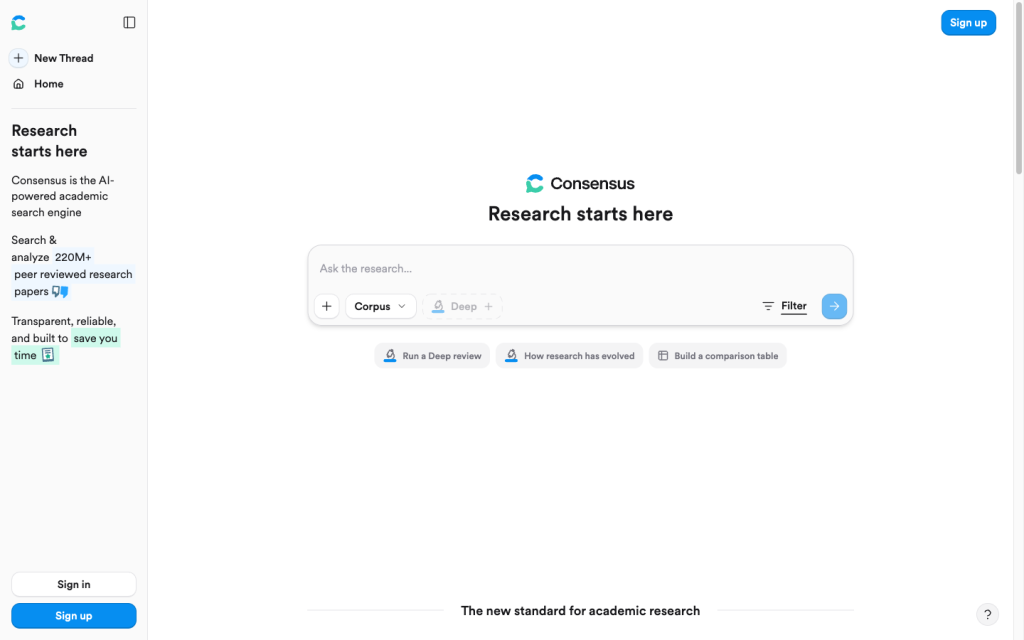
Consensus product image
consensus.app
On this page

Consensus is an AI research workspace focused on scholarly literature rather than general web search. It combines discovery, citation-backed synthesis, structured extraction, library workflows, and exports for researchers and teams. Its strongest use case is speeding up evidence discovery and review while keeping source inspection central; it is not a substitute for verifying original papers or conducting a complete systematic review.

What is Consensus?

Consensus is an AI workspace for scientific research. It retrieves scholarly literature and then analyzes and synthesizes the papers it finds. The product is designed for literature review work, including search, screening, extraction, organization, synthesis, and analysis of uploaded materials.

Scholarly discovery and coverage

Consensus supports natural-language questions, keywords, Boolean operators, titles, authors, and DOIs through semantic and keyword retrieval. Filters cover publication date, study type, sample size, citation count, journal, field, country, open-access status, study design, publisher, and human or animal setting. Research Agent can plan multi-step tasks using search, DOI lookup, and citation-graph traversal.

Coverage is scholarly rather than general web search. Full text depends on the source and access route. Consensus does not access all research, and its Consensus Meter draws on only 5 to 20 top results for yes-or-no questions.

Citation traceability

Generated claims include clickable citations that reveal supporting quotations from full text or abstracts. Citation grounding maps citations to exact paper quotes, section headers, and PDF highlights when available. In deep reviews, a checkmark indicates full-text use, while no checkmark indicates abstract-only use.

Retracted papers are flagged and excluded from AI-generated analyses. Citation inspection remains important because AI can misread a real source or summarize it incorrectly.

Research workflow and outputs

Consensus combines search, screening, extraction, synthesis, organization, collaboration, and export. Deep Research can create and run a search strategy and screen up to 1,000 papers. Table View structures fields such as population, methods, results, outcomes, sample size, duration, and country.

Library and Collections support saved papers, uploads, sharing roles, collection-specific queries, and chat across saved or uploaded materials. Outputs include PDF reports and CSV, RIS, and LaTeX exports. Extraction can be incomplete, and the available features do not provide complete audit-log or PRISMA-grade reproducibility controls.

Who should consider Consensus?

Consensus suits researchers, students, educators, literature review users, clinicians, research groups, academic departments, developers, and internal AI teams. Library Collections and uploads also suit people working from a personal or shared corpus. The API and MCP provide ways to embed scholarly search into applications, agents, and copilot workflows.

It is not a general web search engine or a replacement for a complete systematic review. Medical and other high-stakes users should verify findings against the original literature.

Buyer scenarios

Where the product fits — and where to be careful

Literature-review teams

Need
Find, compare, and synthesize academic literature efficiently.
Why it fits
Natural-language scholarly search, filters, citation-graph traversal, Deep reviews, Table View, and exports support a broad literature-review workflow.
Watch out
It does not cover all research, and it should not be treated as a complete systematic-review workflow.

Strong fit for accelerating discovery, screening, extraction, and synthesis while retaining researcher verification.

Clinicians and medical researchers

Need
Locate and assess medical research and guidelines.
Why it fits
Medical Mode includes papers, clinical guidelines, and leading medical journals, while citation tools expose the underlying literature.
Watch out
It is an evidence-discovery and review aid, not medical advice or a clinical decision standard; verify original literature for high-stakes use.

Useful for evidence discovery and review when paired with professional judgment and primary-source verification.

Pros & Cons

Pros

  • Scholarly search combines semantic and keyword retrieval with detailed filters and citation-graph traversal.
  • Clickable citations, quotations, full-text indicators, and Citation Grounding make it easier to inspect support for generated claims.
  • Deep research, Table View, Library Collections, sharing, uploads, and structured exports cover much of the literature-review lifecycle.
  • REST API and MCP extend scholarly search into custom tools, agents, and copilot workflows.

Cons

  • Consensus does not access all research, and full-text availability depends on the source and access route.
  • AI summaries can misread sources, so citations and original papers require verification.
  • The available features do not establish a complete systematic-review workflow with full audit logs or PRISMA-grade reproducibility controls.
Editorial score breakdown

Editorial scores

Editorial score
4.0
Evidence traceability
4.0

Clickable citations expose supporting quotations, while Citation Grounding can link claims to exact quotes, section headers, and PDF highlights. Full-text versus abstract-only use is distinguished in Deep reviews, though source verification remains necessary.

Research workflow
4.0

Consensus supports search strategy creation, screening, structured extraction, synthesis, Collections, sharing, uploads, and CSV, RIS, LaTeX, and PDF outputs. It lacks established evidence of complete reproducibility controls for systematic reviews.

Source discovery
4.0

The platform offers scholarly semantic and keyword search, extensive filters, citation-graph traversal, medical coverage, and a corpus reported at more than 400M scholarly sources. Coverage and full-text access remain conditional, and not all research is included.

Usability, support & value Not scored

User-review evidence was insufficient to score usability, support, or value.

Pricing and contract model

Consensus has Free, Pro, Deep, Teams, and Enterprise options. Usage limits vary by plan.

PlanPriceIncludes
Free
$0
monthly
Includes unlimited Papers searches, limited Pro messages, 3 Deep reviews per month, Study Snapshots, and included API/MCP calls.
Pro
$20/month or $144/year
monthly or annual
Includes unlimited Pro messages and 15 Deep reviews per month.
Deep
$65/month or $540/year
monthly or annual
Includes 200 Deep reviews per month.
Teams
$20 per seat/month or $240 per seat/year
monthly or annual
Available for up to 200 seats.
  • API and MCP allocations differ between subscription-plan and API details; check the applicable plan terms.

Integrations

Documented connections and access methods for Consensus.

Developer/API

Consensus API Public API

AI protocol

Model Context Protocol Protocol

Productivity suite

Microsoft 365 Copilot Embedded

Data import/export

Zotero Native
Research file formats Native
  • API and MCP call allowances vary by plan and should be checked against the relevant plan or API details.

What's new

Recent product and company updates

  • 2026-09-15

    Microsoft 365 Copilot availability

    Consensus became an official Microsoft Marketplace app for Microsoft 365 Copilot.

    Source

FAQ

What does Consensus cost?
Consensus offers a Free plan. Pro is $20 per month or $144 per year, Deep is $65 per month or $540 per year, Teams is $20 per seat per month or $240 per seat annually, and Enterprise is custom priced.
What sources does Consensus search?
Consensus searches scholarly literature using Semantic Scholar, OpenAlex, and its own scholarly-web crawl. Its corpus includes research papers and, in its September 2026 update, more than 400M scholarly sources including books, preprints, and conference proceedings.
Can I inspect citations in Consensus?
Yes. Generated claims include clickable citations and supporting quotations. Citation Grounding can map citations to exact paper quotes, section headers, and PDF highlights when available; Deep-review markers show whether full text or an abstract was used.
What can I export from Consensus?
Research and citation outputs can be exported in CSV, RIS, and LaTeX. Deep reports can also be copied with citations or exported as PDF.
Review transparency Corrections policy
Change history
  1. 2026-09-18 Initial publication First published version of this review.
22 sources analyzed
  1. How Consensus works help.consensus.app
  2. Consensus home consensus.app
  3. What has changed in Consensus: Summer 26 consensus.app
  4. Consensus pricing consensus.app
  5. What is Consensus? docs.consensus.app
  6. Consensus API consensus.app
  7. Consensus MCP consensus.app
  8. Consensus product changelog help.consensus.app
  9. Responsible AI and limitations help.consensus.app
  10. Literature review consensus.app

Showing 10 of 22 sources · 12 additional sources analyzed

Feedback on this article

Was this review helpful?

Private editorial feedback. It does not change product ratings or rankings.

Rate Consensus

Rate your experience
  • Evidence traceability
  • Research workflow
  • Source discovery
  • Usability, support & value