
Why teams look for a Unify alternative
Consider an alternative to Unify when your team’s primary requirement is more specialized than signal-driven outbound activation. Clay is oriented toward custom enrichment and research workflows; HubSpot centralizes cross-functional CRM work; Starbridge focuses on government, K-12, and higher-education market intelligence; and 6sense and Demandbase support established account-based motions. Gong is a focused choice for conversation-led revenue execution, while Common Room emphasizes unifying signals from an existing stack. Amplemarket is suited to teams seeking a consolidated prospecting, enrichment, research, and engagement workflow. Unify remains compelling when configurable signals, agents, Plays, and practical activation across CRM and outreach systems are the core priorities.
- ! Some reviewers report that complex configurations and navigation can be difficult, despite generally positive ease-of-use feedback.
- ! Review feedback on integrations is mixed: several users describe smooth connections, while others report Salesforce sync issues.
- ! Unify documents substantial data breadth, but buyers should validate accuracy, freshness, and match rates for their target market.
- ! Advanced CRM write access, API/webhooks, signal analytics, and pipeline attribution depend on your plan.
 Unify
Unify  Clay
Clay  HubSpot
  Starbridge
  6sense
  Demandbase
  Gong
Gong  Common Room
  Amplemarket
 Top Unify alternatives (2026)
Ranked by editor score
- 1
Clay combines multi-source enrichment, workflow automation, and a large integration surface for GTM teams that need scalable research and CRM syncing.
Best for: Broad documented enrichment across contact, company, intent, and research use cases.- Broad documented enrichment across contact, company, intent, and research use cases.
- Waterfall enrichment can query multiple providers sequentially to improve coverage.
Pick Clay when your team needs highly flexible enrichment, web research, and waterfall workflows across sales, marketing, growth, and RevOps. It is especially relevant when you want to combine multiple data providers with CRM sync and automation, and can invest in learning and maintaining more complex workflows.
- 2
HubSpot combines a CRM-centered customer platform with Breeze AI, automation, reporting, APIs, and a broad integration ecosystem for coordinated GTM workflows.
Best for: Shared CRM foundation spanning marketing, sales, service, reporting, and revenue workflows.- Shared CRM foundation spanning marketing, sales, service, reporting, and revenue workflows.
- Broad documented automation and AI-assisted research, outreach, and customer-service workflows.
Pick HubSpot when marketing, sales, service, automation, reporting, and CRM data need to operate from a shared foundation. It fits cross-functional teams that value centralized records and broad activation options, while accepting that advanced processes may require more administration.
- 3
Starbridge helps public-sector education sellers find signals, enrich accounts, activate outreach, and manage RFP workflows.
Best for: Covers K–12, higher education, local government, procurement activity, contacts, spending, RFPs, and buying signals.- Covers K–12, higher education, local government, procurement activity, contacts, spending, RFPs, and buying signals.
- AI-supported workflow spans account discovery, prioritization, enrichment, personalized outreach, CRM handoff, and RFP collaboration.
Pick Starbridge when you sell into government, K-12, or higher-education markets and need procurement opportunities, buyer contacts, public-spend context, RFPs, contracts, and early buying signals in one workflow. Its Salesforce and HubSpot connections are particularly relevant for public-sector teams coordinating market intelligence with day-to-day sales activity.
- 4
6sense combines B2B account intelligence, predictive prioritization, AI-assisted workflows, and GTM activation for account-based revenue teams.
Best for: Broad, documented mix of intent, web, CRM/MAP, firmographic, technographic, contact, and buying group signals.- Broad, documented mix of intent, web, CRM/MAP, firmographic, technographic, contact, and buying group signals.
- Configurable workflows support enrichment, audience activation, account creation, contact acquisition, and monitored execution.
Pick 6sense when a mature B2B organization is running coordinated account-based sales and marketing plays and needs intent, web, CRM, marketing, contact, and buying-group signals connected to activation workflows. It is best suited to teams prepared to validate data for their target accounts and invest in setup and administration.
- 5
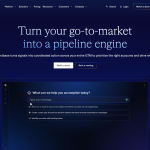
Demandbase is an account-based B2B GTM platform that combines account intelligence, orchestration, AI-assisted workflows, and broad GTM-stack activation.
Best for: Broad coverage of account, people, intent, engagement, technographic, and buying-group signals.- Broad coverage of account, people, intent, engagement, technographic, and buying-group signals.
- Account-based automations can qualify audiences, branch by conditions, and trigger connected GTM actions.
Pick Demandbase when your organization has a defined account-based motion spanning sales, marketing, advertising, and RevOps. It is a strong option for teams that want account, people, intent, engagement, technographic, and buying-group signals connected to audience qualification and downstream GTM actions.
- 6

Gong connects customer interactions and CRM context to support sales execution, coaching, forecasting, engagement, and selected CRM updates. It is best evaluated through a pilot of the AI and workflow outputs your team relies on.
Best for: Connects customer interactions, CRM records, contacts, and external signals for revenue workflows.- Connects customer interactions, CRM records, contacts, and external signals for revenue workflows.
- Supports conversation analysis, deal and account insights, coaching, forecasting, sales engagement, and selected CRM updates.
Pick Gong when customer conversations and CRM context are central to coaching, deal inspection, forecasting, and follow-through. It suits revenue teams that want to use calls, meetings, emails, and interaction analysis to improve deal visibility and seller execution.
- 7
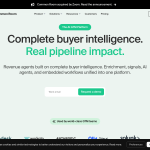
Common Room unifies buyer signals, scoring, AI-assisted research, and GTM activation for B2B RevOps, sales, and marketing teams.
Best for: Common Room brings together buyer signals from customer, product, CRM, community, social, code collaboration, marketing, and engagement sources.- Common Room brings together buyer signals from customer, product, CRM, community, social, code collaboration, marketing, and engagement sources.
- It supports configurable contact and organization scoring with fit and behavioral rules; score models refresh every four hours.
Pick Common Room when you need to unify buyer signals from your existing customer, product, CRM, community, social, code collaboration, marketing, and engagement tools. It is well suited to teams that want configurable scoring and structured account or contact plays, particularly where Salesforce activation is important.
- 8

Amplemarket combines B2B prospect data, signals, AI-assisted outreach, CRM handoffs, and analytics for outbound teams.
Best for: Combines B2B contact and company search, enrichment, signals, outreach, and analytics for outbound work.- Combines B2B contact and company search, enrichment, signals, outreach, and analytics for outbound work.
- Supports configurable AI-assisted research, sequence creation, reply drafting, routing, and workflow actions.
Pick Amplemarket when outbound teams want prospecting, enrichment, research, personalized engagement, and CRM handoffs in a consolidated workflow. It fits teams that want configurable AI-assisted research, sequences, reply handling, and routing, while validating data and intent quality against their ICP.
How we picked these
Every alternative comes from the approved category ranking. We evaluate documented product evidence, buyer-fit tradeoffs, and aggregated public customer feedback. We do not claim hands-on testing unless the linked Review says so, and payment cannot change inclusion or order.
Unify alternatives FAQ
- What is the main difference between Unify and these alternatives?
- Unify centers on using broad GTM signals, AI agents, and trigger-based Plays to identify prospects and activate outreach or CRM actions. The alternatives emphasize different priorities, including custom enrichment, shared CRM operations, public-sector intelligence, account-based orchestration, conversation intelligence, signal unification, and consolidated outbound execution.
- Which alternative is best for account-based marketing and sales?
- 6sense and Demandbase are the most relevant options for mature B2B teams operating coordinated account-based programs. Both provide broad account and intent signal coverage, connected activation paths, and workflow support across sales and marketing systems.
- Which option is best for public-sector sales?
- Starbridge is the specialized choice for teams selling into government, K-12, and higher education. Its documented coverage includes public-sector opportunities, buyer intelligence, RFPs, contracts, public spend, grants, meeting records, and related buying signals.
- Which alternative should I consider for flexible enrichment workflows?
- Clay is the strongest fit for teams building custom enrichment, research, and signal-to-action workflows. Its documented strengths include broad enrichment coverage, waterfall enrichment across providers, integrations, workflow automation, and CRM synchronization.